

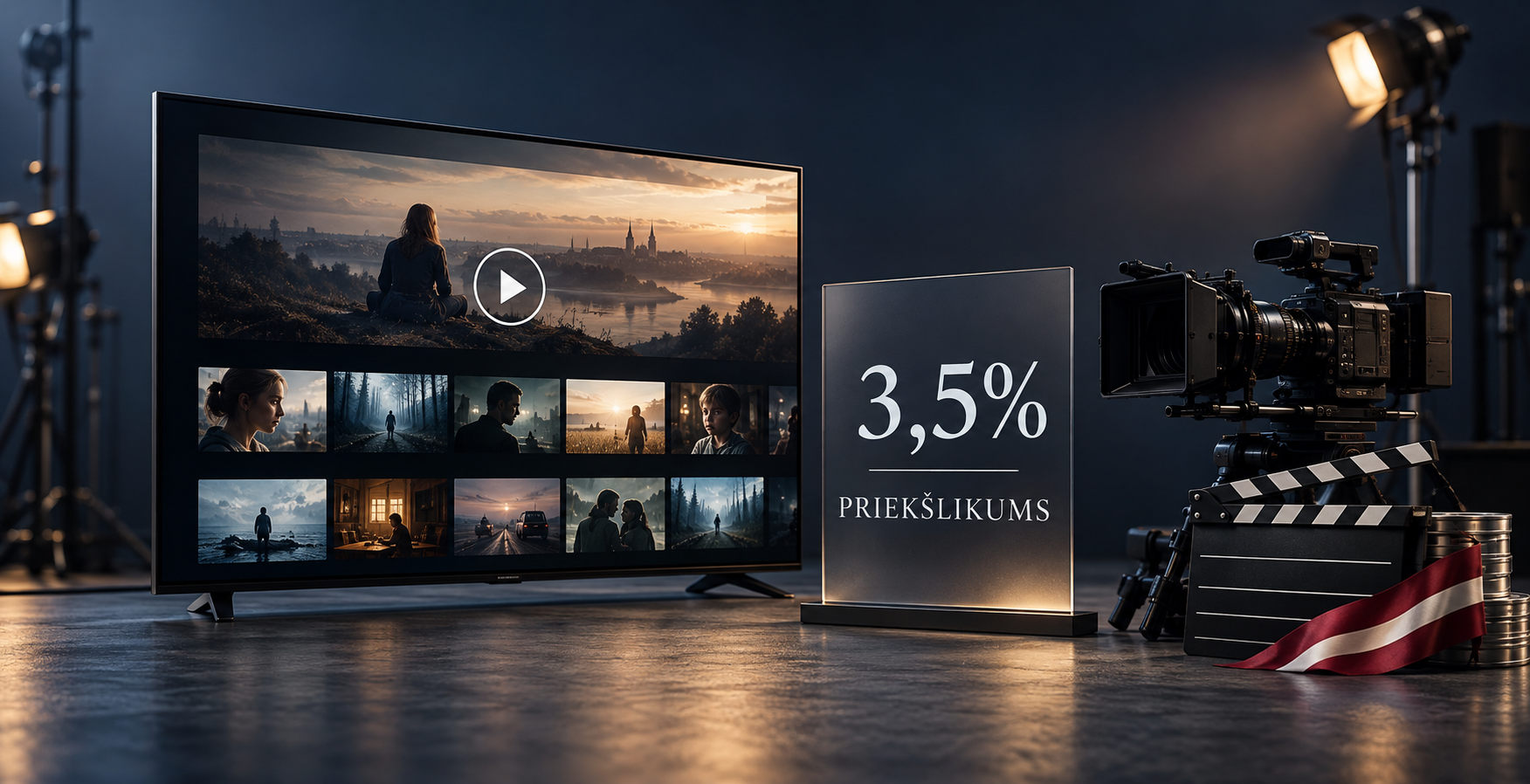
The “Netflix tax” proposal has not been scrapped, but it cannot yet be presented as an obligation in force. President Edgars Rinkēvičs said on 7 October that work would continue without the urgent procedure, according to LSM. The model for platforms' contributions and the rules governing its application remain a legislative matter.
RUMOURS AND FACTS
The question being examined: does the Prime Minister's call to abandon the proposal mean it has already been scrapped?
Conclusion: no. A political position does not, by itself, replace a decision by the Saeima. This article is based on information checked on the morning of 8 October 2026.
What has happened to the bills?
Draft resolutions have been submitted to the Saeima to remove urgency status from the bills amending the Electronic Mass Media Law and the Film Law. The agenda for the resumed sitting checked did not yet show a voting result.
Three things must therefore be distinguished: a proposal to halt the initiative, a proposal to change the parliamentary procedure and the text of the law itself. One does not automatically establish the others. Committee backing is not the Saeima's final vote either.
What does a 3.5% contribution mean?
The calculation base in the proposal reviewed is revenue earned in Latvia in the previous reporting year from on-demand audiovisual services. The proposed contribution is 3.5%. This is how it is formulated in the committee-backed second-reading text of Bill No. 1454/Lp14.
The model would cover Latvian providers and providers operating in other EU countries whose target audience is in Latvia. The draft includes exemptions for low turnover, small audiences and certain cases depending on a service's nature or subject matter. It therefore cannot be assumed that the obligation would apply without exception to every website featuring video.
Illustrative calculation: if a provider subject to the obligation had a relevant revenue base of €10,000,000, 3.5% would equal €350,000. This is a mathematical example, not revenue data for Netflix or any other platform. It illustrates only the percentage method; the draft also contains a transitional alternative.
An important detail: an alternative is also proposed until the end of 2030
For the transition period ending on 31 December 2030, the committee's text provides for a contribution calculated using the 3.5% formula or at least €300,000 a year, excluding VAT. This is an alternative calculation method, not a €300,000 minimum that must be added to the percentage payment.
The claim that “every platform will have to pay exactly 3.5% in all circumstances” therefore does not explain the full proposed framework. Before budgeting for an amount, applicable exemptions and the chosen contribution method must be assessed. The draft also contains a condition comparing total required and actual contributions over the preceding three reporting years.
Why does the term “tax” not tell the whole story?
The committee's proposal offers three ways to comply:
- Production: directly finance European works made in Latvia in the Latvian language or Latvian films without dialogue.
- Licences: acquire screening rights to European audiovisual works in Latvian or Latvian films without dialogue, created in Latvia by other media providers or independent producers.
- Payment: transfer funds to the National Film Centre's budget for Latvian films in Latvian, with Latvian subtitles or without dialogue.
A payment into the budget is therefore one of the proposed options. Direct investment or purchasing a licence, meanwhile, could both help fulfil the obligation and add to a platform's content. This distinction matters for platforms' cost planning and for producers negotiating partnerships.
What dates are currently included in the draft?
The draft provides for the first report to be submitted by 31 May 2028, covering 2027. It specifies that the law would enter into force on the day after promulgation. These are distinct legal dates. While the text is still under consideration, they must not be presented as a fixed timetable already in force.
Does the European Union require exactly 3.5%?
Article 13 of the Audiovisual Media Services Directive permits financial contribution requirements, including for a service established in another Member State that targets the domestic audience. Cross-border requirements must be proportionate and non-discriminatory. The specific 3.5% rate is a choice made in Latvia's proposal. It is not a single EU tax with an identical rate in every country.
Will subscriptions automatically become 3.5% more expensive?
No — that price change cannot be calculated from the contribution percentage. The proposal's calculation base is the provider's revenue. The final price, however, is a commercial decision influenced by competition, costs and the platform's content strategy.
A platform could absorb the costs, change how it allocates its investment or revise its prices. These are possible scenarios, not platform decisions established in this article. Claiming that prices will definitely remain unchanged would also be unfounded.
What can Latvian businesses conclude from this?
- For platform operators: planning should distinguish revenue attributable to Latvia, eligible content investments and any payment into the budget. Obligations can be calculated under the adopted rules once their final content and application dates are known.
- For producers and content rights holders: it is worth preparing project proposals, rights documentation and licensing terms. However, the bill does not, by itself, guarantee funding for any particular project.
- For subscribers: a price announcement from the specific service will provide a reliable basis for conclusions about their bill, rather than the proposal's percentage rate in a headline.
Editorial assessment: the practical question is how a potential obligation would translate into commissions for new content, licensing deals or public funding. Assessing this requires following the final text, the conditions for eligible contributions and the implementation dates.
Official information sources
- Bill No. 1454/Lp14: committee's table of proposals for the second reading
- Saeima: the contribution model backed by the committee
- Agenda for the resumed Saeima sitting and submitted amendments
- Directive 2010/13/EU, consolidated version
Comments
No comments yet. Yours could be the first!
Add a comment