

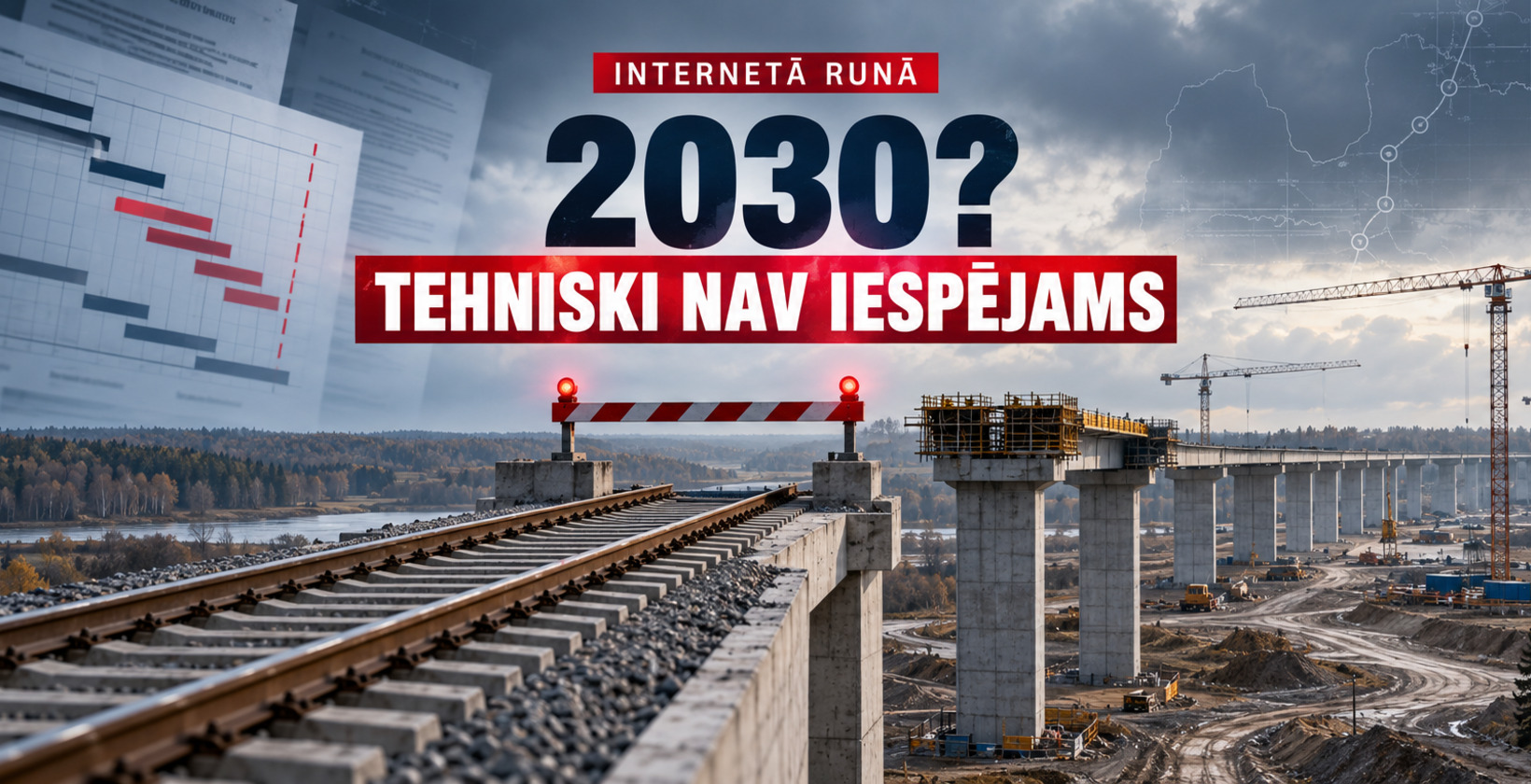
PEOPLE ONLINE SAY: “The Rail Baltica main line in Latvia will be completed by 2030.”
Status: 🔴 False. If made today, this claim no longer corresponds to the official position of Latvia’s Ministry of Transport. On 2 October, Transport Minister Rihards Kozlovskis announced that completing the Rail Baltica main line in Latvia by 2030 is technically impossible.
This does not mean that Rail Baltica has been cancelled or that all construction is stopping. It means something more specific: the previous completion deadline for Latvia’s main line is no longer achievable, while the project’s scope, schedule, costs and governance model must be substantially revised.
What did the Ministry of Transport say in January?
On 29 January 2026, the ministry stated that successful implementation of Rail Baltica’s first phase by 2030 remained directly dependent on sufficient EU funding under the next 2028–2034 multiannual budget.
The year 2030 was therefore not presented as an unconditional promise. It remained a conditional target: if sufficient and timely EU funding became available, the deadline would still be pursued. At the time, the ministry focused primarily on funding availability and rising project costs.
The January statement also said that estimated costs for the full Rail Baltica project across the Baltic states had increased to €23.8 billion at 2023 prices, compared with the original official estimate of €5.8 billion at 2017 prices.
What changed by October?
On 1 October, the Cabinet reviewed an informative report on Rail Baltica’s future implementation in Latvia. After the meeting, the minister no longer spoke only about a funding condition. He concluded that completing the main line by 2030 is technically impossible and that project costs must be fundamentally revised.
“Construction of the Rail Baltica main line by 2030 is technically impossible and the project costs must be fundamentally reviewed.”
The ministry linked this conclusion to an independent assessment by the international consulting company Alvarez & Marsal. The assessment examined governance, financial, economic, technological and legal aspects of the project.
The problem is not only a funding shortage
The independent assessment is especially important from an accountability perspective: finding more money alone will not be enough. With current capital-cost estimates, the forecast funding gap and the implementation schedule, Rail Baltica cannot be delivered in Latvia using the previous approach.
The ministry says structural improvements are required in at least three areas:
- project governance;
- planning;
- cost control.
The relevant question is therefore no longer only “where will the missing funding come from?”. The public may also reasonably ask how earlier decisions were made, why the realistic schedule was not acknowledged sooner and who is accountable for weaknesses in governance and cost control.
What has the government decided to do next?
The government has ordered the development of a minimum viable configuration, or MVC, for Rail Baltica. It should define the smallest infrastructure scope that would allow the main line to function.
- By the end of 2026, the Ministry of Transport must carry out a market consultation to engage an independent adviser for the MVC.
- Until new decisions are taken, activities already underway may continue only within the funding already allocated.
- No new financial or contractual commitments may be made without Cabinet approval.
- By year-end, the State Chancellery and the ministry must propose a new governance model under Cabinet supervision.
- Latvia will continue seeking €10 billion in funding for the Baltic states at an 85% EU co-financing rate under the next multiannual budget.
What is still unknown?
No new completion date for Latvia’s main line has been publicly established. The MVC, its costs and the project elements to be retained, postponed or redesigned have not yet been finally approved.
Claims that Rail Baltica will now certainly be completed in another specific year would therefore also be unsupported. The confirmed facts are that the 2030 deadline for Latvia’s main line is no longer technically achievable and that a new delivery model still has to be developed.
Conclusion: from a conditional target to official impossibility
In January, 2030 remained a conditional target dependent on sufficient EU funding. By October, the government had acknowledged that the deadline was technically unattainable under the previous approach and that the project requires changes not only in financing but also in governance, planning and cost control.
It is therefore false to claim today that the Rail Baltica main line in Latvia will be completed by 2030. At the same time, there is no basis for claiming that the entire project has been cancelled: the government continues to pursue a reduced, functionally viable configuration.
Comments
No comments yet. Yours could be the first!
Add a comment