

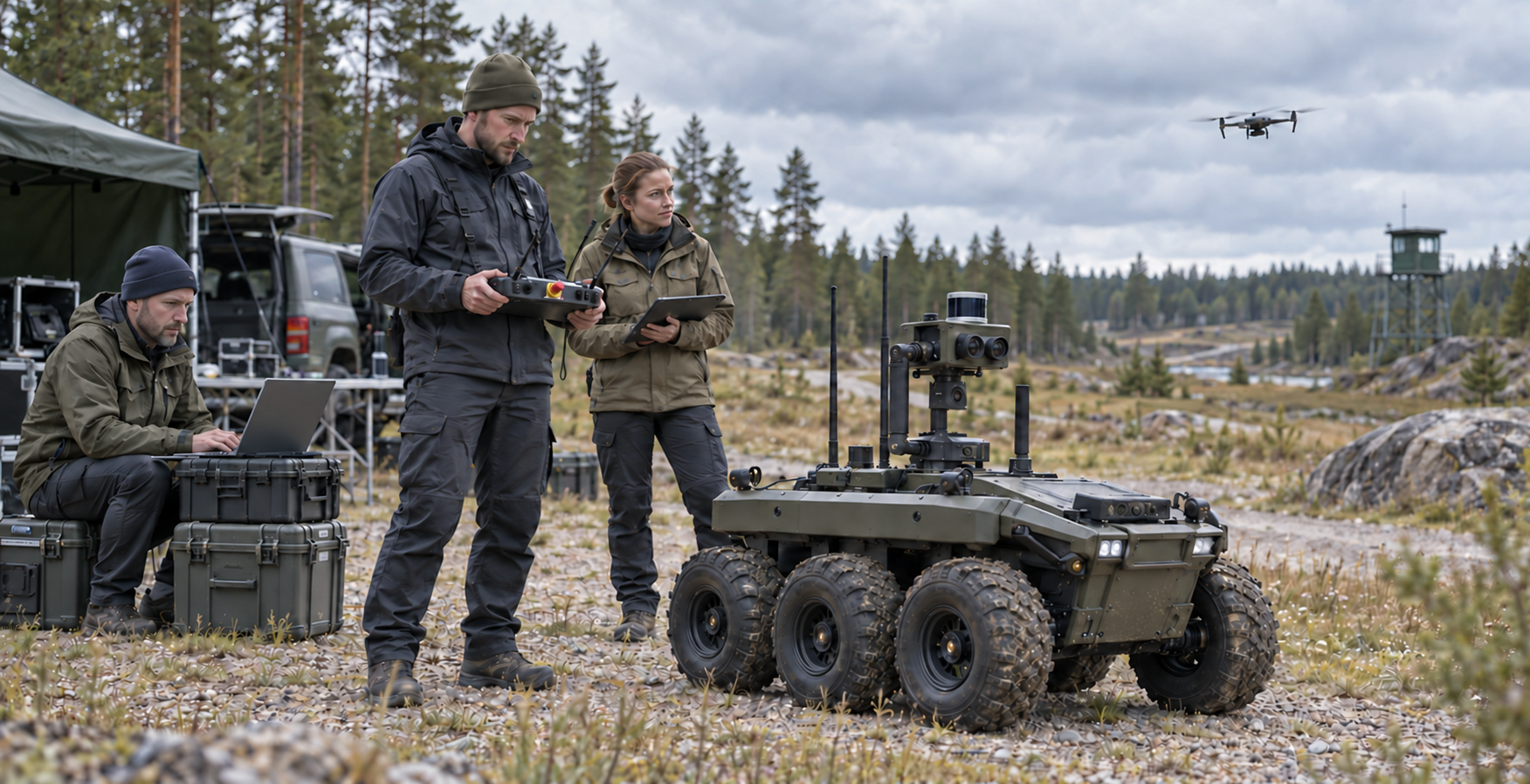
The 128 states party to the Convention on Certain Conventional Weapons have reached consensus in Geneva on a non-binding document concerning autonomous weapon systems. After more than a decade of talks, it is a significant common outcome that could lead to formal negotiations on prohibitions, restrictions and human-control requirements.
The agreement does not itself create new legal obligations for Latvian companies. Nevertheless, companies developing autonomous drones, ground robots, military logistics platforms, cyber-defence solutions or target-identification technology should already consider these issues in their product architecture.
What exactly did the 128 states agree on?
The agreement was reached within the UN Group of Governmental Experts on emerging technologies in the area of lethal autonomous weapon systems. The group operates under the Convention on Certain Conventional Weapons.
The discussions concern systems that, once activated, can identify, select and engage targets with varying levels of autonomy and without intervention by a human operator in the execution of those functions.
The group’s mandate was to formulate by consensus a set of elements for a possible instrument without prejudging whether the eventual outcome should be a legally binding treaty, non-binding guidelines or another form of regulation.
Has an international ban on autonomous weapons been adopted?
No. The Geneva document is not an international treaty and does not introduce a general ban on autonomous weapons.
It provides a common basis for further work. It could support formal negotiations on systems that should be prohibited, restrictions applicable to other systems and the required degree of human judgement and control.
The group’s final report is expected to be submitted to the Seventh Review Conference of the Convention, scheduled for 16–20 November 2026. The conference may decide on the next stage, but formal treaty negotiations are not yet guaranteed.
Why is the consensus significant?
Until the final day, there was a risk that objections from the United States and Russia would prevent adoption of a common text. Both countries favour national guidelines over new legally binding international rules.
The consensus shows that participating states were nevertheless able to establish a common foundation. Reuters has also reported that parts of the text were diluted during the final hours to obtain agreement.
The outcome therefore cannot be treated as a strict regulatory regime. Its main value is political and procedural: after more than a decade of discussions, governments have a shared reference point for the next stage.
Is every autonomous military system an autonomous weapon?
No. An autonomous military platform is not automatically a lethal autonomous weapon system.
An unmanned ground vehicle that carries supplies, plans routes or evacuates casualties performs a different function from a system that independently identifies, selects and engages targets with force.
An autonomous cyber-defence solution is not inherently a lethal weapon either. The distinction may become more complex when a system makes decisions directly affecting physical objects, target selection or the use of force.
A company should therefore document which functions are automated, which decisions require human authorisation and whether the system merely recommends an action or executes it independently.
How does this relate to Latvia’s €2.4 million funding call?
On 4 September 2026, Latvia’s Ministry of Defence opened a funding call for the development of military and dual-use products. The total available budget is €2.4 million.
The call focuses on four priorities for autonomous military platforms:
- data security;
- mobility;
- energy efficiency;
- protection in combat conditions.
Eligible areas include autonomous cyber-defence and zero-trust security, military logistics and unmanned transport systems, hybrid propulsion, low-observability technologies and intelligent or remotely controlled defence systems.
An individual company can receive up to €300,000, while a consortium can receive up to €500,000. Applications remain open until 18 September 2026.
What should a defence-tech company include in its product architecture?
- Defined autonomy boundaries. Document what the system performs independently and which decisions require human approval.
- Human control. Specify where an operator can approve, interrupt, modify or cancel an action.
- Audit logs. Retain information about inputs, recommendations, operator decisions and actions executed.
- Operational limits. Establish technical boundaries covering location, time, target categories and permitted actions.
- Safe deactivation. Give the operator an effective method of stopping or disabling the system.
- Explainability and traceability. Make it possible to determine why the system identified an object or recommended an action.
- Cybersecurity. Protect against manipulated sensor data, unauthorised control, model interference and software supply-chain threats.
- Legal review. Before export or technology transfer, assess military and dual-use export controls, sanctions and the intended end user.
Does the Geneva agreement replace existing requirements?
No. The non-binding status of the new document does not remove existing obligations concerning international humanitarian law, military and dual-use export controls, sanctions, cybersecurity or public procurement.
Companies must distinguish between possible future autonomous-weapons rules and the restrictions that already apply to exports and technology transfers.
What should a company applying for Latvian funding do?
- Classify the product’s military, dual-use or civilian functions.
- Separate navigation and logistics autonomy from target-identification and force-related functions in the project description.
- Include human control, auditability and safe deactivation in the technical architecture.
- Check whether components, software or technical information may be subject to export controls.
- Consider forming a consortium if the project requires several areas of expertise.
- Submit the application by 18 September 2026.
Frequently asked questions
Did 128 states ban autonomous weapons?
No. They agreed on a non-binding document that may provide a basis for further negotiations.
Does the agreement impose new legal duties on Latvian companies?
No. The Geneva document does not itself create directly applicable obligations for Latvian businesses.
Is an autonomous logistics drone an autonomous weapon?
Not necessarily. The decisive issue is whether the system identifies, selects and engages targets using force.
When could formal international negotiations begin?
The final report is expected to be considered at the Convention’s Review Conference in November 2026. A decision to begin formal negotiations is not guaranteed.
How much funding is available under Latvia’s call?
Up to €300,000 is available to an individual company and up to €500,000 to a consortium. The total budget is €2.4 million.
Information updated on 5 September 2026. The wording of the final UN document and the status of future negotiations may still be clarified.
Comments
No comments yet. Yours could be the first!
Add a comment