

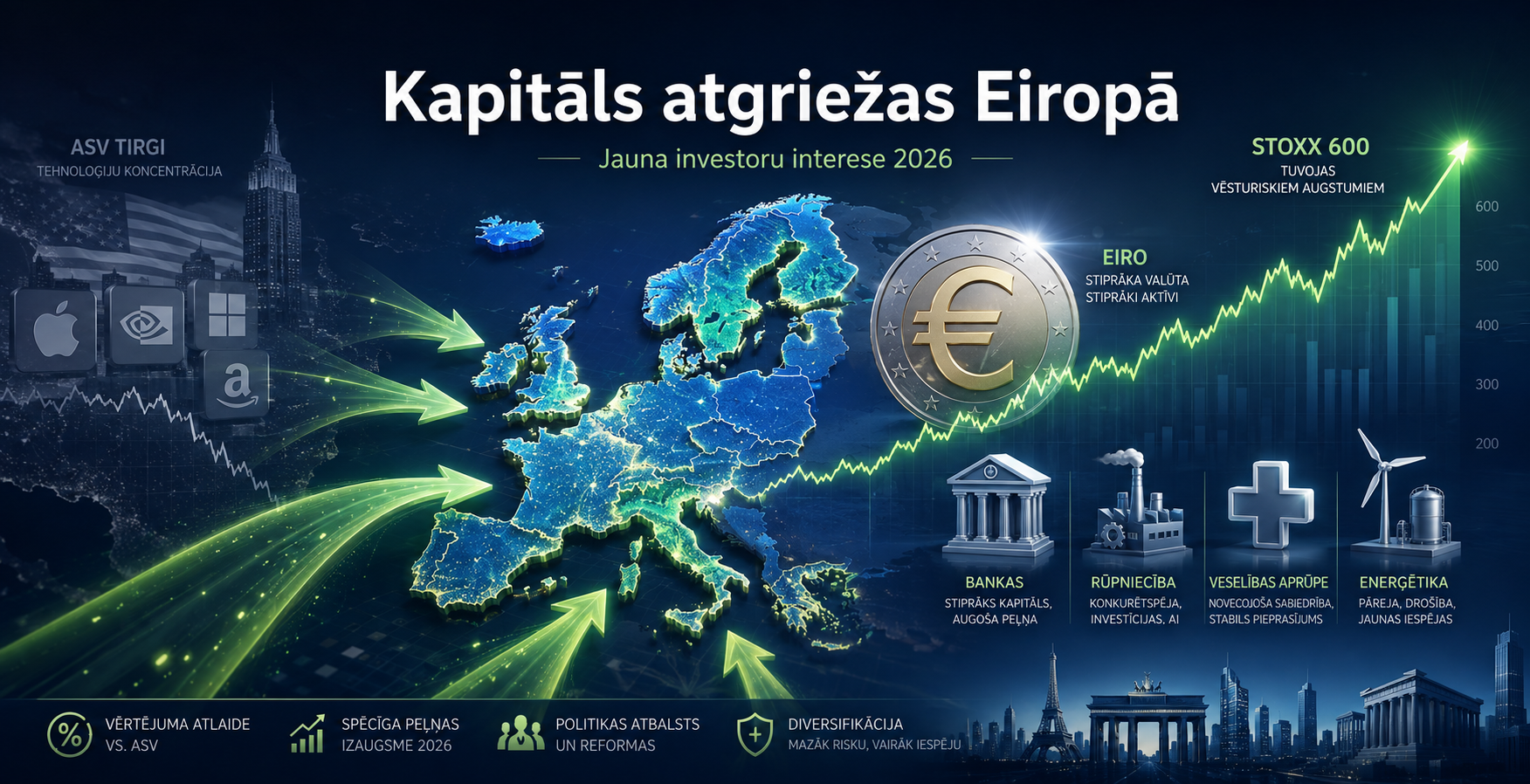
European financial markets are experiencing a notable shift in the summer of 2026. The STOXX Europe 600 is close to historic highs, earnings expectations are improving and global investors are again increasing their exposure to Europe after years dominated by US technology stocks.
Reuters, citing LSEG data, reported that European equities attracted $2.44 billion in the week to 12 August – the strongest inflow since late February.
Why is Europe attracting investors again?
Corporate earnings are one important reason. STOXX 600 companies are expected to deliver approximately 24.1% second-quarter earnings growth, the strongest rate in almost four years.
European stocks also remain significantly cheaper than their US counterparts. The STOXX 600 trades at around 15 times expected 12-month earnings, representing an approximately 26% valuation discount to the S&P 500.
A lower valuation does not automatically mean European equities will rise, but the gap has become increasingly difficult for global investors to ignore.
Is US technology concentration becoming a risk?
Europe's market structure differs substantially from the United States. Technology has a relatively small weight in the STOXX 600, while banks, industrials, healthcare and energy play much larger roles.
At a time of sharp price swings in AI and semiconductor shares, Europe offers investors a different risk profile. The current movement therefore appears more like portfolio diversification than a wholesale withdrawal from US markets.
A stronger euro also reflects changing sentiment
The euro has strengthened by roughly 3% against the US dollar from its June lows. Part of the move reflects a weaker dollar, but European economic data have also helped: euro-area business activity recently reached an eight-month high.
Where are the risks?
Equity-market optimism does not mean Europe has suddenly become a low-risk investment. Government bond yields remain elevated, while higher oil prices are again increasing inflation concerns and costs for businesses.
If inflation remains persistent and central banks are forced to maintain tighter monetary policy, credit conditions, economic growth and corporate earnings could come under pressure.
What could this mean for an investor in Latvia?
European equities can provide diversification away from the largest US technology companies. For investors whose income and expenses are mainly in euros, euro-denominated assets can also reduce direct exposure to EUR/USD fluctuations.
However, several weeks of capital inflows do not yet prove a long-term structural rotation from the United States to Europe. Earnings, ECB policy, bond yields, energy prices and economic growth remain crucial indicators.
Frequently asked questions
Are investors abandoning US stocks?
No. Current data suggest greater diversification toward Europe rather than a mass withdrawal from the US market.
Why are European stocks cheaper?
European indices contain fewer highly valued technology companies and greater exposure to traditional sectors that generally trade at lower valuation multiples.
Is now the right time to buy European stocks?
There is no universal answer. Lower valuations and stronger earnings are positive factors, but interest-rate, inflation, energy-price and geopolitical risks remain.
This article is for informational purposes only and does not constitute individual investment advice. Market data reflect conditions as of 21 August 2026.
Comments
No comments yet. Yours could be the first!
Add a comment