

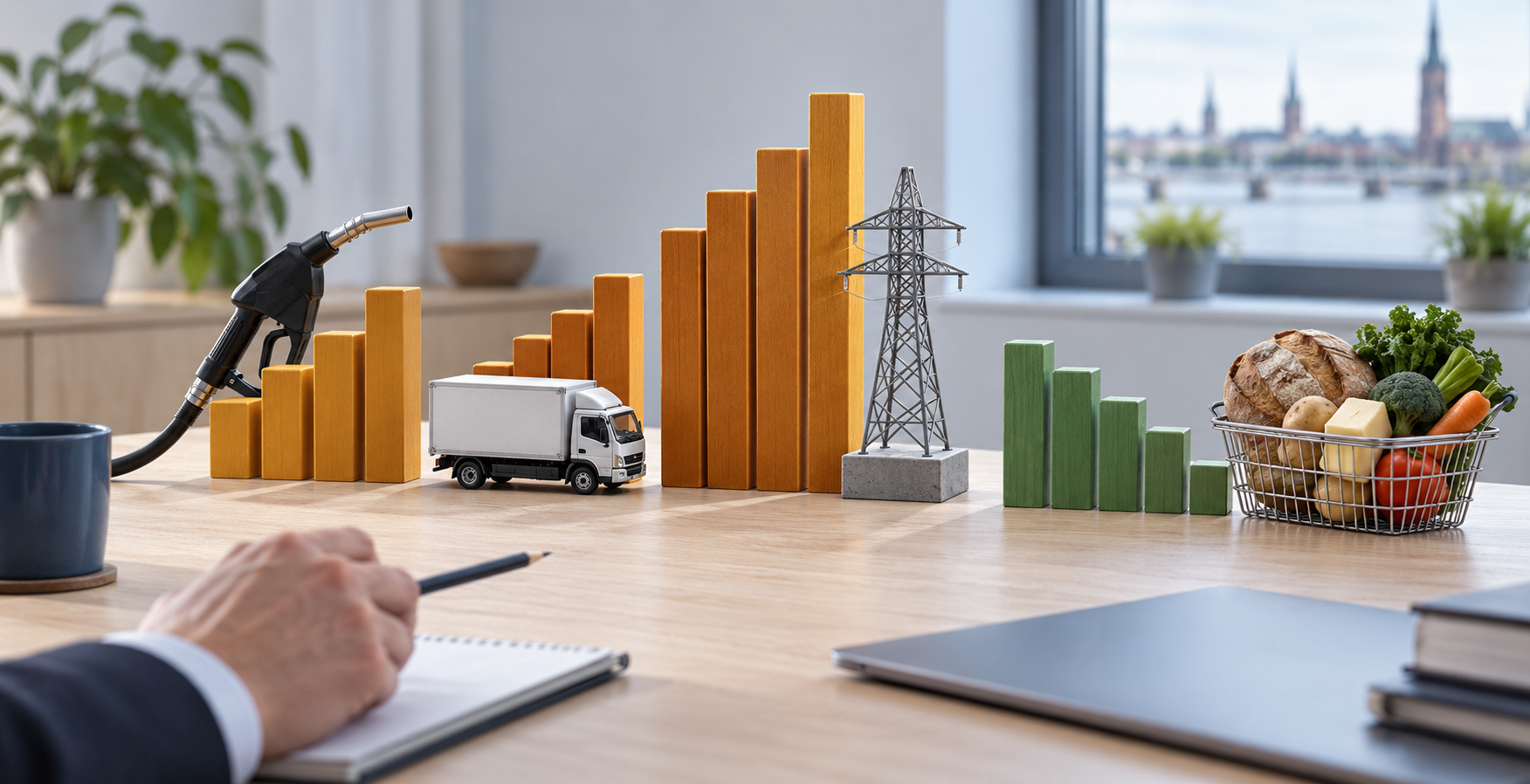
Latvia’s annual inflation rate accelerated to 3.2% in August 2026 even though prices for food and non-alcoholic beverages fell by 4.0% year on year. The main sources of price pressure are now transport, fuel, housing and energy — costs that businesses cannot easily replace or reduce.
Compared with July, the overall consumer price level increased by 0.3%. Annual inflation stood at 2.6% in July, meaning that the rate rose by 0.6 percentage points within one month.
What are the key inflation figures?
- consumer prices increased by 0.3% during August;
- annual inflation accelerated from 2.6% to 3.2%;
- 12-month average inflation reached 3.3%;
- transport prices rose by 8.6% year on year;
- fuel prices increased by 22.1%;
- housing and energy costs rose by 6.8%;
- food and non-alcoholic beverages became 4.0% cheaper.
The 3.2% inflation rate therefore does not reflect a uniform increase in all prices. Some everyday goods have become cheaper, while transport, energy and numerous services continue to rise in price.
How can inflation increase when food becomes cheaper?
The consumer price index is a weighted average of price changes across different goods and services. A decline in one category can reduce inflation without fully offsetting sharp increases elsewhere.
The fall in food and non-alcoholic beverage prices reduced annual inflation by approximately 0.9 percentage points. Transport added 1.1 percentage points, while housing, water, electricity, gas and other fuels added another 1.1 percentage points.
Without the decline in food prices, Latvia’s headline inflation rate would have been considerably higher.
How sharply did fuel prices increase?
Transport prices were 8.6% higher than a year earlier, primarily because average fuel prices increased by 22.1%:
- diesel fuel rose by 24.5%;
- petrol rose by 18.3%;
- automotive gas rose by 0.1%.
Fuel prices increased by 8.8% in August alone, including an 11.5% monthly rise in diesel prices.
For businesses, fuel prices affect more than the direct cost of operating vehicles. They can increase freight, courier, passenger-transport, construction, agricultural and warehouse-servicing costs. Part of this increase may subsequently be passed on through the final prices of goods and services.
What is happening to housing and energy costs?
Prices for housing, water, electricity, gas and other fuels rose by 6.8% year on year. The annual increases included:
- natural gas — 16.6%;
- solid fuels — 13.3%;
- sewerage services — 12.1%;
- water supply — 9.1%;
- heat energy — 8.8%;
- refuse collection — 6.7%;
- electricity — 3.2%.
These costs affect households and users of commercial premises. The effect on an individual company will depend on its energy contracts, lease terms, consumption and applicable service tariffs.
Did all food become 4% cheaper?
No. The average price level of the entire food and non-alcoholic beverage category fell by 4.0%. Price changes for individual products varied substantially.
Butter became 23.2% cheaper, vegetable oils 17.4%, potatoes 16.4%, low-fat milk 14.4%, cheese 8.3%, eggs 7.0% and bread 6.3%.
At the same time, fresh fruiting vegetables rose by 7.8%, fresh or frozen fish by 8.4%, and dried, salted or smoked fish by 30.8%.
A particular business’s food costs may therefore differ significantly from the average for the entire category.
Which service industries face strong price pressure?
- restaurants and accommodation — 7.6%;
- insurance and financial services — 6.8%;
- recreation, sport and culture — 6.5%;
- personal care and miscellaneous services — 5.1%;
- healthcare — 4.2%.
Businesses may consequently face higher costs for travel, insurance, employee healthcare, outsourced services and customer service.
What does 3.2% inflation mean for Latvian businesses?
The principal risk is an uneven increase in production and operating costs. A company may benefit from lower prices for certain materials while paying substantially more for fuel, heat, electricity, transport and services.
The businesses most exposed include those with large vehicle fleets, regular freight needs, high energy consumption, long-term fixed-price contracts or limited profit margins.
Will Latvia’s inflation affect the ECB decision on 10 September?
The ECB Governing Council’s monetary policy meeting takes place on 9–10 September 2026, with the decision and press conference scheduled for 10 September.
Latvia’s inflation rate is an important domestic signal, but it does not determine the ECB’s interest-rate decision on its own. The ECB assesses inflation across the euro area, inflation projections, wage developments, economic growth and the transmission of monetary policy.
The 3.2% figure is Latvia’s national consumer price index. For its price-stability assessment, the ECB uses the euro-area Harmonised Index of Consumer Prices. The two measures are related but are not methodologically identical.
Latvia’s August data alone therefore cannot establish whether the ECB will raise, reduce or maintain its key interest rates.
What should a business review in its budget?
- Update the fuel-cost scenario. Calculate costs if current prices remain in place or increase by another 5–10%.
- Review energy contracts. Check price-fixation periods and the next tariff-review date.
- Recalculate unit costs. Separate transport, energy, raw materials and outsourced services.
- Review price-indexation clauses. Long-term agreements should include a clear cost-adjustment mechanism.
- Assess working-capital needs. Higher operating costs may increase cash requirements even if sales remain unchanged.
- Create a company-specific cost index. Headline inflation may not reflect the company’s actual expenditure structure.
What do the data mean for investors?
Higher inflation can reduce the real return on fixed-income investments and influence expectations about interest rates. However, one monthly Latvian reading is not sufficient grounds for buying or selling shares, bonds or property.
Investors should also consider euro-area inflation, ECB communication, market interest rates, companies’ ability to pass costs on to customers and the risks of the specific investment.
Frequently asked questions
What was Latvia’s inflation rate in August 2026?
Annual inflation was 3.2%, while consumer prices increased by 0.3% compared with July.
Why did inflation rise from 2.6% to 3.2%?
The principal pressure came from transport and fuel, housing and energy costs, and higher prices for several services.
Did food really become 4% cheaper?
Yes. The average price level for food and non-alcoholic beverages was 4.0% lower than in August 2025. This does not mean that every individual product became cheaper.
How much did fuel prices rise?
Average fuel prices increased by 22.1% year on year, including a 24.5% increase for diesel and an 18.3% increase for petrol.
Will the ECB raise interest rates because of Latvian inflation?
This cannot be determined from Latvian data alone. The ECB bases its decisions on euro-area-wide inflation, forecasts, wages, economic growth and other indicators.
Information updated on 9 September 2026. The ECB’s 10 September monetary policy decision had not yet been published when this article was prepared.
Comments
No comments yet. Yours could be the first!
Add a comment