
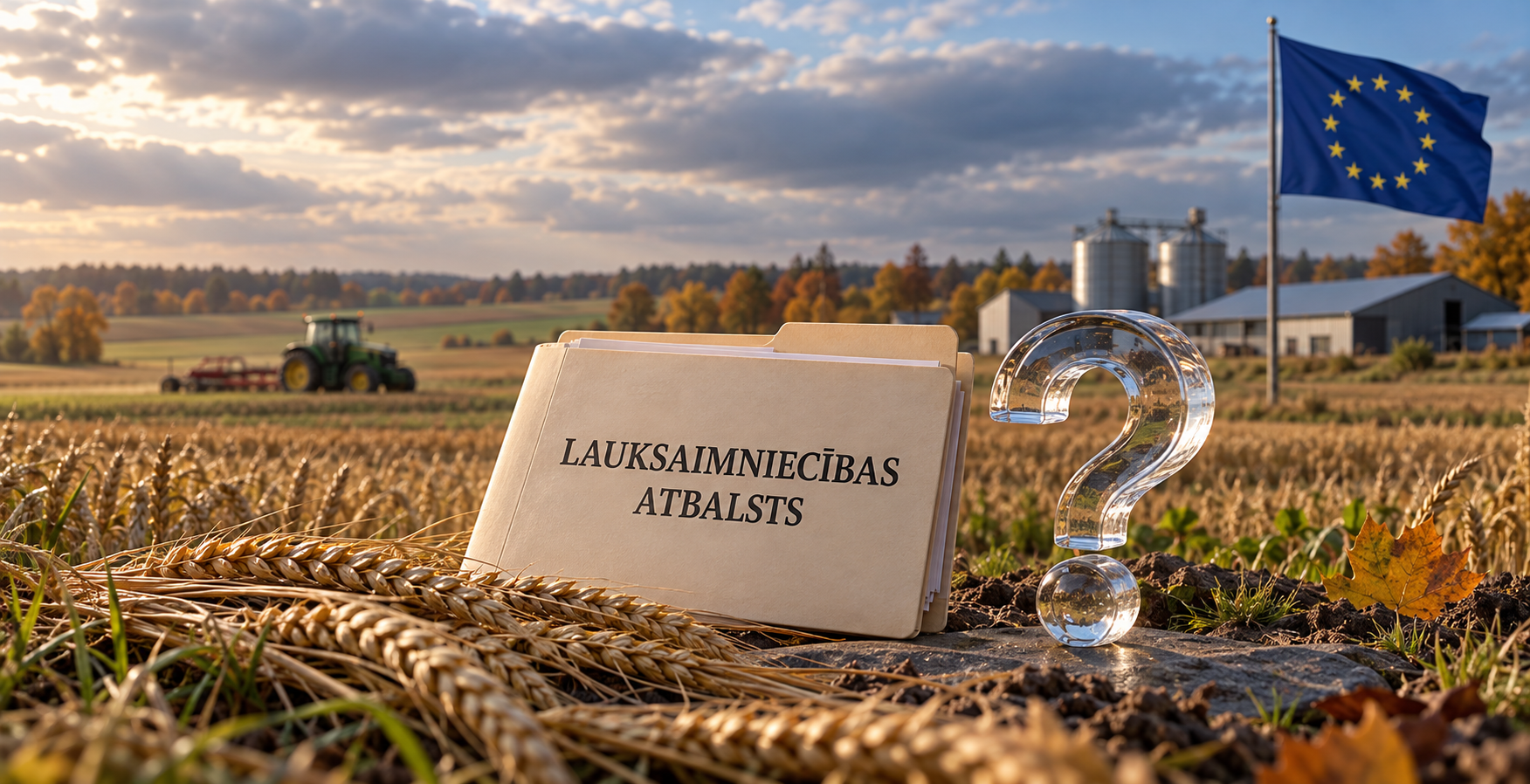
Latvian agricultural support after 2027 remains subject to negotiation. The minimum earmarked in the European Commission's proposal is not the final amount the sector will receive. Nor has a uniform payment reduction for every farm been adopted.
On 15 October, Latvijas Radio reported a risk of an approximately €650 million, or 20%, reduction. Agriculture Minister Uldis Augulis estimated that aligning direct payments would require an additional €1.6 billion over the full period.
What exactly does the earmarked €2.62 billion mean?
The Commission's published country allocation lists €2,620,796,000 for Latvia for 2028–2034 at current prices. This is the proposed safeguarded minimum for farmers' income support. The allocation calculation is based on each country's share of Common Agricultural Policy funding in 2027.
“Income support” is broader than a per-hectare payment: the Commission also includes farm investment, agri-environmental measures and support for small and young farmers. A percentage change in the overall envelope therefore cannot automatically be translated into an individual farm's next payment rate.
Why is the minimum not all the potential funding?
Member States could increase support using partnership plan funds. No specific addition is guaranteed for Latvia.
The Commission proposes earlier access from 2028 to €45 billion EU-wide otherwise available at mid-term review; rural areas would receive at least 10% of plan resources outside earmarked amounts. Final terms remain subject to agreement.
In February 2026, the Ministry of Agriculture had already highlighted another problem: the direct-payment convergence element in the calculation formula does not provide the necessary additional funding if a country's total allocation is capped. Both the total amount and the allocation mechanism therefore matter in negotiations.
The European Council's conclusions of 16 October confirm that budget negotiations continue.
How can amounts be compared without misleading conclusions?
Funding comparisons must use the same number of years, price basis and scope of support. EU funding must be distinguished from Latvian co-financing, the guaranteed minimum from potential additions, and direct payments from other rural development measures. Otherwise, two correct amounts may produce an incorrect conclusion about an individual farm's revenue.
What can a farm do now?
A practical conclusion for business planning: expected subsidies in an investment project should be distinguished by their degree of certainty, rather than assuming one optimistic figure throughout the loan term.
- Show support under current conditions separately from assumptions for the period after 2027 in cash-flow projections.
- Check whether machinery, construction or land purchases remain financially viable with lower support and higher production costs.
- Plan several funding scenarios without treating any percentage mentioned in the discussion as an individual reduction already determined.
- Follow the final EU agreement package and Latvia's support conditions before including potential additions in the baseline cash-flow forecast.
Businesses will need answers to three questions: how much funding will actually be earmarked for Latvia, how will it be allocated and what requirements will recipients have to meet? The current proposal does not yet provide a final answer to all three.
Official information sources
- European Commission: CAP funding proposal and minimum country allocations
- European Commission: questions and answers on the CAP after 2027
- European Commission: current explanation of the funding proposal
- Ministry of Agriculture: five countries' call to fund payment convergence, 10 February 2026
- European Council conclusions, 16 October 2026
Additional news source
Latvijas Radio: farmers' and minister's assessments, 15 October 2026
Comments
No comments yet. Yours could be the first!
Add a comment