

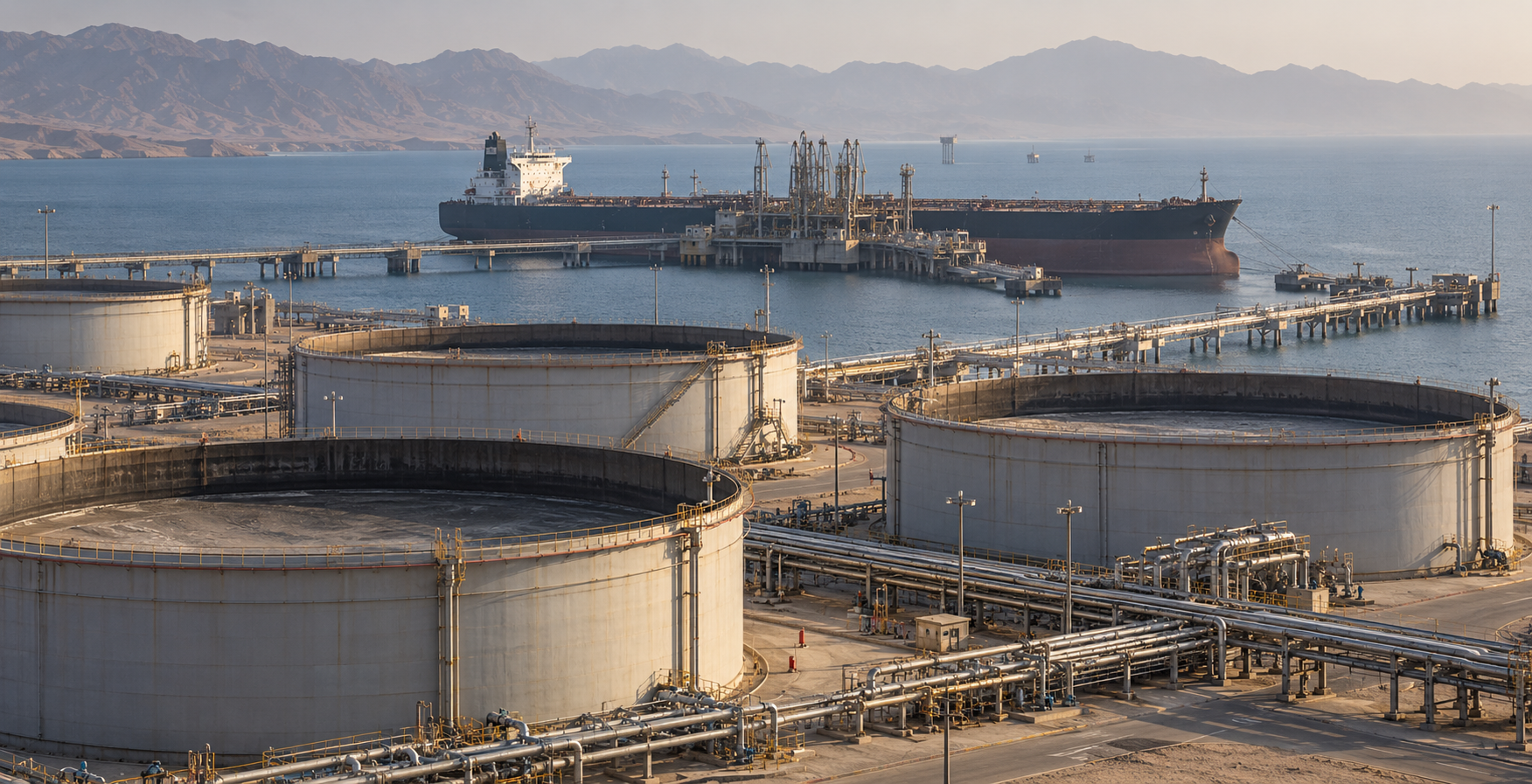
Saudi Arabia may have only 5–7 days in which oil stocks at the Red Sea port of Yanbu can maintain the current pace of exports. Unless the East–West pipeline restarts following a drone attack, up to four million barrels per day — approximately 4% of global oil supply — could be removed from the market.
This estimate does not refer to all Saudi oil reserves. Industry sources cited by Reuters were describing stocks available at Yanbu, from which much of the oil delivered through the pipeline has recently been exported.
Additional stocks are held at Egypt’s Ain Sukhna and Sidi Kerir ports. However, the sources said those inventories were not full and could only delay a major export decline if flows through the East–West pipeline were not restored.
Why are the next 5–7 days critical?
The East–West pipeline crosses the Arabian Peninsula, connecting Saudi oil-producing areas in the east with the Red Sea port of Yanbu. It enables Saudi crude to reach international markets without passing through the Strait of Hormuz.
Over the past six months, the pipeline has helped Saudi Arabia redirect approximately four million barrels per day to Yanbu. Estimates for some recent periods placed throughput as high as 4–5 million barrels per day.
The pipeline was halted after drone strikes. Saudi Arabia has not publicly disclosed a precise repair schedule or the full extent of the damage. Estimates provided to Reuters vary substantially:
- some sources believe pumping could restart partially while repairs continue;
- an optimistic scenario would allow the damage to be repaired relatively quickly;
- the most cautious estimate suggests repairs could take five to six weeks.
The 5–7-day period is therefore not an automatic deadline for all Saudi exports to stop. It represents the period during which stocks at Yanbu may support the current export rate. If the pipeline does not resume at least partial operations, exports must be reduced, additional inventories used or limited alternative routes found.
How much oil could disappear from the market?
Sources cited by Reuters said the pipeline outage threatens up to four million barrels per day, equivalent to approximately 4% of global oil supply.
This is the volume at risk, not a confirmed permanent loss. The actual reduction will depend on:
- the duration of pipeline repairs;
- whether partial pumping can resume;
- available inventories at Yanbu and the Egyptian ports;
- the ability to redirect some exports through Hormuz;
- the availability of tankers, insurance and port infrastructure.
The position is more serious because Saudi oil production has already fallen substantially. The kingdom told OPEC that output declined to 6.2 million barrels per day in August, compared with 10.9 million barrels per day in February before the war began.
What is happening in the Strait of Hormuz?
Preliminary ship-tracking data indicate that commodity-vessel transits through Hormuz fell to single digits per day over the weekend, well below the previous ten-day average of 14 daily transits.
Only four tracked vessels exited the Gulf through the strait over the weekend, while ten entered. These figures exclude ships that may have disabled their Automatic Identification System transponders to avoid detection.
Before the war began on 28 February 2026, approximately 125 large commercial vessels normally passed through Hormuz each day. Their cargoes included oil, liquefied natural gas, chemicals, fertiliser, metals, grain and other commodities.
The East–West pipeline shutdown is therefore particularly dangerous. Saudi Arabia cannot simply redirect all oil previously sent to Yanbu back through an already severely constrained Hormuz route.
Why have tanker costs reached record levels?
Reuters reported that tanker rates reached record highs during the previous week. Several pressures are affecting shipping costs simultaneously:
- high war-risk insurance premiums;
- a limited number of vessels whose owners are prepared to enter high-risk routes;
- security risks to ships and crews;
- shortages of bunker fuel;
- longer alternative routes;
- possible delays and vessel downtime.
Tankers can still use the Suez Canal or sail around Africa, but on some routes this can add approximately 22 days to a voyage to Asian markets. It also increases vessel-hire, fuel, crew and insurance costs.
Businesses must therefore consider more than the quoted price of crude oil. Even where the required barrels remain available, physically delivering them to a refinery is becoming more expensive.
Why has Brent risen to approximately $108?
On the morning of 14 September 2026, Brent crude rose approximately 3% to $107.81 per barrel, while U.S. crude reached $102.94.
The market is pricing several risks simultaneously:
- uncertainty surrounding the East–West pipeline repair schedule;
- the sharp decline in Hormuz shipping traffic;
- attacks on vessels and energy infrastructure;
- the Houthi-related threat around Bab el-Mandeb;
- record tanker-transport costs;
- limited capacity to replace disrupted supplies rapidly.
Even a rapid pipeline restart would not eliminate shipping, insurance and regional-security risks. Partial or full restoration of pumping would nevertheless significantly reduce the immediate risk of a major Saudi export decline.
How could this affect fuel prices in Latvia?
Oil-price changes are not reflected at Latvian filling stations on the same day. Local retail prices are also influenced by European refined-product prices, the euro-dollar exchange rate, taxes, existing inventories, supply contracts and competition.
However, Brent remaining above $100 alongside record transport costs would create clear upward pressure on:
- diesel and petrol prices;
- road freight and courier rates;
- aviation and maritime transport costs;
- agricultural and construction expenses;
- plastics, chemicals and packaging prices;
- retail supply-chain costs.
How does the oil crisis affect inflation and interest rates?
More expensive energy affects more than fuel. Higher transport and production costs gradually feed into food, goods and service prices, creating broader inflationary pressure.
Reuters reported on 14 September that markets assigned an 86% probability to a 25-basis-point increase in the U.S. Federal Reserve’s policy rate. European Central Bank policymaker Mārtiņš Kazāks said that energy-driven inflation could strengthen the case for further monetary tightening.
This creates a double risk for businesses: energy and transport costs may rise at the same time as borrowing costs.
What should businesses do during the next few days?
- Calculate operating costs under Brent scenarios of $110, $120 and $130 per barrel.
- Check how frequently transport and supply partners may adjust their rates.
- Review which customer contracts allow price adjustments following increases in energy costs.
- Assess fuel, raw-material and critical-goods inventories without engaging in unjustified panic buying.
- Stress-test cash flow for simultaneous increases in input costs and interest rates.
- Monitor pipeline repairs, Yanbu exports, tanker rates and Hormuz traffic rather than following only the Brent price.
What should be monitored during the next 5–7 days?
Four developments will be particularly important:
- whether Saudi Arabia announces a specific East–West pipeline repair schedule;
- whether partial pumping resumes before repairs are completed;
- whether export volumes from Yanbu begin to decline;
- whether vessel traffic through Hormuz and Bab el-Mandeb falls further.
If the pipeline resumes at least partial operations, the immediate four-million-barrel risk will decline. If repairs take several weeks and Hormuz traffic does not improve, the market could enter a substantially more severe phase of supply disruption and price pressure.
Frequently asked questions
Will Saudi Arabia run out of oil after 5–7 days?
No. The Reuters estimate concerns stocks at Yanbu available to maintain current exports. It does not refer to all Saudi oil reserves or oil remaining in the country’s fields.
Have four million barrels per day already disappeared?
No. This is the volume at risk. The actual decline will depend on repair times, inventories and the ability to restore partial pumping or use alternative routes.
How long could repairs take?
Saudi Arabia has not announced a precise timetable. Sources cited by Reuters described both a possible earlier partial restart and a cautious repair estimate of five to six weeks.
Is the Strait of Hormuz completely closed?
No. Some vessels continue to transit the strait. Tracked traffic is nevertheless exceptionally low, and ships operating with disabled identification transmitters may not appear in the preliminary data.
Is $107.81 a permanent Brent price?
No. It was the market price cited by Reuters on the morning of 14 September 2026. Oil prices change continuously during trading.
Information updated on 14 September 2026. This article is for information only and does not constitute individual investment advice. Conditions and market prices may change rapidly.
Comments
No comments yet. Yours could be the first!
Add a comment