

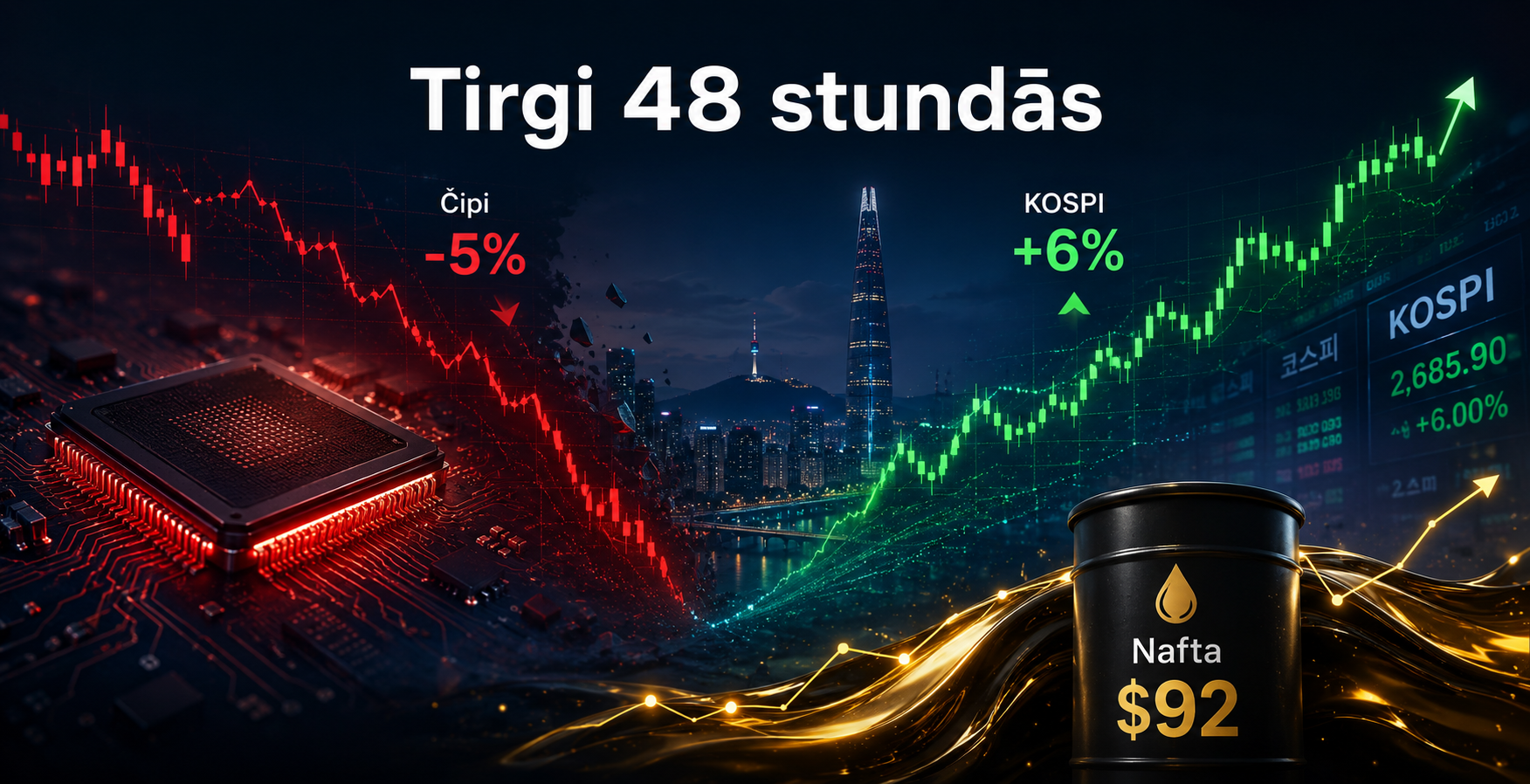
The last 48 hours in financial markets showed how quickly one macroeconomic chain can move completely different asset classes. Rising oil prices increased inflation concerns, US government bond yields surged, and investors began reducing exposure to technology and AI-related stocks.
Why did semiconductor stocks suddenly fall?
On 18 August, the Philadelphia Semiconductor Index fell about 5%. Nvidia declined 2.3%, Micron 7%, Sandisk 9% and Western Digital 7.4%.
The main pressure did not come from suddenly deteriorating company results. Higher oil prices increased inflation concerns, while the US 30-year Treasury yield reached its highest level since 2007. When yields on lower-risk assets rise, investors become less willing to pay extremely high valuations for future technology-sector earnings.
From almost -6% to +6% in one day
South Korea's KOSPI fell 5.8% on 19 August as selling in AI-related stocks accelerated. Just one day later, the index rebounded by 5.9%.
SK Hynix produced an even more dramatic reversal. After its shares had fallen nearly 10%, the chipmaker announced a 40 trillion won, or approximately $28.6 billion, share buyback and cancellation programme. In the following session SK Hynix jumped about 12.7%, while Samsung Electronics rose 9.5%.
Why has oil become a major market driver?
On 20 August Brent crude traded around $92 a barrel, extending its rise for a fifth consecutive session. The main driver is uncertainty in the Middle East and disruption around the Strait of Hormuz, through which close to one-fifth of global oil consumption normally flows.
Oil matters even to traders who never trade commodities. More expensive energy can increase inflation expectations, push bond yields higher and ultimately put pressure on equity valuations.
What can an active trader learn from these 48 hours?
- a stock can move because of macroeconomic forces rather than company-specific news;
- a sharp fall does not guarantee another decline the next day;
- bond yields and oil prices may be as important as the stock chart itself;
- one corporate decision, such as a massive share buyback, can change sentiment within hours.
Active trading requires understanding not only where the price is moving, but what is causing the move.
This article is for informational purposes only and does not constitute individual investment or trading advice. Financial instruments can fluctuate sharply and invested capital may be lost.
Comments
No comments yet. Yours could be the first!
Add a comment