Accounting in Latvia is becoming increasingly digital. Structured electronic invoices, or e-invoices, are being introduced in stages, and new businesses need to understand both the requirements already in force in 2026 and those approaching in 2028.
One of the most important distinctions is between an ordinary invoice sent electronically and a structured e-invoice. A PDF and a structured XML e-invoice are not the same thing, and the applicable obligations depend on who receives the invoice.
What is a structured e-invoice?
Under the Latvian Accounting Law, a structured electronic invoice is an invoice prepared, sent and received in a structured electronic format that allows automatic electronic processing.
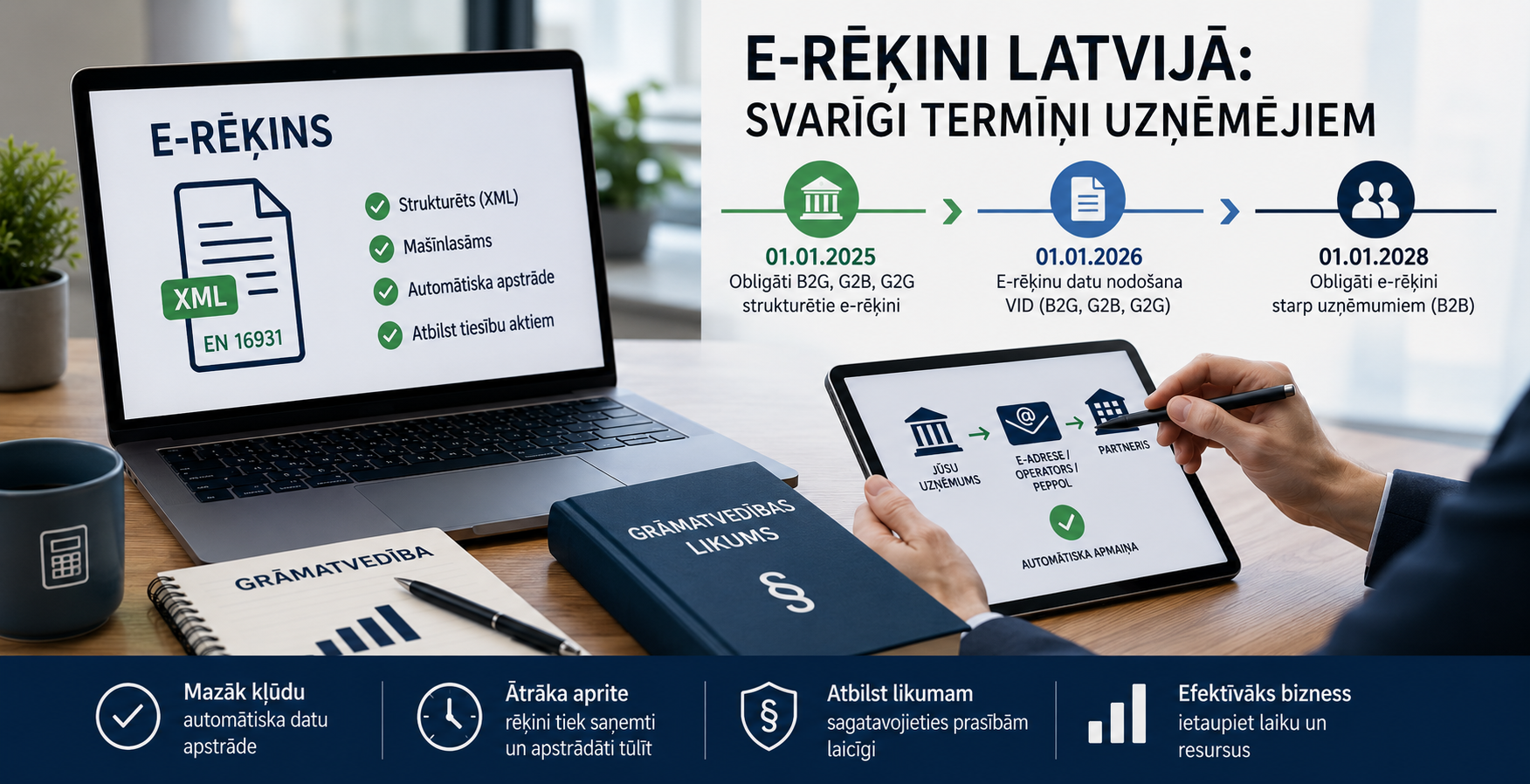
In Latvia, the e-invoice data file is XML-based and must comply with the European EN 16931 standard and the PEPPOL BIS Billing 3.0 specification used in Latvia's e-invoicing environment.
Why is a PDF not a structured e-invoice?
A PDF is primarily a human-readable representation of a document. An accounting system cannot process all fields from an ordinary PDF in the same standardised way as it can process structured XML data.
This does not mean that PDF invoices are invalid in every situation. Outside transactions where a structured e-invoice is mandatory, an electronic or paper supporting document may still be used for accounting purposes if it complies with the applicable legal requirements.
Which e-invoicing dates should businesses know?
1 January 2025 – transactions with budgetary institutions
Since 1 January 2025, structured e-invoices have generally been mandatory for transactions between Latvia's public administration and Latvian registered businesses, covering B2G, G2B and G2G transactions.
A business issuing an invoice for payment to a Latvian budgetary institution must generally issue it as a structured e-invoice.
1 January 2026 – submission of e-invoice data to the State Revenue Service
From 1 January 2026, e-invoice data must also be submitted to the Latvian State Revenue Service in the mandatory G2G, B2G and G2B segments.
Where the official electronic address, or e-address, is used to send the e-invoice, the relevant e-invoice information is transmitted automatically to the State Revenue Service.
Depending on the chosen solution, data may also be submitted through an integrated e-invoice service provider, the State Revenue Service API or XML file upload functionality in EDS. Where submission is mandatory, the e-invoice must generally reach the State Revenue Service no later than five working days after it is sent.
2026–2027 – transition period for B2B
Mandatory structured e-invoicing between private-sector Latvian businesses has not yet started.
During 2026 and 2027, businesses may voluntarily exchange structured e-invoices in B2B transactions. Submission of those B2B e-invoice data to the State Revenue Service is also voluntary during the transition period.
1 January 2028 – mandatory B2B e-invoicing
From 1 January 2028, invoices issued for payment between Latvian registered businesses will generally have to be prepared as structured e-invoices.
The issued e-invoices will also have to be submitted to the State Revenue Service. Certain statutory exceptions apply, so the nature of the individual transaction must also be considered.
How can an e-invoice be delivered?
A business is not required to use one particular commercial e-invoicing operator. Latvian rules provide several delivery channels:
- the official electronic address, or e-address;
- an e-invoice service provider or operator;
- another electronic delivery channel, including system-to-system integration or another electronic channel agreed between the parties.
Businesses can agree on the delivery channel they use for their e-invoice exchange.
How should a new business prepare?
1. Check the capabilities of your invoicing software
Confirm that your chosen system can generate structured XML e-invoices compliant with EN 16931 and PEPPOL BIS Billing 3.0 requirements.
If the company invoices budgetary institutions, producing only a PDF is no longer sufficient.
2. Select an appropriate delivery channel
Consider whether your company is better served by e-address, an e-invoice service provider or direct software integration.
A simple workflow may be sufficient for a small number of invoices, while larger volumes usually make automation and accounting-system integration increasingly important.
3. Check access to e-address
E-address is one of the state-supported channels for structured e-invoice exchange. When it is used for e-invoicing, the transmission of the relevant data to the State Revenue Service is handled automatically from 2026.
4. Keep customer and business-partner information accurate
Automated exchange depends on accurate master data. Business names, registration numbers and the required information about each partner's chosen invoice-receiving channel should be maintained correctly.
5. Prepare for 2028 before the deadline
Even if a company does not currently work with public-sector customers, there is little benefit in waiting until the end of 2027. When selecting accounting or invoicing software, its readiness for mandatory B2B e-invoicing should already be considered.
What changes in everyday accounting?
- Less manual data entry – structured fields can be processed automatically.
- Lower risk of transcription errors – invoice numbers, dates and amounts do not have to be repeatedly re-entered.
- Faster document processing – systems can receive and process invoice data automatically.
- Standardised information – invoice data follow a defined structure.
- Easier system integration – e-invoicing can be connected with accounting and other business systems.
Do cash-register receipts also need to become e-invoices?
Not in every case. Latvian law provides an exception for transactions where payment is evidenced by a compliant transaction document produced under the rules governing electronic cash-register and payment-registration devices.
Mandatory structured e-invoicing therefore does not mean that every retail purchase must automatically generate an XML invoice.
Does the requirement apply to businesses that are not VAT registered?
VAT registration status is not the decisive criterion. Structured e-invoicing requirements arise from the Accounting Law and depend on the legal status of the parties and the type of transaction.
A business that is not VAT registered may therefore still be required to issue a structured e-invoice where the transaction falls within the mandatory scope and no statutory exception applies.
Will PDF invoices disappear entirely?
No. A PDF can continue to serve as a human-readable representation of an invoice and, in situations where structured e-invoicing is not mandatory, may also serve as an accounting supporting document if the applicable requirements are satisfied.
However, where a structured e-invoice is mandatory, sending only a PDF does not fulfil that requirement.
Conclusion: prepare before the requirement becomes mandatory
In 2026, Latvian businesses are in the middle of the transition towards structured e-invoicing. For transactions with budgetary institutions, structured invoicing is already an everyday requirement, while private-sector B2B businesses still have time to prepare for 2028.
For a new business, the practical approach is to select invoicing and accounting systems from the beginning that can support structured e-invoices, maintain accurate partner information and work with the necessary electronic delivery channels.
2028 only feels distant until a business has thousands of customers, years of accumulated document processes and an accounting system that must suddenly be rebuilt.
Comments
No comments yet. Yours could be the first!
Add a comment