
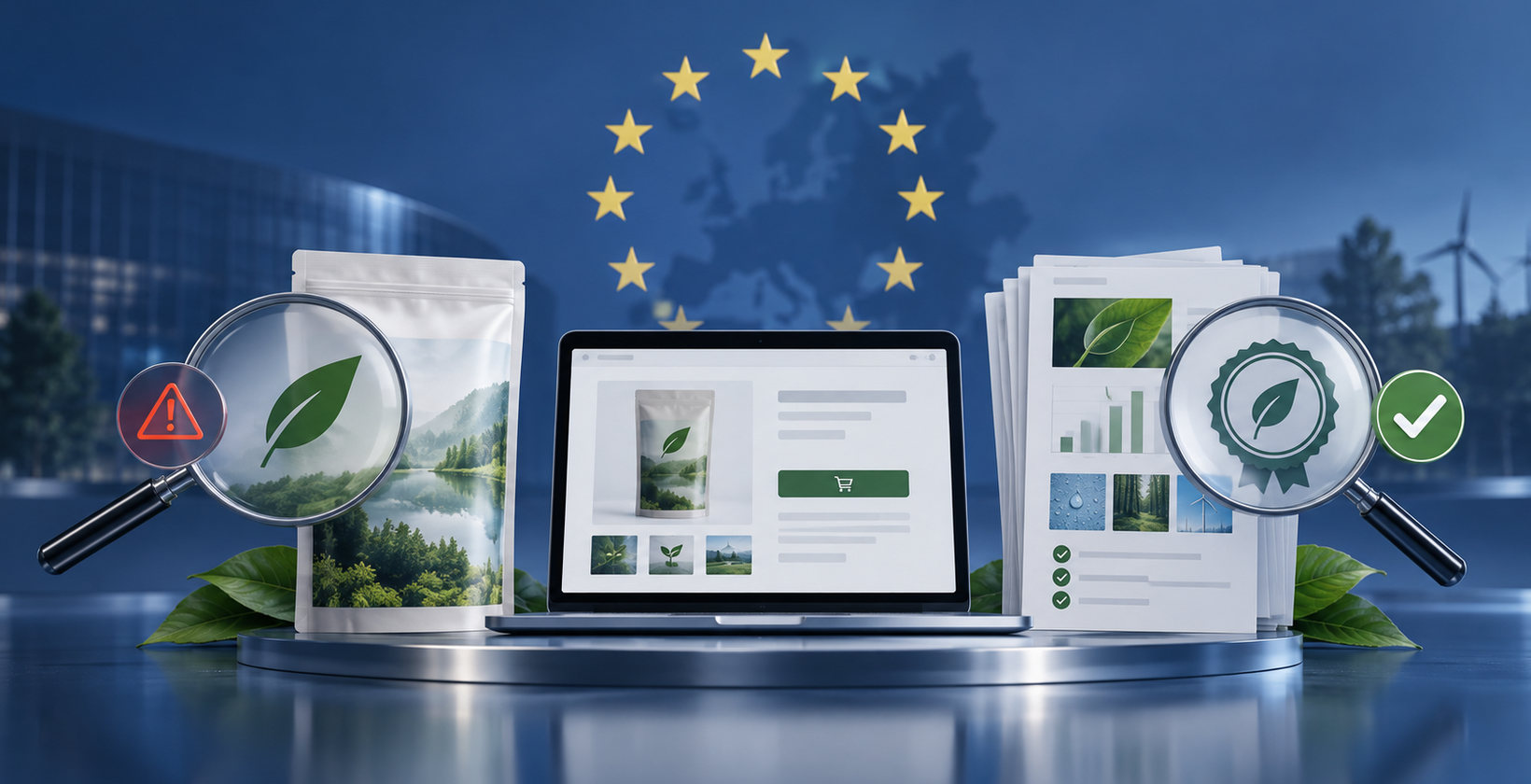
From 27 September 2026, the word “green” will no longer be enough to support environmental marketing in Latvia. Amendments to Latvia’s Unfair Commercial Practices Prohibition Law will bring the EU anti-greenwashing rules into application. They affect advertisements, online stores, packaging, product and company names, self-created eco labels, climate-neutrality promises and even statements about durability and repairability.
Businesses have only days left to review their consumer-facing claims. This is not merely a reputational issue: the supervisory authority may impose a fine of up to 4% of annual turnover or revenue for an unfair commercial practice. If the infringement is confined to Latvia, the statutory maximum is EUR 300,000.
What changes on 27 September?
Latvia transposed Directive (EU) 2024/825 through amendments adopted in 2025, with the relevant provisions entering into force on 27 September 2026. The rules do not prohibit businesses from communicating genuine environmental benefits. They require a claim to be specific, intelligible, limited to the correct part of the product or business activity and supported by verifiable evidence.
1. Vague claims such as “green” or “environmentally friendly” become high risk
Generic environmental claims include expressions such as “environmentally friendly”, “eco-friendly”, “green”, “climate friendly”, “carbon friendly”, “energy efficient”, “biodegradable” and “biobased” where the specification is not provided in clear and prominent terms on the same medium.
The word “green” is not automatically banned in every context. A generic claim may be used where the trader can demonstrate recognised excellent environmental performance relevant to that claim. This could be an EU Ecolabel or an officially recognised EN ISO 14024 type I ecolabel scheme. A company’s own certificate or an unexplained “certified” statement is not automatically sufficient.
A safer approach is to replace a broad slogan with a verifiable fact. Instead of “green packaging”, a business might state that 100% of the energy used to manufacture that packaging came from renewable sources, provided it can document the statement. A specific claim must still be truthful and non-misleading.
2. Self-created eco badges may need to be removed
A sustainability label will be prohibited unless it is based on a certification scheme or established by a public authority. This directly affects green seals, leaves, medals and “eco choice” emblems created by a trader where consumers may understand them as independent proof of environmental quality.
A green colour, leaf or water droplet is not automatically prohibited. In context, however, a symbol combined with wording, a name or other design elements may amount to an implicit environmental claim or a sustainability label. Businesses must assess the overall impression, not merely each graphic element in isolation.
3. One attribute cannot make the entire product or company “green”
The new provisions prohibit an environmental claim about an entire product, service or business where the claim concerns only a specific aspect. Recyclable packaging does not by itself justify calling the whole product environmentally friendly. Solar panels at one facility do not automatically support a claim that the entire company operates sustainably.
The scope of the claim should match the scope of the evidence. If the data concern packaging only, the wording must concern packaging only. Evidence for one product line cannot be converted into a brand-wide promise.
4. Carbon offsets cannot turn a product into “climate neutral”
The rules prohibit claims, based on greenhouse-gas offsetting, that a product, service, digital service or digital content has a neutral, reduced or positive environmental impact in terms of emissions.
This does not prohibit a company from buying carbon credits or reporting accurately on them as a separate activity. It does mean that offsets alone cannot support a consumer-facing label such as “climate-neutral product”, “CO2-neutral delivery” or a comparable claim about the offer itself.
5. Future net-zero promises need a credible plan
Claims about future environmental performance must be backed by clear, objective, publicly available and verifiable commitments. The European Commission’s guidance points to a detailed and realistic implementation plan with measurable, time-bound targets, allocated resources and regular verification by an independent third-party expert. The findings must be available to consumers.
A statement such as “we will be climate neutral by 2030” without interim targets, responsibilities, resources and verification therefore becomes a legal risk rather than merely an ambitious slogan.
6. A mandatory EU requirement cannot be advertised as a special benefit
Where a feature is already required by law for all products in the relevant category, a trader may not present it as a distinctive benefit of its own offer. Consumers must not be led to believe that the company voluntarily provides something special when it is simply complying with a legal obligation.
7. Durability, repairs and software updates are also covered
The amendments go beyond classic greenwashing. The blacklist also captures false claims about durability, repairability or lifespan; withholding information about a software update’s negative impact; and presenting a functionality-enhancing update as necessary.
It also covers prompting consumers to replace consumables earlier than technically necessary and misleading statements about the effect of non-original consumables or spare parts. These provisions are particularly relevant to electronics, household appliances, printing equipment, software and repair services.
Where should a business look for risky claims?
- packaging, labels and product instructions;
- product pages, filters, banners and SEO copy in online stores;
- search, social media and influencer advertising;
- brochures, trade fairs and sales presentations;
- product, range, brand and company names;
- sustainability reports where their wording is reused in consumer marketing;
- descriptions published by distributors and marketplaces.
The legislation primarily concerns business-to-consumer commercial practices. A B2B supplier should nevertheless provide accurate evidence when its information is likely to be reused on packaging or in consumer advertising.
A practical audit before 27 September
- Create a claims register. Record the exact wording, channel, product, territory and person responsible.
- Flag generic terms. Search for “green”, “eco”, “sustainable”, “climate friendly”, “biodegradable”, “CO2 neutral” and comparable expressions.
- Check the scope. Does the evidence concern the entire product and lifecycle, or only the packaging, one material or one production stage?
- Assign an evidence owner and review date. Record the source, method, verification date and expiry or next-review date.
- Remove non-compliant self-labels. Verify whether every eco emblem is established by a public authority or based on a compliant certification scheme.
- Review climate-neutrality wording. Do not use offsets to claim that a product has neutral or reduced emissions impact.
- Align partner content. Send distributors approved wording and require obsolete descriptions to be replaced.
Does one wrong word really trigger a 4% fine?
No. Four per cent is a statutory maximum, not an automatic fine for every inaccurate phrase. The authority must consider the nature, gravity and duration of the infringement, consumer losses, previous infringements, financial benefit, remedial steps, cooperation and other circumstances.
For an unfair commercial practice confined to Latvia, the maximum is 4% of the previous financial year’s net turnover, capped at EUR 300,000. Cross-border cases may take account of turnover in the EU and European Economic Area states concerned. Separate maximums apply where turnover information is unavailable or false.
The bottom line
Environmental marketing does not become illegal on 27 September, but it must become precise and evidence-based. A business should be able to answer three questions: what exactly are we claiming, which part of the product or activity does it cover, and where is the independently verifiable evidence?
If any of those answers is unclear, the claim should be narrowed or removed before 27 September.
Comments
No comments yet. Yours could be the first!
Add a comment