

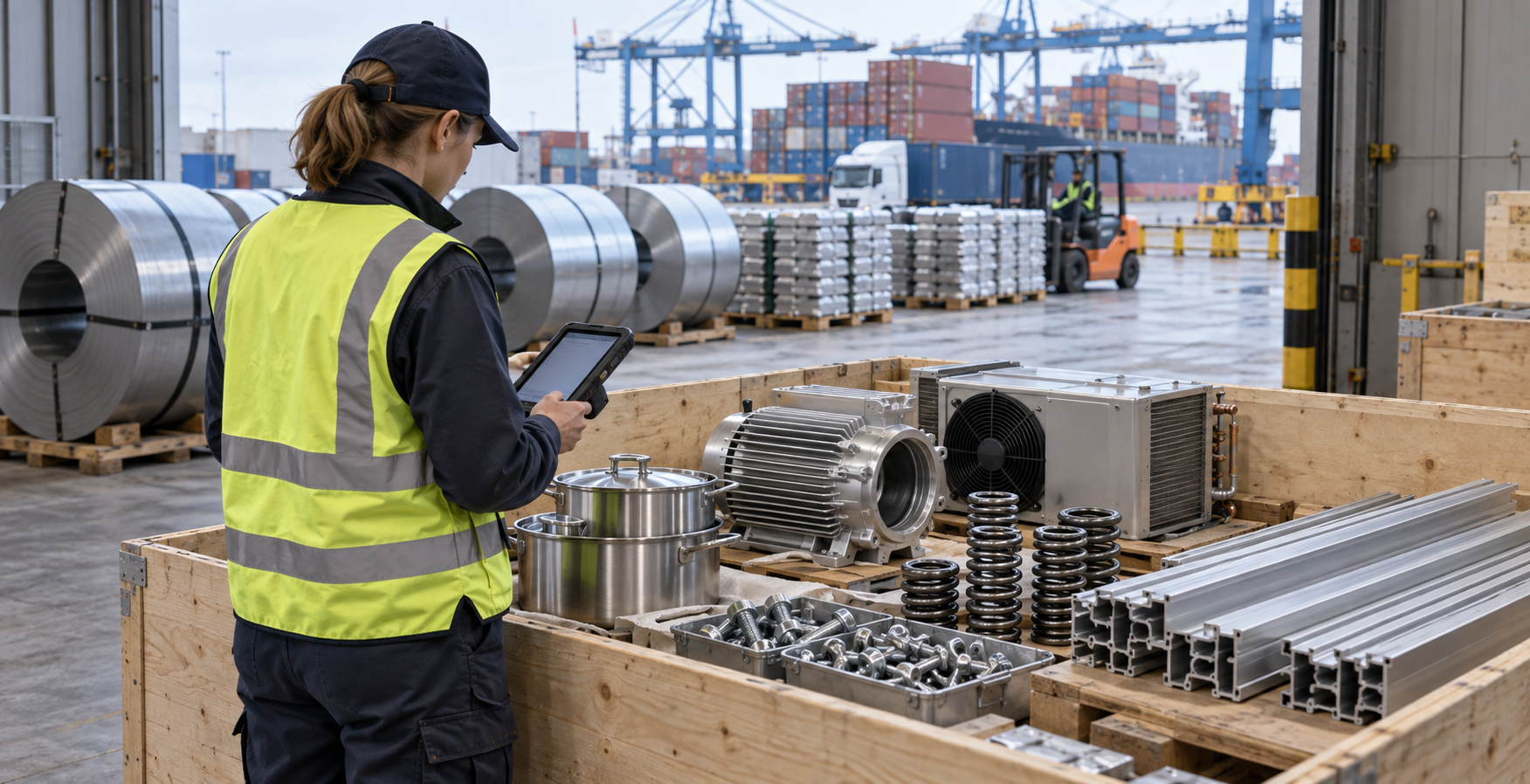
The European Union’s Carbon Border Adjustment Mechanism, or CBAM, could be expanded from basic materials to hundreds of finished and semi-processed products containing substantial amounts of steel or aluminium. The European Commission’s original proposal covers approximately 180 additional downstream products, while the European Parliament Environment Committee supports a significantly wider scope described in specialist analyses as approximately 457 product codes.
Parliament’s plenary debate takes place on 14 September 2026, with the vote scheduled for 15 September. The vote will establish Parliament’s position for subsequent negotiations with the Council of the EU. It will not be the final legislation and will not immediately place every proposed product within the CBAM system.
What is CBAM and which goods does it currently cover?
CBAM is an EU mechanism intended to apply a carbon cost to imported carbon-intensive goods comparable to that faced by European producers through the EU Emissions Trading System.
The existing mechanism mainly covers specified goods in six sectors:
- cement;
- iron and steel;
- aluminium;
- fertilisers;
- electricity;
- hydrogen.
Whether the rules apply is not determined solely by a general product name or the material from which it is made. The decisive factor is the product’s exact Combined Nomenclature, or CN, code and the annexes to the applicable regulation.
Why does the Commission want to extend CBAM?
The current system predominantly covers basic materials. This creates a risk that manufacturing may move outside the EU, with finished products imported into Europe instead of the underlying materials.
For example, CBAM may cover imported steel material while excluding a machine or household item manufactured outside the EU using the same steel. The EU producer would continue to face European carbon costs, while the foreign finished-product manufacturer could avoid them.
The proposed expansion is intended to reduce this carbon-leakage risk and prevent circumvention through minor processing, assembly or customs-classification changes outside the EU.
How do the Commission and Parliament proposals differ?
The European Commission proposal would add approximately 180 downstream products with a high steel or aluminium content from 2028. According to the Commission’s assessment, around 94% are intermediate industrial goods and only a small share are household products.
Potentially covered goods include:
- metal fittings and fasteners;
- wire and springs;
- metal cylinders and containers;
- industrial radiators;
- casting and other specialised machinery;
- other steel- and aluminium-intensive goods.
The Environment Committee’s position supports a wider range. Specialist regulatory analyses count its proposed scope as approximately 457 product codes, including certain:
- solar panels;
- heat pumps;
- metal kitchen and household articles;
- electric-motor components;
- machinery and equipment parts;
- other finished steel and aluminium products.
The final list has not been adopted. The number of products and the individual CN codes may change during negotiations between Parliament, the Council and the Commission.
Will the new obligations apply immediately after Parliament’s vote?
No. Parliament’s vote establishes its negotiating position on the Commission proposal. Under the ordinary legislative procedure, agreement must subsequently be reached with the Council.
Where the institutions’ positions differ, they will have to negotiate:
- the final list of products and CN codes;
- the application date;
- the embedded-emissions calculation methodology;
- anti-circumvention measures;
- exemptions and administrative simplification;
- the relationship with the EU Emissions Trading System.
The Commission proposal envisages including the additional downstream products from 2028. The final date will only be known once the legislative procedure has been completed.
Which Latvian businesses could be affected?
The primary risk factor is not the company’s size or sector but whether it imports goods from outside the EU under a CN code included in the final regulation.
Potentially affected Latvian businesses may include importers of:
- manufacturing machinery and parts;
- metal construction products;
- fasteners, wire, springs and fittings;
- steel or aluminium cylinders and containers;
- heating and ventilation equipment;
- electric-motor and engineering components;
- certain renewable-energy equipment;
- metal kitchen and household goods.
A distributor that does not manufacture the goods may still be affected if it acts as the importer in the customs declaration.
What new obligations could importers face?
If a product’s CN code is added to the expanded CBAM scope, the importer may have to:
- determine the embedded emissions of the imported product and relevant inputs;
- obtain information from the non-EU producer or supplier;
- verify that data are complete and compatible with the EU methodology;
- maintain information about origin, production installation and materials;
- calculate any carbon price already paid in the country of origin;
- submit the required CBAM declarations;
- purchase and surrender the necessary CBAM certificates;
- retain calculations and evidence for possible inspections.
For finished products, the most difficult element may not be purchasing certificates but obtaining reliable emissions data for the steel or aluminium incorporated into the product.
How could the expansion affect prices?
Importers may face three main categories of cost:
- CBAM certificate costs;
- costs of obtaining, calculating and verifying emissions data;
- internal systems, customs-classification and compliance costs.
A supplier unable to provide reliable actual-emissions data may become more expensive or risky than a competitor with transparent production records. If EU default values must be used, calculated emissions may be higher than the producer’s actual emissions.
These costs may flow into prices for machinery, construction products, energy technologies and consumer goods. The impact will differ by product and depend on metal content, production emissions, the carbon price paid in the country of origin and the price of EU emissions allowances.
What is the Temporary Decarbonisation Fund?
Parliament is also considering a Temporary Decarbonisation Fund alongside the CBAM expansion.
CBAM is gradually replacing free emissions allowances for the relevant EU industries. However, CBAM mainly protects the European market. When EU producers export to countries without an equivalent carbon price, they may remain at a disadvantage.
The Commission’s proposed fund is intended as temporary support for certain goods in the aluminium, fertiliser, iron and steel sectors and potentially other energy-intensive industries exposed to continued carbon-leakage risk.
It is not an automatic compensation mechanism for every CBAM importer. Its central purpose is to support decarbonisation and the export competitiveness of EU producers.
What should Latvian businesses do now?
- Create an inventory of all goods imported from outside the EU, including full CN codes.
- Identify products containing substantial amounts of steel or aluminium.
- Check whether each CN code accurately reflects the product’s characteristics.
- Ask suppliers whether they can provide installation and emissions data in a format compatible with EU requirements.
- Add contractual duties requiring suppliers to provide CBAM information and accept responsibility for inaccurate data.
- Model possible cost effects using several emissions and EU allowance-price scenarios.
- Monitor the final CN-code list instead of relying on general product descriptions.
The sensible first step is a customs-classification and data-availability audit. Businesses should not assume that all 457 discussed product codes will appear in the final regulation, but waiting until the last application date would create unnecessary risk.
Frequently asked questions
Has the European Parliament already approved 457 products?
No. The Environment Committee supports a much wider list described in analyses as approximately 457 product codes. The plenary vote is scheduled for 15 September, after which negotiations with the Council will still be required.
Will the CBAM expansion take effect in 2026?
The Commission proposal envisages adding the downstream products from 2028. The final date and transitional arrangements will be known only after completion of the legislative process.
Does CBAM apply to goods produced in the EU?
CBAM applies to specified goods imported from outside the EU. Carbon costs for EU producers arise mainly through the EU Emissions Trading System.
Is it sufficient to know that a product is made of steel?
No. The exact CN code and the annexes to the final regulation must be checked. Two visually similar products may have different customs classifications and obligations.
Will a Latvian importer need data from a Chinese or other foreign factory?
In many cases, yes. The importer will need cooperation from the supplier and production installation to obtain information about production processes, materials and embedded emissions.
Information updated on 14 September 2026 before the European Parliament vote. Product numbers, CN codes, application dates and obligations may still change during the legislative process.
Official information sources
- European Parliament: debate and vote on CBAM, the decarbonisation fund and carbon-market stability
- European Parliamentary Research Service: Temporary Decarbonisation Fund
- EUR-Lex: Commission proposal establishing the Temporary Decarbonisation Fund
- European Commission: Carbon Border Adjustment Mechanism
Comments
No comments yet. Yours could be the first!
Add a comment