
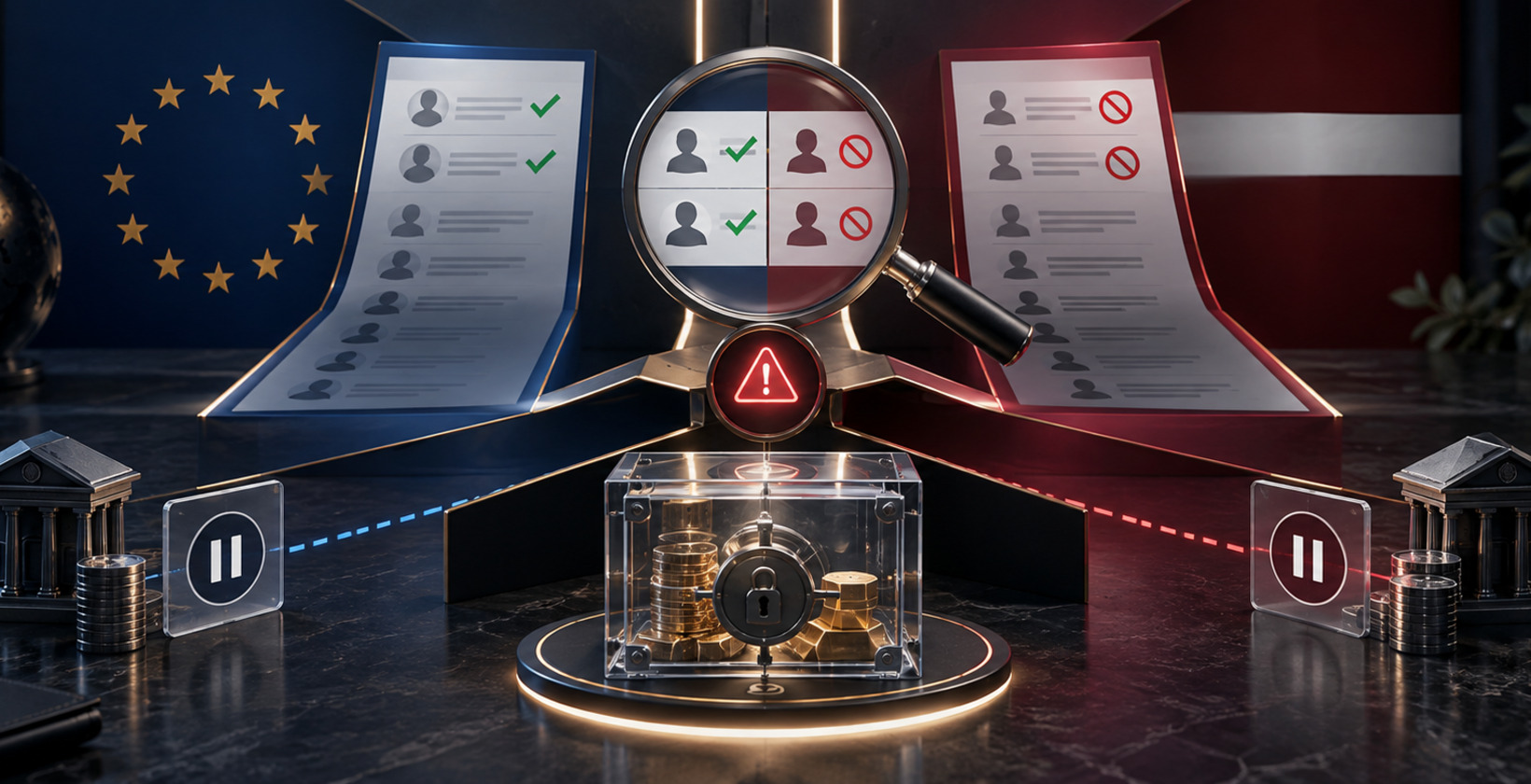
In two high-profile cases, the European Union and Latvian sanctions lists no longer produce the same result. On 22 September, the EU extended for 36 months its individual sanctions regime covering nearly 3,000 persons and entities linked to Russia’s aggression against Ukraine. At the same time, Russian businessmen Mikhail Fridman and Alisher Usmanov were removed from that regime’s list. Latvia imposed national financial and entry restrictions on both men on the same day.
This is not merely a political development. It changes compliance practice: a negative match against the EU list does not by itself mean that a transaction is permitted in Latvia.
What changed at EU level?
EU member states agreed to extend until 22 September 2029 the individual restrictive measures targeting persons responsible for undermining or threatening Ukraine’s territorial integrity, sovereignty and independence. The regime was prolonged for 36 months instead of the customary six-month renewal.
The compromise included the removal of Fridman and Usmanov from this EU sanctions list. It is therefore no longer accurate to describe them as listed under this particular EU individual sanctions regime. However, delisting at EU level does not cancel restrictions imposed by individual countries and does not remove the obligation of businesses operating in Latvia to check Latvia’s national sanctions.
Latvia’s response took effect immediately
On 22 September, the Latvian Cabinet adopted orders imposing national sanctions on Fridman and Usmanov. The orders entered into force upon signature and were published officially on 23 September. They impose financial restrictions as well as a ban on entering, staying in or transiting Latvia.
The financial restrictions have a broad practical scope. Funds and economic resources owned, held or controlled, directly or indirectly and wholly or partly, by the sanctioned persons must be frozen without delay. Funds or economic resources must not be made available to them, including indirectly or through third parties acting on their behalf, under their direction or for their benefit.
The Latvian government stated that the national instrument was intended to prevent the release of these persons’ funds and economic resources in Latvia. The orders must be reviewed at least annually, and an appeal does not suspend their application.
Why is a name-only search insufficient?
Sanctions screening is not limited to matching an exact name against a list. A company must also assess ownership, beneficial owners, actual control and persons acting on behalf of or for the benefit of a sanctioned person. A transaction may be restricted even where the direct contractual counterparty is not itself named on a list.
The geography of the transaction, payment bank, currency, end user, final destination and delivery route may also matter. Other national regimes can become relevant where the transaction has the required jurisdictional link. An automated “not on the EU list” result must therefore not become the final approval.
What should a Latvian business do now?
- Add Latvian national sanctions to screening. A process or IT system that checks only the EU consolidated list is incomplete.
- Re-screen existing relationships. Review customers, suppliers, payees and legal persons whose ownership or control chain could involve Fridman or Usmanov.
- Do not rely solely on a legal ownership percentage. Assess actual control, instructions, representation and indirect benefit.
- Keep evidence of the review. Record the sources used, screening time, possible matches and the reasoning behind the decision.
- Pause unclear transactions. If a potential match or control link appears, do not transfer funds or resources until the case has been properly assessed and, where necessary, guidance has been obtained from Latvia’s Financial Intelligence Unit.
The new risk: one counterparty, two different results
This case demonstrates why sanctions compliance can no longer be designed as a single-list filter. The same person may return no match at EU level while remaining subject in Latvia to an asset freeze and a prohibition on making funds or economic resources available.
Businesses using an external screening provider should immediately confirm whether Latvian national sanctions are included in the provider’s data and how quickly changes are reflected. Internal procedures should identify who decides on a possible match and how a transaction is placed on hold.
Key conclusion: removal from one EU list is not a universal clearance for a transaction. Latvian businesses must apply the restrictions in force in Latvia and assess not only the name but also ownership, control and the persons that ultimately benefit.
This article is for information only and does not constitute individual legal advice.
Sources
- Reuters — EU extension and delisting agreement
- Latvian Cabinet — Latvia’s position and national response
- Likumi.lv — Cabinet order imposing national sanctions
- Likumi.lv — Law on International Sanctions and National Sanctions of Latvia
- Financial Intelligence Unit of Latvia — sanctions implementation information
Comments
No comments yet. Yours could be the first!
Add a comment