

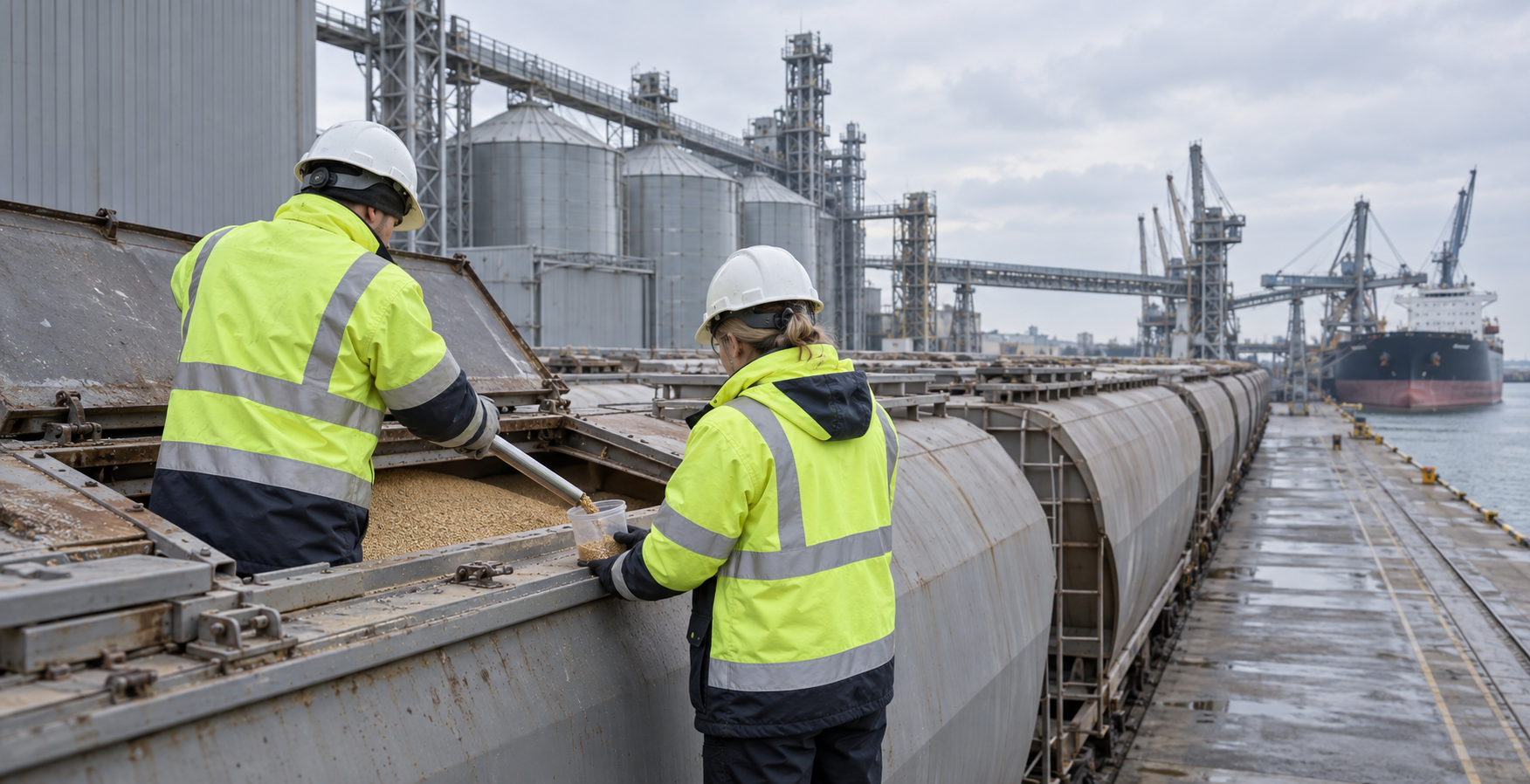
Latvia plans to substantially increase charges on the transit and handling of Russian and Belarusian grain, seeking to make the use of Latvian infrastructure economically unattractive. Following a coalition meeting on 7 September 2026, Prime Minister Andris Kulbergs announced a political agreement to pursue what has been described as a 300% tariff.
Businesses should note that the measure has not been adopted or entered into force. No draft legislation, calculation methodology, implementation date or complete list of affected services had been published when this article was prepared.
What has the coalition agreed?
The publicly stated objective is to increase charges on Russian and Belarusian grain cargoes, their transit and their handling through Latvian infrastructure. The purpose is not to increase public or port revenue but to make the route commercially unviable.
Coalition parties support increasing the tariffs, while discussions about a complete prohibition of Russian and Belarusian grain transit are continuing.
Latvia also wants a common Baltic approach. If restrictions applied in only one country, cargo could be redirected to Lithuanian or Estonian ports without materially reducing Russia’s overall export options.
Has the 300% tariff already been adopted?
No. It is currently a political agreement announced after a coalition meeting. No adopted law or government regulation presently requires companies to pay the new charge.
Before the measure can be applied, the authorities must determine:
- the products and Combined Nomenclature codes covered;
- whether the charge applies to transit, railway transport, port services, terminal handling or several stages simultaneously;
- which party is liable to pay;
- the amount on which the tariff will be calculated;
- the authority responsible for administration and enforcement;
- the entry-into-force date;
- how the mechanism complies with European Union law.
Does a “300% tariff” mean that costs will triple?
Public statements have used several different expressions: a “300% tariff”, a “threefold tariff” and an “increase of 300%”. These expressions are not mathematically identical.
- 300% of the current rate produces a final charge equal to three current rates.
- An increase of 300% adds three current rates to the existing rate, producing a fourfold final charge.
The actual cost increase cannot be calculated until a legally binding formula is published. Businesses should not base contracts or financial forecasts solely on the percentage used in political communications.
How does the plan differ from Latvia’s existing import ban?
Latvia already prohibits the import of a broad range of Russian and Belarusian agricultural and feed products for placement on the Latvian market. The applicable regulations identify the relevant Combined Nomenclature codes.
Importing goods into Latvia and moving them in transit to a third country are not the same legal operation. Goods under a customs-transit procedure may cross Latvia and be handled at a port without entering free circulation in the European Union.
The European Union’s increased tariffs on Russian and Belarusian agricultural products also concern imports into the EU market. When adopting earlier measures, the Council of the EU expressly stated that they did not affect transit through the EU to third countries.
Why is the legal mechanism still unclear?
The EU’s common commercial and customs policies are largely matters of EU competence. Latvia cannot simply introduce a separate national customs duty as if it were an ordinary domestic tax measure.
Public statements suggest that the intended solution may concern infrastructure and cargo-handling charges. Without draft legislation, however, it is impossible to determine whether the measure will be a public charge, a regulated infrastructure fee, increased port and terminal charges or a combination of instruments.
The legal structure will determine which businesses are affected, how the payment can be administered and whether it is compatible with EU law and transit rules.
How will the origin of grain be verified?
The government plans to strengthen transit-cargo inspections and cooperate with Ukrainian representatives and laboratories. The objective is to identify grain that may have been illegally removed from Russian-occupied Ukrainian territories and presented for export as Russian-origin goods.
A review of accompanying documents alone may not always be sufficient. Verification may require comparison of the document chain, producer, consignor, storage location, transport route and laboratory indicators.
No binding methodology has yet been published governing sample collection, the legal significance of laboratory results, inspection times or the procedure when origin cannot be reliably confirmed.
Which businesses could be affected?
- port terminals and stevedoring companies;
- rail-freight operators and infrastructure users;
- freight forwarders and customs representatives;
- warehouses, grain elevators and testing laboratories;
- ship agents and grain-cargo service providers;
- companies with contracts involving Russian or Belarusian-origin cargo.
The effects could also reach businesses that do not handle Russian or Belarusian cargo. Lower cargo volumes may change infrastructure utilisation, port revenue, demand for rolling stock and the pricing structure applied to other customers.
What should businesses do now?
- Identify contracts involving higher-risk cargo. Check origin, consignor, consignee, route and Combined Nomenclature code.
- Do not treat the tariff as already effective. A charge that has not been adopted cannot be added to invoices as a mandatory state tariff.
- Review price-adjustment clauses. Contracts should determine which party bears new fees, infrastructure charges and inspection costs.
- Prepare a complete origin-evidence chain. A single certificate may be insufficient where there are reasonable concerns about the documentation.
- Allow time for inspections. Sampling and laboratory testing may create storage costs and delays involving wagons or vessels.
- Monitor the legislative text. The real commercial impact can only be calculated after publication of the tariff base, liable party and entry date.
Frequently asked questions
Is a 300% tariff already in force in Latvia?
No. A coalition-level political agreement has been announced, but no legislation containing the precise implementation rules has yet been adopted and published.
Are Russian and Belarusian grain imports already prohibited?
Latvia’s existing rules prohibit the import of specified agricultural and feed products from Russia and Belarus. Transit to third countries is legally different from import into the Latvian or EU market.
Will the new tariff be a customs duty?
That is not yet known. Public statements also refer to infrastructure and cargo-handling tariffs. The legal form can only be determined after publication of draft legislation.
Would a 300% tariff mean a fourfold charge?
An increase of 300% produces a fourfold final charge, while a tariff equal to 300% of the current rate produces a threefold charge. Both descriptions have appeared publicly, so the legally binding formula must be awaited.
Will every transit shipment be inspected?
Plans have been announced for transit inspections and cooperation with Ukrainian laboratories, but no methodology governing selection, sampling and decision-making has been published.
Information updated on 8 September 2026. The article should be updated when draft legislation, the tariff methodology or the entry-into-force date is published.
Information sources
- Cabinet of Ministers: verification of transit-grain origin at Latvian ports
- Likumi.lv: agricultural and feed products prohibited from import into Latvia
- Council of the EU: higher tariffs on Russian and Belarusian grain products
- TV3 News: coalition agreement on higher transit tariffs
- Reuters: Latvia’s plan to restrict Russian and Belarusian grain transit
Comments
No comments yet. Yours could be the first!
Add a comment