
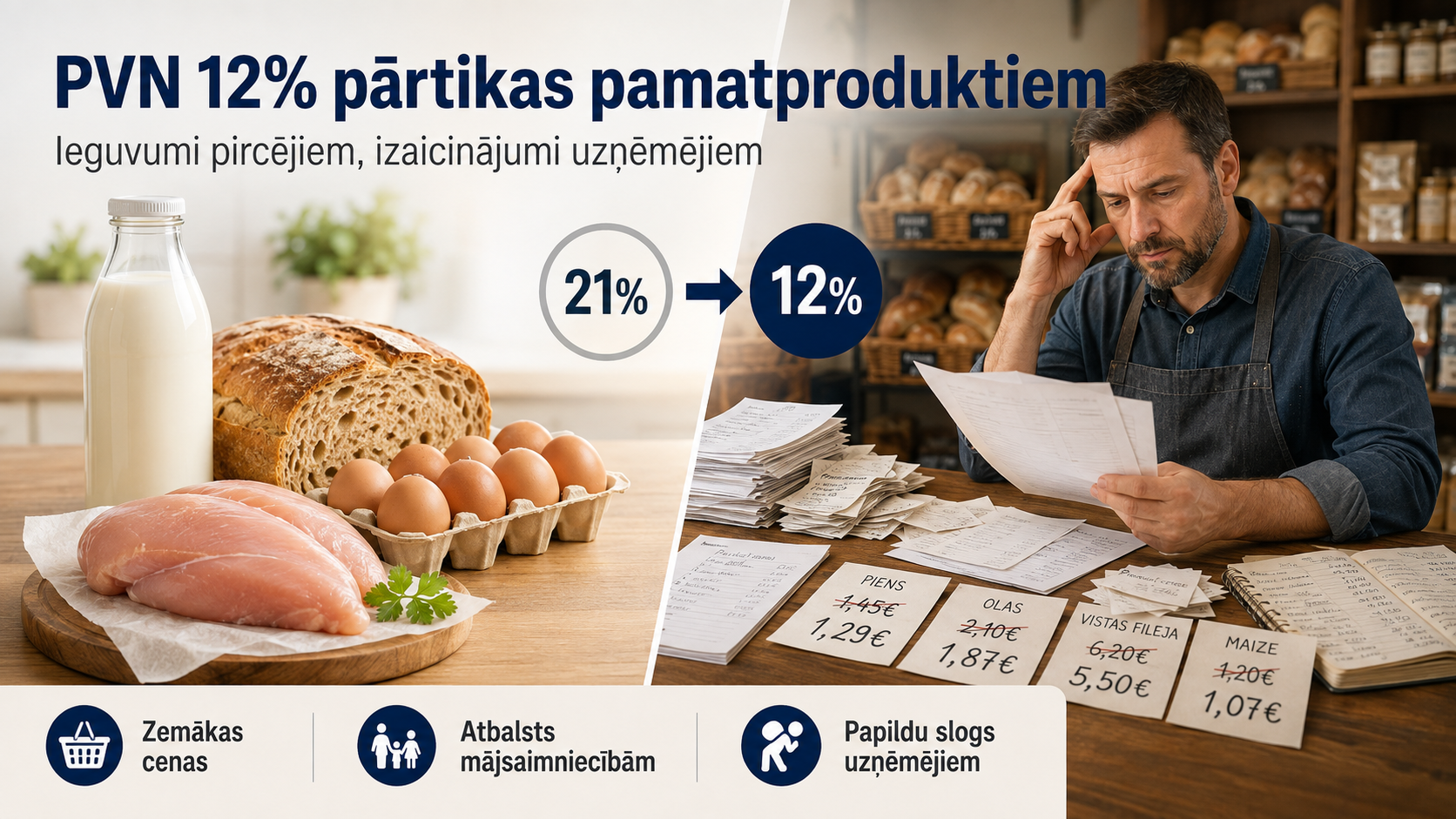
From 1 July 2026, Latvia applies a reduced value-added tax rate of 12% instead of the standard 21% rate to selected categories of basic food products. The measure has been introduced as a pilot project and, under the current legislation, applies until 30 June 2027.
The purpose of the change is to reduce the burden of everyday food prices on households. Consumers may benefit from lower prices, while producers, retailers, catering businesses and accountants must also manage new operational responsibilities and compliance risks.
Which products qualify for the 12% VAT rate?
The reduced rate does not automatically apply to every product containing the words “bread”, “milk”, “poultry” or “eggs”. Eligibility depends on the product description and the conditions set out in Annex 2 to the Latvian Value Added Tax Law.
- Bread – qualifying rye, wheat, mixed-flour, speciality, portion and flatbread categories, including certain products with permitted ingredients.
- Milk – fresh, sterilised or pasteurised cow’s, sheep’s or goat’s milk, including lactose-free milk.
- Poultry meat – fresh or chilled chicken, duck, turkey, goose, guinea fowl and quail meat and certain offal.
- Eggs – unprocessed poultry eggs in their shells.
Important exclusions
- Ultra-high-temperature, condensed and evaporated milk.
- Flavoured milk and plant-based drinks such as oat or almond drinks.
- Frozen poultry, sausages, smoked products and other processed meat products.
- Pastries, including buns, pies and croissants.
- Crispbread, rusks, toast, breadcrumbs and breadsticks.
In borderline cases, businesses should not rely solely on the commercial name of a product. Its ingredients, processing method and compliance with the statutory product description must be reviewed.
The positive side: potential for lower consumer prices
Reducing VAT from 21% to 12% does not mean that the shelf price automatically falls by nine per cent. If the net price remains unchanged and the full tax reduction is passed on to the customer, the gross price falls by approximately 7.4%.
For example, a product previously priced at EUR 2.00 including 21% VAT would cost approximately EUR 1.85 with 12% VAT if its net price remained unchanged.
Potential benefits for businesses
- Increased demand – a lower final price may support sales of qualifying food products.
- Greater price competitiveness – businesses can demonstrate the effect of the VAT reduction more clearly.
- Customer confidence – transparent price changes and correct VAT information on receipts reduce misunderstandings.
- Support for high-frequency product sales – the measure covers food groups that customers purchase regularly.
However, VAT is not the only factor affecting retail prices. Purchase costs, logistics, labour, energy, margins and other business expenses also influence the final price.
The other side: product classification risk
The most difficult task for businesses is distinguishing products that qualify for the 12% rate from similar products that remain subject to 21% VAT.
Pasteurised cow’s milk may qualify for the reduced rate, while UHT or strawberry-flavoured milk does not. Fresh or chilled chicken may qualify, while frozen poultry remains subject to the standard rate. Certain bread products qualify, while pastries and unbaked dough do not.
Incorrect classification may result in errors in receipts, invoices, VAT returns and inventory records. Businesses should therefore retain a clear basis for the VAT rate assigned to each product.
Updating accounting, retail and pricing systems
The new rate affects more than accounting software. It may require changes to cash registers, point-of-sale systems, inventory software, online shops, price labels, product catalogues, invoice templates and data exports provided to accountants.
Businesses should verify
- That the correct VAT rate has been assigned to every qualifying product.
- That receipts and invoices display the correct tax amount.
- That online and physical store prices remain consistent.
- That accounting exports separate 12% transactions from 21% transactions.
- That price labels, promotions and bundled offers have been reviewed.
- That employees understand how borderline products must be assessed.
What happens to stock purchased before 1 July?
The Latvian State Revenue Service has clarified that no special transition period applies to previously purchased inventory. If a product qualifies for the reduced rate and is supplied or sold after 1 July 2026, the 12% rate applies even if the business originally purchased it with 21% VAT.
Businesses therefore needed to switch the sales VAT rate for all qualifying inventory on the effective date.
A temporary rate requires planning for another transition
Under the current legislation, the reduced rate applies until 30 June 2027. Unless further amendments are adopted, businesses will need to review product tax rates, prices and system settings again after the pilot period.
Technical changes should therefore be implemented in a way that allows VAT rates to be updated centrally, reliably and with a clear audit history.
Conclusion: a lower rate requires more precise records
The reduced VAT rate may deliver a genuine benefit to consumers and create additional demand for businesses, but only when the rate is applied correctly and price changes are managed transparently.
The main task is not simply to replace the number 21 with 12. Businesses must classify products accurately, verify their systems, retain supporting information and ensure that correct data reaches their accountant.
A reduced tax rate may simplify the price for the customer, but inside the business it requires accurate product classification and controlled system updates.
Comments
No comments yet. Yours could be the first!
Add a comment