

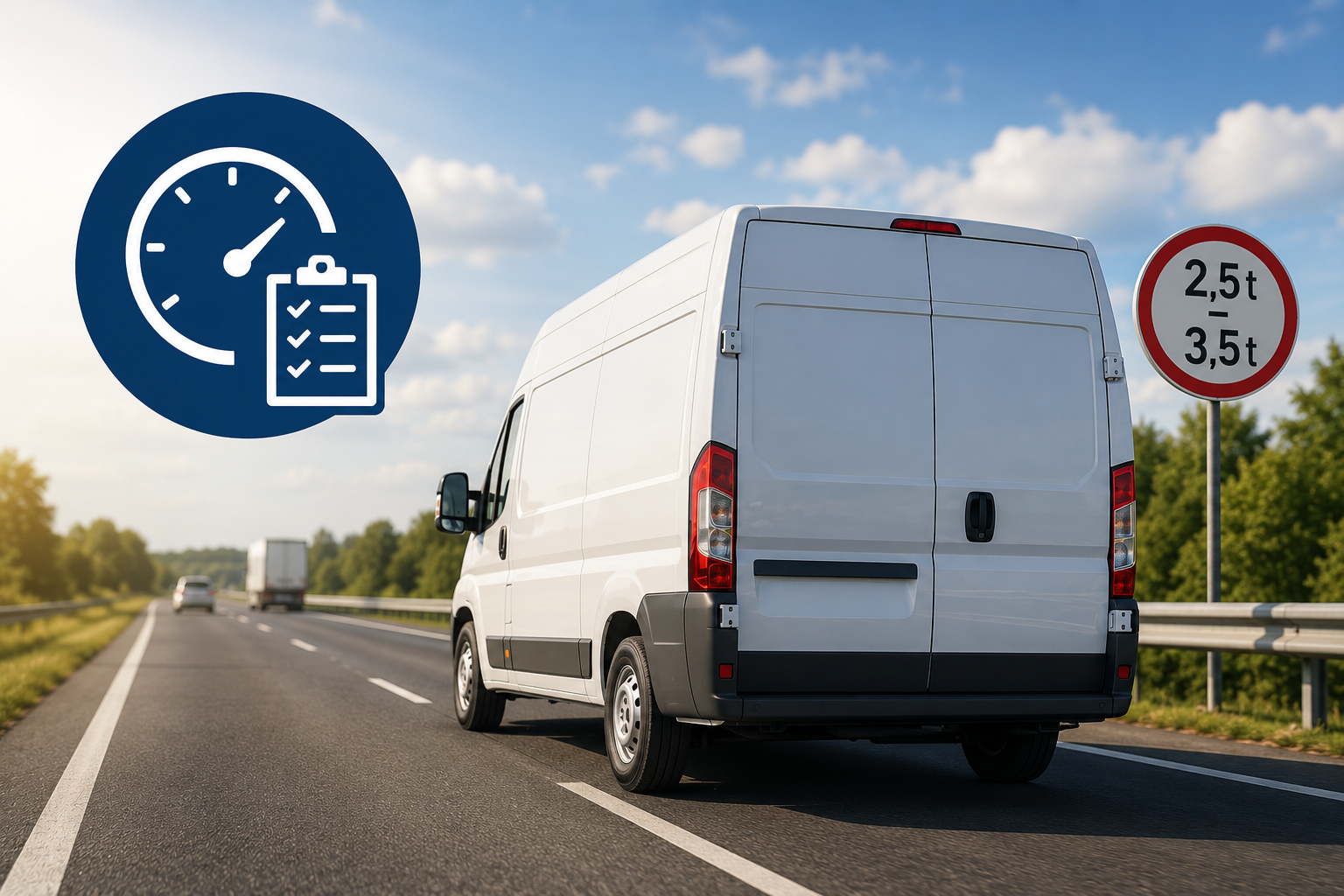
Since 1 July 2026, businesses using light commercial vehicles between 2.5 and 3.5 tonnes for international freight transport or cabotage for hire or reward have been subject to significantly stricter EU rules. Covered vehicles must use a G2V2 smart tachograph, drivers must comply with driving and rest-time rules, and driver-posting requirements may apply to certain transport operations.
On 24 August, Latvia's State Revenue Service specifically reminded businesses that the changes are not merely a technical transport requirement. They can also affect payroll, working-time records, business-trip and posting documentation and the correct calculation of taxes.
Which vehicles are covered by the new rules?
The new regime applies where the maximum permissible mass of the vehicle or vehicle combination, including any trailer or semi-trailer, exceeds 2.5 tonnes but does not exceed 3.5 tonnes, and it is used for international carriage of goods or cabotage for hire or reward.
This means that the weight of the van alone is not necessarily decisive. If a trailer is attached, the maximum permissible mass of the entire combination must be considered.
For vehicles in the 2.5–3.5 tonne category that operate exclusively within Latvia, this specific extension introduced on 1 July does not apply. Existing rules for heavier vehicles above 3.5 tonnes remain in force.
Are own-account business transports also covered?
Not always. EU legislation provides an exemption for vehicles between 2.5 and 3.5 tonnes where goods are transported on the company's or driver's own account, the transport is not carried out for hire or reward and driving is not the driver's main activity.
A separate exemption may also apply to vehicle combinations up to 7.5 tonnes carrying materials, equipment or machinery for the driver's work, or craft-produced goods, within a 100-kilometre radius of the undertaking's base, provided driving is not the driver's main activity and the transport is not performed for hire or reward.
A construction or service company transporting its own tools may therefore be in a different regulatory situation from a courier or transport company carrying a customer's goods for payment.
Which tachograph is required?
Vehicles falling within the new rules must be fitted with a second-generation version 2 smart tachograph, commonly referred to as Smart Tachograph G2V2.
The device records driving time, breaks, rest periods and other work. Drivers must use their driver card correctly and record their activities in accordance with the applicable rules.
How long may the driver drive?
- Normal daily driving time is limited to 9 hours.
- It may be extended to 10 hours no more than twice per week.
- Weekly driving time may not exceed 56 hours.
- Total driving time over two consecutive weeks may not exceed 90 hours.
- After 4.5 hours of driving, a break of at least 45 minutes is required.
- The 45-minute break may, under the rules, be split into a 15-minute and a 30-minute period.
The employer must organise work schedules in a way that allows drivers to comply with these limits in practice.
When is a driver considered posted to another country?
Not every international journey automatically constitutes posting.
A driver working for a Latvian operator who performs a normal bilateral operation from Latvia to another country or back to Latvia is generally not considered a posted driver. Transit through another country without loading or unloading also does not normally constitute posting.
Posting rules generally apply to cross-trade operations between countries where the operator is not established and to cabotage, where a foreign operator carries out domestic transport in another Member State.
What changes for remuneration and documentation?
Where a driver is considered posted, the applicable remuneration and employment conditions of the host Member State must be taken into account.
Before the posting starts, the operator must submit a posting declaration through the EU Road Transport Posting Declaration portal. During roadside controls, the driver may need to present a copy of the declaration, evidence of the transport operation and tachograph records.
Latvia's State Revenue Service has highlighted that employers must maintain correct records of working time, remuneration, business trips and postings because these elements may also affect tax calculation and reporting.
What should businesses check now?
- Check the maximum permissible mass of every vehicle and combination, including trailers.
- Identify vehicles used for international commercial transport or cabotage.
- Confirm that affected vehicles have a Smart Tachograph G2V2 installed.
- Ensure drivers have valid driver cards and know how to record activities correctly.
- Review driving, break and rest-time schedules.
- Classify routes as bilateral, cross-trade or cabotage operations.
- Prepare posting declarations and supporting documents where required.
- Review remuneration, business-trip and posting records with the company's accountant or payroll specialist.
- Confirm that the operator also holds the required Community licence and certified copy for international commercial freight operations.
Why should businesses take the change seriously?
Many vans below 3.5 tonnes previously operated outside the tachograph and driving-time regime commonly associated with heavy goods vehicles. For international commercial transport, the relevant threshold has now effectively been extended down to vehicles exceeding 2.5 tonnes.
A company that still treats such a vehicle simply as an ordinary van may therefore face compliance issues involving not only the tachograph but also working time, posting, remuneration and documentation.
The key question is no longer simply “how much does our van weigh?”, but “what are we transporting, where are we transporting it, for whom and for what remuneration?”.
Frequently asked questions
Does every van over 2.5 tonnes now need a tachograph?
No. The rules apply to specified international freight and cabotage operations. Vehicle weight, the type of transport and whether it is carried out for hire or reward must all be considered.
Does the trailer count towards the weight threshold?
Yes. The regulation considers the maximum permissible mass of the vehicle including any trailer or semi-trailer.
Does the new 2.5-tonne threshold apply to domestic transport?
No. The specific extension from 1 July 2026 applies to international carriage of goods and cabotage. Domestic-only operations in the 2.5–3.5 tonne category are not covered by this particular extension.
Does transporting a company's own goods always require a tachograph?
No. EU legislation provides an exemption for certain own-account transport where no hire-or-reward service is provided and driving is not the driver's main activity.
Do posting rules apply every time a driver crosses an EU border?
No. Bilateral operations and transit are generally outside the posting regime, while cross-trade and cabotage operations are generally covered.
Sources
- Latvian State Revenue Service – new requirements for light commercial vehicles in international transport, 24 August 2026.
- Road Transport Administration of Latvia – guidance on tachograph requirements for vehicles above 2.5 tonnes.
- European Labour Authority – Light Commercial Vehicles 2026 guidance on driving and rest times, smart tachographs and posting of drivers.
- European Commission – Mobility Package I guidance on tachographs and driver posting.
- Regulation (EC) No 561/2006 and Regulation (EU) No 165/2014.
Comments
No comments yet. Yours could be the first!
Add a comment