

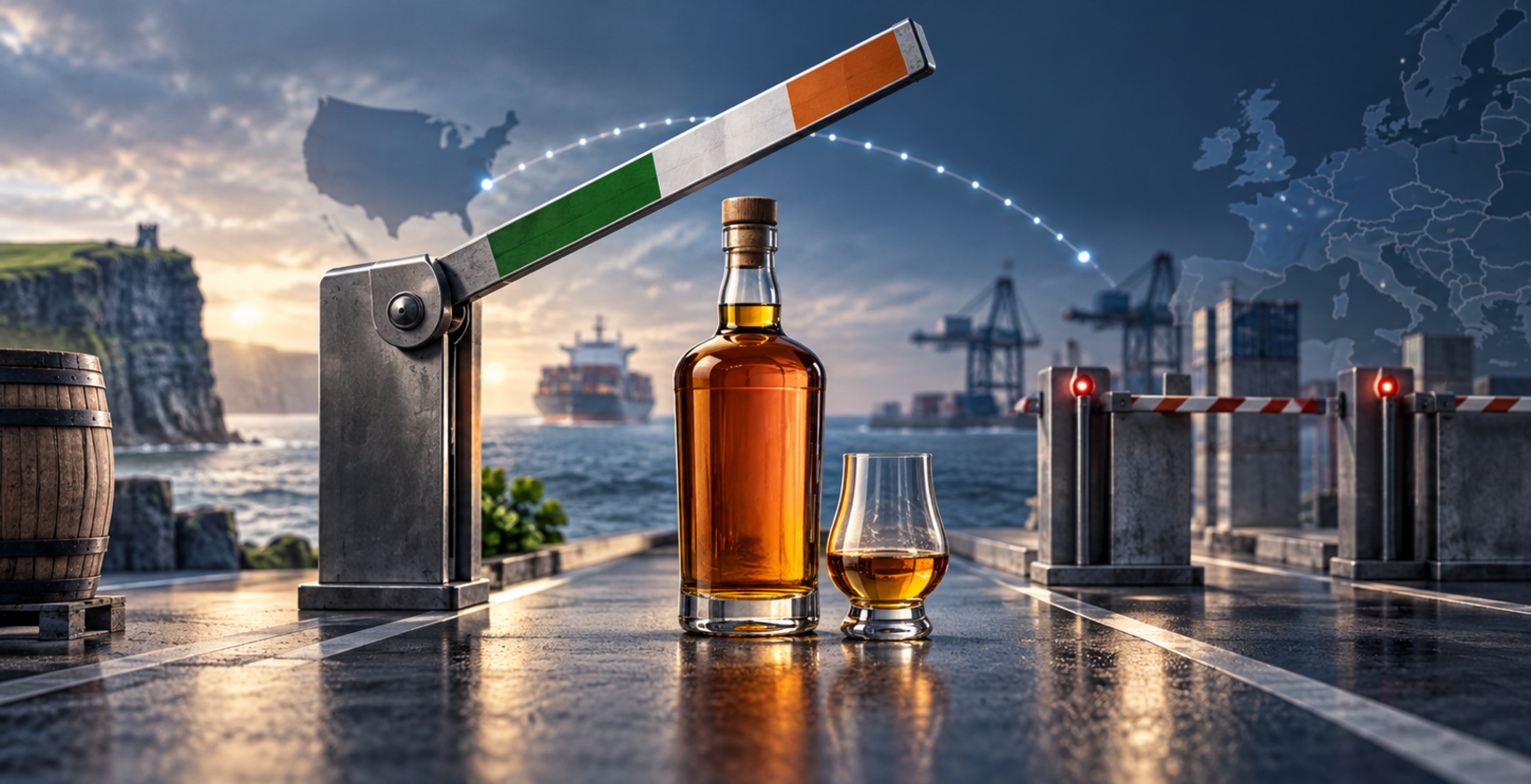
Short answer: U.S. President Donald Trump publicly pledged on 13 September 2026 to remove the 10% tariff on Irish whiskey. This is a significant political signal for Irish producers, but at the time of the announcement neither an implementation date nor a legal instrument changing the customs regime had been published. The tariff therefore cannot yet be treated as effectively removed.
What exactly did Trump announce?
Trump announced the plan at the closing ceremony of the Irish Open golf tournament in Doonbeg after meeting Irish Prime Minister Micheál Martin. According to Reuters and the Associated Press, he said the tariff on Irish whiskey would be removed. The product currently faces a 10% U.S. tariff rate applied within the broader regime covering EU imports.
The Irish whiskey industry welcomed the statement and renewed its call for the restoration of a reciprocal zero-tariff regime for alcoholic drinks traded between the EU and the United States. The industry's response, however, does not itself change the customs rate.
Has the 10% tariff already been removed?
No — at least its practical implementation has not yet been publicly confirmed. The Associated Press reported that details on how soon the removal could take effect were not immediately available. Industry representatives also stressed that they were waiting for the announcement to be fully implemented.
For businesses, the decisive step will not be the political statement but a published U.S. decision and customs implementation terms: the effective date, precise product scope, rules of origin and relevant customs codes. Until then, exporters and importers should not automatically revise prices or promise tariff-free deliveries to customers.
Does this signal a broader U.S. retreat from tariffs on EU goods?
Not at this stage. The announcement concerns one specific product group and Irish origin. It does not remove U.S. tariffs on EU wine, other spirits or any other categories of goods.
The move may be viewed as a possible precedent in political negotiations because individual industries could use the Irish example to seek similar exemptions. That is an analytical conclusion, however, not an adopted U.S. decision on further relief. Every other product would require a separate political and legal solution.
Why did Irish whiskey face a competitive imbalance?
The United States had previously granted tariff relief to U.K. whiskey. This covers Scotch and drinks produced in Northern Ireland, while whiskey produced in the Republic of Ireland retained the 10% tariff. Similar products therefore entered the U.S. market with different customs burdens depending on their origin.
What does this mean for Latvian businesses?
The direct impact on most Latvian companies is limited. The change would matter to businesses involved in Irish whiskey supply chains, distribution, logistics or exports to the United States. The announcement itself creates no new tariff relief for Latvian producers.
Latvian exporters should nevertheless follow how the precedent develops. If the United States begins granting more product- or country-specific exemptions, competitive conditions could shift both within the EU single market and in the U.S. export market. This is particularly relevant in sectors where a 10% price difference can materially affect the allocation of orders.
Practical checklist for exporters
- do not assume the tariff has been removed solely on the basis of a public pledge;
- verify the official effective date and covered customs codes;
- check whether any relief covers goods already in transit or held in a bonded warehouse;
- state clearly in contracts which party bears customs charges and the risk of tariff changes;
- do not apply an Irish exemption to other goods of EU origin without a separate legal basis.
Conclusion
Trump's pledge is important to the Irish whiskey industry and may provide momentum for broader EU–U.S. talks on drinks tariffs. As of 14 September 2026, however, the accurate wording is “pledges to remove”, not “the tariff has been removed”. A genuine market change can be confirmed only after legally binding terms and a customs implementation date have been published.
Comments
No comments yet. Yours could be the first!
Add a comment