

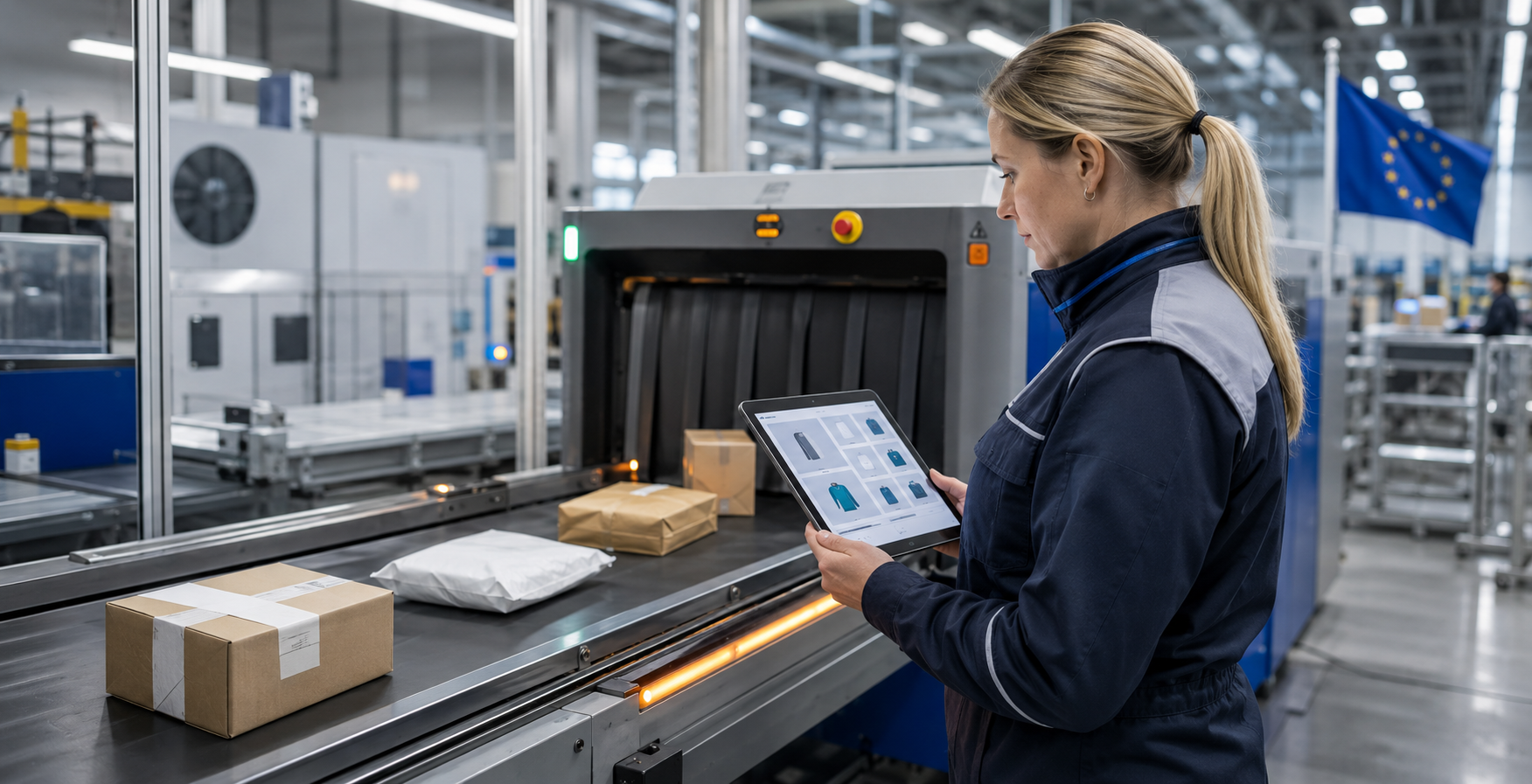
The EU customs reform will fundamentally change who is responsible for goods sold from non-EU countries to consumers in the European Union. Customs formalities, payments and certain product-compliance obligations will no longer simply be left to the final customer. A seller or e-commerce platform facilitating a cross-border distance sale may be treated as the importer.
However, the entire reform is not yet in force. The Council of the EU approved the final text on 3 September 2026, while approval by the European Parliament in plenary is expected later in September. The legislation must then be signed and published in the Official Journal of the European Union.
What is already in force and what is still pending?
- Already in force: since 1 July 2026, a temporary €3 customs duty has applied to low-value e-commerce consignments from non-EU countries for each different product category according to its customs tariff classification.
- Not yet fully adopted: the new Union Customs Code, including the system under which platforms may be treated as importers.
- Included in the reform text: an EU-wide handling fee for small consignments, to be introduced by member states no later than 1 November 2026. The Commission has not yet set its amount.
- From 1 July 2028: use of the new EU Customs Data Hub is expected to become mandatory for e-commerce businesses.
The temporary €3 customs duty and the planned handling fee must therefore not be treated as a single charge. They are separate instruments with different purposes and calculation rules.
What does treating a platform as the importer mean?
Where a non-EU business sells goods directly to an EU consumer through an online platform, the seller or the platform facilitating that distance sale may be treated as the importer for customs purposes.
The responsible company will have to ensure:
- submission of the necessary product and transaction data to customs authorities;
- correct product classification, customs value and origin information;
- payment or guarantee of customs duties and other applicable charges;
- compliance of the goods with applicable EU product-safety and other requirements;
- an establishment in the EU or an appropriate EU-based representative.
The objective is to ensure that customs costs and documentation are handled before delivery instead of the customer discovering additional formalities only when the parcel arrives.
This does not mean that importing becomes free for the consumer. A platform may incorporate the costs into the product price or delivery charge. What changes is the legally responsible party and the point at which the charges are administered.
How does the temporary €3 customs duty work?
Since 1 July 2026, the previous customs-duty relief for low-value e-commerce consignments has been replaced by a temporary €3 duty. It is intended to remain in place until 1 July 2028, after which the normal EU customs tariffs applicable to the respective products will apply.
The €3 is calculated neither for the whole parcel nor simply for every physical unit. It applies to every different category of goods in the consignment according to tariff classification.
- Five identical T-shirts in one consignment – €3 if they share the same tariff classification.
- One T-shirt and one watch – €6 because the consignment contains two different product categories.
The duty generally applies to distance-sales consignments with a value not exceeding €150, subject to the exceptions provided by the legislation. It does not replace import VAT and is not the same as an administrative charge imposed by a postal operator, courier or customs representative.
What is known about the new handling fee?
The reform text approved by the Council provides for a separate EU-wide handling fee to cover the cost of supervising the rapidly increasing number of small e-commerce consignments.
Member states would begin collecting the fee when the required information system becomes operational and, in any event, no later than 1 November 2026. The Commission must still determine the amount and practical application of the fee.
It is therefore not currently accurate to claim that the final fee will be €2 or any other specific amount. Publicly discussed estimates are not the same as a rate formally established by the Commission.
What penalties could platforms face?
The reform introduces stronger liability for businesses that systematically or repeatedly fail to comply with customs and product-compliance requirements.
In the most serious cases, the consequences may include:
- a fine of up to 6% of the total value of goods imported into the EU during the previous 12 months;
- suspension or withdrawal of authorised economic operator or trusted-trader privileges;
- classification of the company as a high-risk operator;
- in cases of repeated and systematic non-compliance, restrictions on access to the online platform.
The 6% figure is not an automatic penalty for a single incorrect commodity code. It is intended for the most serious cases, while the actual penalty will depend on the nature, frequency and legal assessment of the infringement.
What will the reform mean for Latvian businesses?
Latvian online stores importing goods
Businesses will need stronger control over commodity codes, origin, customs value, manufacturer and product identifiers, and compliance documentation. Incorrect platform data may become not only a cause of delivery delays but also a source of financial liability.
Businesses purchasing through non-EU platforms
Businesses should verify whether customs charges are collected at checkout, who acts as the declarant and whether invoices separately identify the product price, VAT, customs duty and other charges. This is particularly important where the goods will be resold in Latvia.
Latvian retailers sourcing goods from EU warehouses
If goods have already been imported and released for free circulation in the EU, their subsequent delivery from another member state is not itself a new import. However, the business should be able to document the supply chain and verify that the original import was carried out correctly.
Businesses operating their own marketplace
The company should assess whether it merely displays listings or actively facilitates distance sales by controlling the order, payment or delivery process. Whether importer obligations may apply will depend on the platform’s actual role in the transaction.
Will the reform also benefit businesses?
The reform is not solely an enforcement measure. The EU Customs Data Hub is intended gradually to replace fragmented national customs systems, allowing companies to submit information through one environment and reuse it for multiple consignments.
The most reliable companies will be able to use the simplified Trust and Check regime and face fewer inspections. The existing authorised economic operator, or AEO, status will also remain available so that customs simplifications are not limited to the largest market participants.
What should businesses do now?
- Identify the seller, declarant and importer in every supply model.
- Check commodity codes, origin, customs value and product identifiers.
- Separate the €3 customs duty, import VAT, courier administration charges and the planned EU handling fee.
- Review contracts with platforms, logistics providers and customs representatives.
- Prepare systems for transferring structured product and supply-chain data.
- Monitor the European Parliament vote and the Commission’s decision on the handling fee.
Frequently asked questions
Is the entire EU customs reform already in force?
No. The Council has approved the final text, but as of 4 September 2026, approval by the European Parliament in plenary, signature and publication in the Official Journal are still pending.
Does the €3 customs duty already apply?
Yes. The temporary €3 customs duty has applied since 1 July 2026. It is a separate measure that has already been adopted.
Is €3 charged for every product in a parcel?
Not necessarily. The duty is calculated according to different tariff categories, not simply the number of physical units. Several identical goods under one classification may attract one €3 duty.
Will buyers have to bear the new costs?
Legal payment responsibility will move to the seller, platform or other responsible declarant. Businesses may nevertheless reflect these costs economically in product prices or delivery charges.
Will the new requirements apply to goods purchased from another EU country?
Not where the goods have already been properly imported and released for free circulation in the EU. The reform primarily concerns goods entering the Union from non-EU countries.
Information current as of 4 September 2026. The content and implementation dates should be checked again after the European Parliament vote and publication of the legislation.
Comments
Izskaidrojošs raksts ar noderīgu informāciju par muitas reformu!
Paldies!
Add a comment