

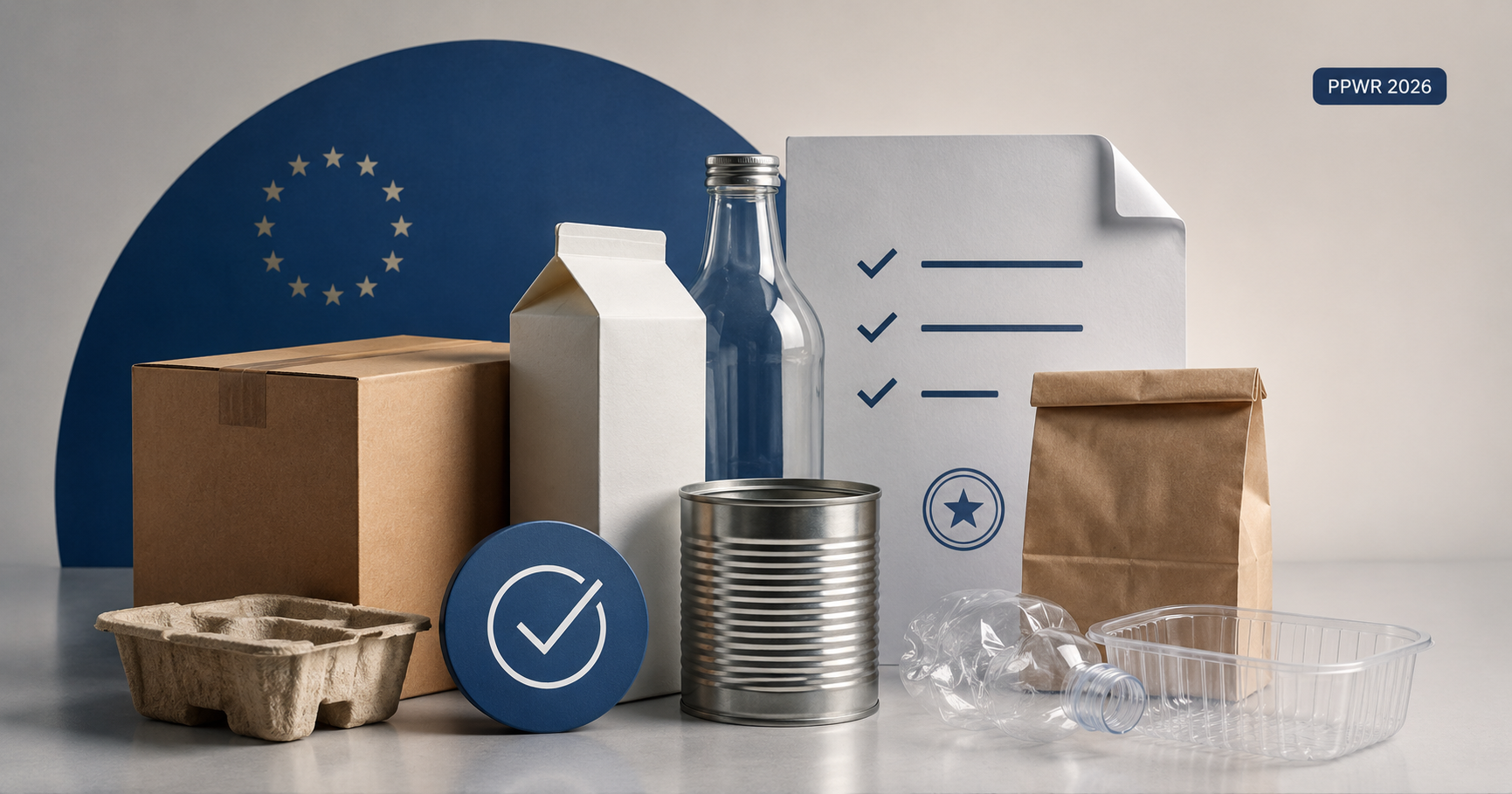
From 12 August 2026, Regulation (EU) 2025/40 on packaging and packaging waste, commonly known as the PPWR, becomes generally applicable across the European Union. It introduces a more harmonised framework covering the production, placing on the market, composition, documentation, recyclability and life cycle of packaging.
The PPWR is sometimes described as a “new packaging tax”. This is misleading. The Regulation itself does not introduce a uniform EU tax that every company must pay from 12 August 2026 for each kilogram of packaging it places on the market.
For businesses, the most immediate changes concern demonstrating packaging compliance, maintaining documentation, ensuring traceability and complying with restrictions on certain substances.
What is the PPWR?
The PPWR is an EU regulation establishing common rules for packaging and packaging waste across the European Union. It aims to reduce unnecessary packaging, improve recyclability, encourage reuse and reduce the presence of substances of concern.
What changes for businesses from 12 August 2026?
The obligations are not identical for every business. They depend on whether the company acts as a manufacturer, importer, distributor or another economic operator defined by the Regulation.
Businesses should pay particular attention if they manufacture packaging, have packaging manufactured under their own name or trademark, import packaged products from outside the EU or package and market their own products.
Technical documentation and the EU declaration of conformity
A key principle of the PPWR is that manufacturers must be able to demonstrate that packaging complies with the applicable requirements of the Regulation.
Where the manufacturer obligations apply, technical documentation must be prepared and an EU declaration of conformity issued.
How long must the documentation be retained?
- Non-reusable packaging – technical documentation must generally be kept for five years after the packaging is placed on the market.
- Reusable packaging – the retention period is ten years.
This means that relevant businesses need a systematic process for obtaining, linking and retaining information from packaging and material suppliers.
Packaging must be identifiable
The PPWR also introduces traceability requirements. Manufacturers must ensure that packaging carries a type, batch or serial number, or another element allowing it to be identified.
Where the size or nature of the packaging does not allow the information to be placed directly on it, the relevant information may in certain cases be provided in accompanying documentation.
Food-contact packaging and PFAS
One requirement applying from 12 August 2026 concerns packaging intended to come into contact with food.
Food-contact packaging may not be placed on the market if the concentration of per- and polyfluoroalkyl substances, or PFAS, reaches or exceeds the limit values established by the Regulation.
Businesses dealing with food therefore need to pay particular attention to the composition of packaging materials, coatings and other components.
Who should pay particular attention?
- Food manufacturers.
- Catering businesses using their own packaging.
- Food-packaging manufacturers and suppliers.
- Importers of packaged food or packaging from outside the EU.
- Private-label businesses.
Will there be a new packaging tax from 12 August?
No. The PPWR itself does not introduce a new uniform EU packaging tax on businesses.
Latvia already has national rules concerning packaging, including the natural resources tax and extended producer responsibility systems.
Businesses placing relevant products on the Latvian market for the first time may, subject to the applicable national rules, qualify for an exemption from natural resources tax by participating in an authorised extended producer responsibility system.
These Latvian tax and waste-management obligations should not be confused with the new EU packaging-compliance requirements under the PPWR.
What about the EUR 0.80 per kilogram of plastic?
The EU budget contribution based on non-recycled plastic packaging waste is also not a new PPWR tax introduced in August 2026.
This EU own resource has existed since 1 January 2021 and is calculated using a call rate of EUR 0.80 per kilogram of non-recycled plastic packaging waste.
Importantly, it is a contribution by Member States to the EU budget rather than a new uniform PPWR invoice directly charged to every business for each kilogram of plastic packaging it uses.
What should businesses do now?
Companies should first determine their role in the packaging supply chain and identify which PPWR obligations apply to them.
Practical checklist
- Determine your role – manufacturer, importer, distributor or another regulated economic operator.
- Map your packaging – identify materials, suppliers and how each type of packaging is used.
- Organise supplier documentation – obtain the information required to assess compliance.
- Review food-contact packaging – with particular attention to the PFAS restrictions.
- Establish traceability – packaging should be linkable to the relevant documentation.
- Create a retention process – reflecting the applicable five- or ten-year periods.
- Separately review Latvian tax and EPR obligations – the PPWR does not automatically replace them.
Which businesses may be most affected?
- E-commerce businesses packaging goods for customers.
- Manufacturers using packaging for their own products.
- Importers from outside the European Union.
- Food manufacturers and catering companies.
- Private-label businesses.
- Companies ordering customised branded packaging.
Conclusion: not simply a new tax, but a new level of compliance
For Latvian businesses, 12 August 2026 does not simply mark the introduction of a new “packaging tax”. The more significant change is the EU-wide shift towards stricter and more harmonised requirements governing packaging and the evidence businesses must maintain to demonstrate compliance.
For a business using standard packaging purchased from established suppliers, the immediate priority may be obtaining the necessary documentation and confirming its legal role. Manufacturers, importers and private-label businesses may face significantly broader obligations.
At the same time, Latvia's natural resources tax and extended producer responsibility system continue to operate alongside the PPWR.
The key PPWR question for a business is not simply “how much will I pay per kilogram?”, but “can I demonstrate that my packaging complies with the new requirements?”.
Comments
No comments yet. Yours could be the first!
Add a comment