

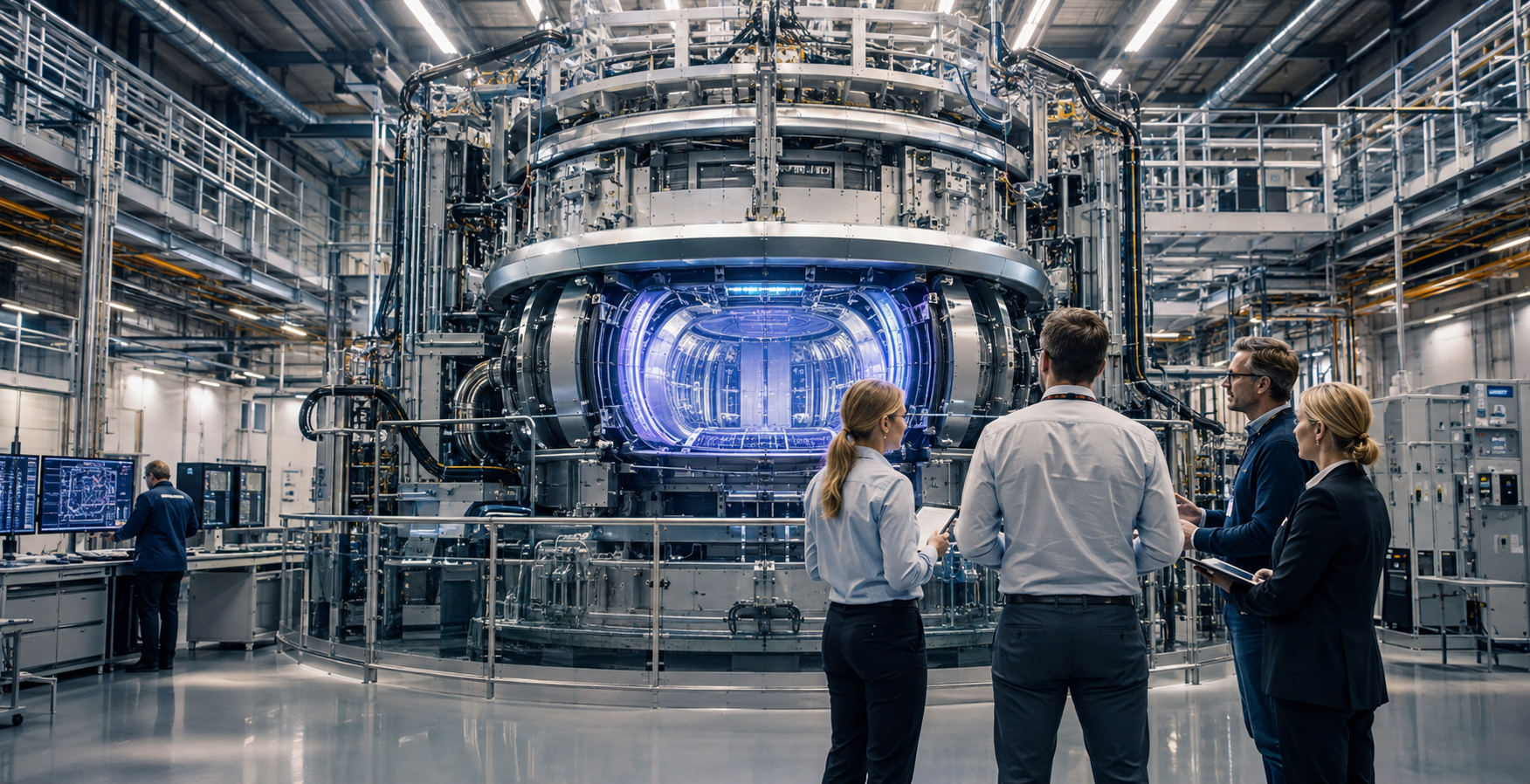
Italian energy company Eni is targeting the development of a commercial fusion power plant in Europe by the early 2040s or potentially earlier. Although no final location, investment budget or construction schedule has yet been confirmed, Eni is already investing in the technology, signing long-term power purchase agreements and developing infrastructure needed to industrialise fusion energy.
Why is Eni's interest in fusion significant?
For decades, fusion has primarily been associated with scientific research and experimental physics. That is beginning to change as energy companies increasingly examine how the technology could be transformed into commercial electricity generation.
Eni has invested in US-based Commonwealth Fusion Systems, or CFS, since 2018. CFS was created by researchers connected with the Massachusetts Institute of Technology and is developing magnetic-confinement fusion technology.
CFS ultimately aims to begin supplying electricity from its first industrial-scale ARC fusion power plant in the United States in the early 2030s.
Is fusion electricity already commercially available?
No. There is currently no commercial fusion power station continuously supplying electricity to the public grid.
Eni's early-2040s objective should therefore be understood as a strategic target rather than a guaranteed opening date. The technology must still demonstrate not only physical performance but also long-term reliability, economic competitiveness, safety and the ability to build and operate plants at industrial scale.
How is fusion different from conventional nuclear power?
Today's nuclear power stations generate energy by splitting heavy atomic nuclei through nuclear fission. Fusion uses the opposite principle: light atomic nuclei, typically hydrogen isotopes such as deuterium and tritium, are combined at extremely high temperatures.
The reaction can release very large amounts of energy. Fusion itself does not produce carbon dioxide during electricity generation, but commercial plants would still require highly complex infrastructure, careful management of radioactive tritium and materials capable of surviving intense neutron exposure.
Why is Commonwealth Fusion Systems attracting major investment?
CFS uses high-temperature superconducting magnets capable of generating extremely strong magnetic fields. The objective is to confine the fusion plasma within a more compact reactor than many earlier fusion designs.
The company's first planned industrial-scale ARC power station in Virginia is designed for approximately 400 MW of electricity generation and is expected to target grid connection in the early 2030s.
Eni has already signed a power purchase agreement worth more than $1 billion with CFS. This means Eni is not only supporting development of the technology but is also helping establish a future commercial market for the electricity it could produce.
Why is the fusion fuel cycle a major challenge?
One important challenge is tritium. Deuterium can be extracted from water, while tritium is extremely scarce in nature. Commercial fusion plants would therefore require systems capable of efficiently producing, recovering, purifying and recycling tritium.
In 2026, Eni and the UK Atomic Energy Authority created the RH3OVA joint venture to develop services and technologies for the fusion fuel cycle. Separately, the H3AT tritium facility in the United Kingdom is expected to be completed by 2028 to support testing of tritium processing, storage and recycling technologies.
What could commercial fusion change for Europe's economy?
If fusion becomes commercially viable, its economic impact could extend far beyond electricity generation. A new industrial supply chain could emerge around superconductors, specialised materials, engineering, construction, energy equipment, fuel management and technical services.
In theory, fusion could provide Europe with a stable low-carbon electricity source while reducing dependence on imported fossil fuels. This could be particularly important for energy-intensive manufacturing, data centres and other sectors that require continuous electricity supply.
Would fusion mean cheap and unlimited electricity?
It is far too early to make that assumption. The potential fuel supply may be extensive, but the plants themselves are expected to be technologically complex and capital intensive.
The final cost of electricity will depend on construction costs, equipment lifetime, maintenance requirements, the fuel cycle, regulation and how reliably a plant can operate.
The critical commercial question is therefore no longer only whether fusion can work in a laboratory. It is whether fusion can ultimately produce electricity at a cost that customers and energy markets are willing to pay.
Frequently asked questions
When does Eni want a fusion power plant in Europe?
Eni's current ambition is to have a commercial European fusion plant in operation by the early 2040s or earlier. A final location and construction timetable have not yet been publicly confirmed.
Is there already a commercial fusion power station?
No. Experimental machines and the first industrial-scale projects are still under development.
Is fusion the same technology used in current nuclear power plants?
No. Existing nuclear plants use fission, while fusion combines light atomic nuclei to release energy.
Why should businesses care about fusion today?
A new investment and industrial supply chain is already beginning to form around fusion. If the technology reaches commercial scale, it will require engineering, construction, materials, IT, specialised energy equipment, fuel-cycle services and many other business capabilities.
Sources
- Reuters – report on Eni's ambition to develop commercial fusion power in Europe, 23 August 2026.
- Eni – information on its partnership with Commonwealth Fusion Systems and the ARC project.
- Eni and Commonwealth Fusion Systems – information on their power purchase agreement worth more than $1 billion.
- Eni and UK Atomic Energy Authority – information on RH3OVA and development of the fusion fuel cycle.
Comments
No comments yet. Yours could be the first!
Add a comment