

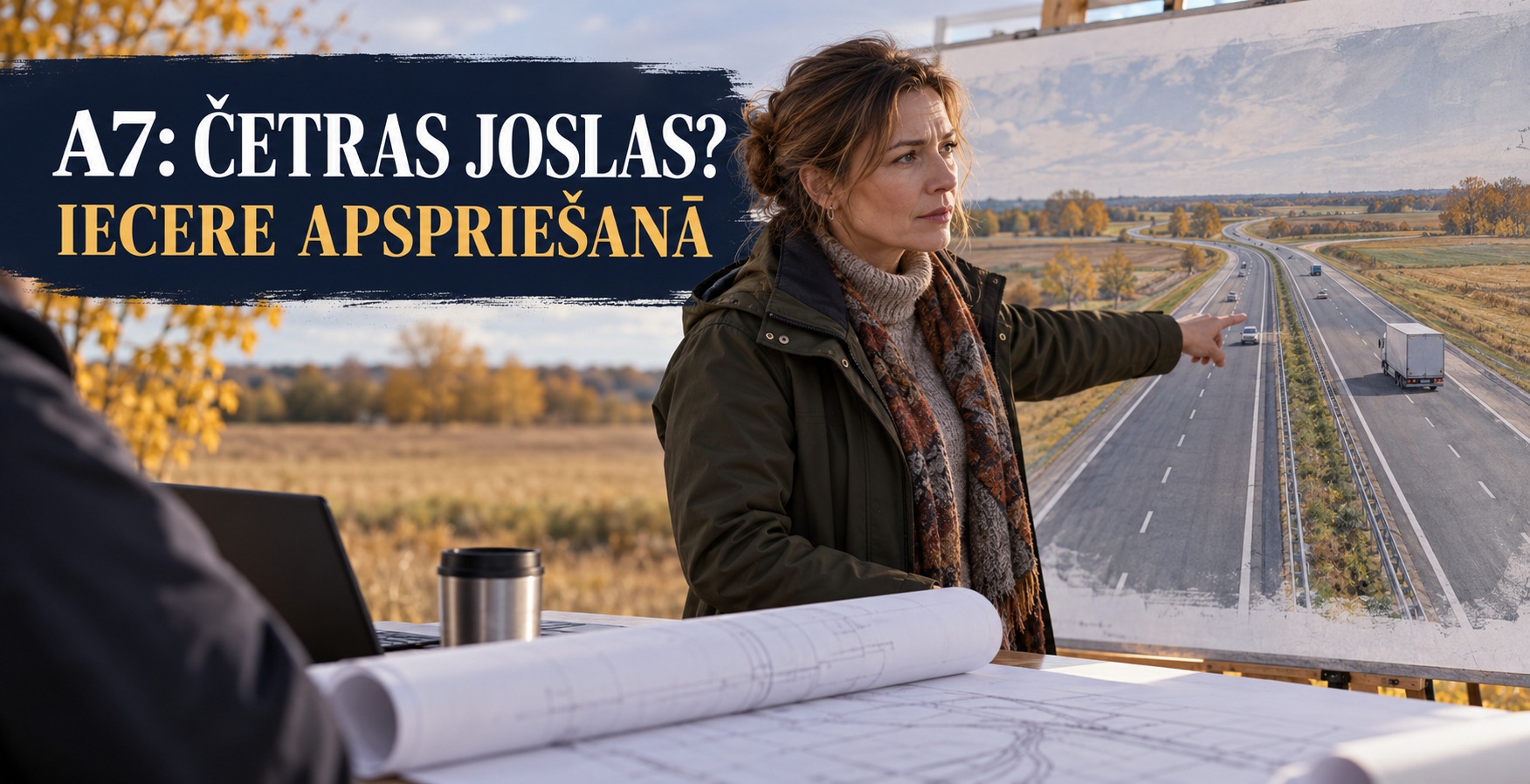
The A7 consultation meeting is on 3 November 2026 at 18:00 at Ceraukste community hall. Comments go to the State Environmental Service (VVD) at pasts@vvd.gov.lv by 13 November inclusive. Check the organiser’s news section for remote participation details.
What road is currently proposed?
The project description proposes approximately 14.3 km and four lanes from the end of the Bauska bypass to Lithuania. The stated 120 km/h is a planned design parameter, not today’s speed limit.
One option bypasses Ceraukste on a new alignment; the other widens the existing road through the village. Both then rebuild the existing road towards the border.
Consultation does not mean construction has started
The VVD decision requires an environmental impact assessment (EIA). Initial consultation helps identify matters for further study. The documents reviewed do not confirm a construction start date or secured construction funding.
A business investment plan should therefore distinguish existing infrastructure, the option under discussion and implementation dates that remain unknown. Consultation on a proposal is not, by itself, a basis for promising a customer faster deliveries after a particular date.
Why does the last kilometre matter to a business?
Komercreģistrs analysis: a haulier needs to consider the whole route to the unloading point, not just speed on the main road. A factory, warehouse or farm should check whether proposed connections would allow convenient access from both directions and turning manoeuvres for its vehicles.
For a local shop or service business, customer access may also matter. Employees need a route from their bus stop or home. These are questions to examine, not a claim that any access has already been removed or that a particular business will suffer losses.
What should you prepare before taking part?
The editorial team’s practical checklist:
- Mark your property and the entrance actually used; attach a diagram or photograph.
- List regular delivery directions, vehicle dimensions and seasonal peaks in activity.
- Compare both options: where could access, crossing points or connections to neighbouring properties change?
- Ask about access during possible construction, including for emergency services and employees.
- Describe noise, dust, drainage and connections between fields as separate issues.
A measurable question is more useful than a general objection
Illustrative editorial example: if an alternative access route added 4 km to each trip and a business made 15 trips a day, the difference would be 60 km a day. This is not a calculation for the specific A7 project; it demonstrates how to explain a concern.
Separate current data, assumptions and the explanation requested in your submission. Identify the location on the map and the solution you would like considered. Keep the document sent and evidence of submission. A precise question makes it possible to compare the eventual answer with the design. Bring a specific list of questions to the meeting so the discussion goes beyond general support for or opposition to the project.
When assessing a business in our business listings, also check access to its operating site. Our services overview covers company formation and change documents; it does not replace examination of the road project or property.
Comments
No comments yet. Yours could be the first!
Add a comment