

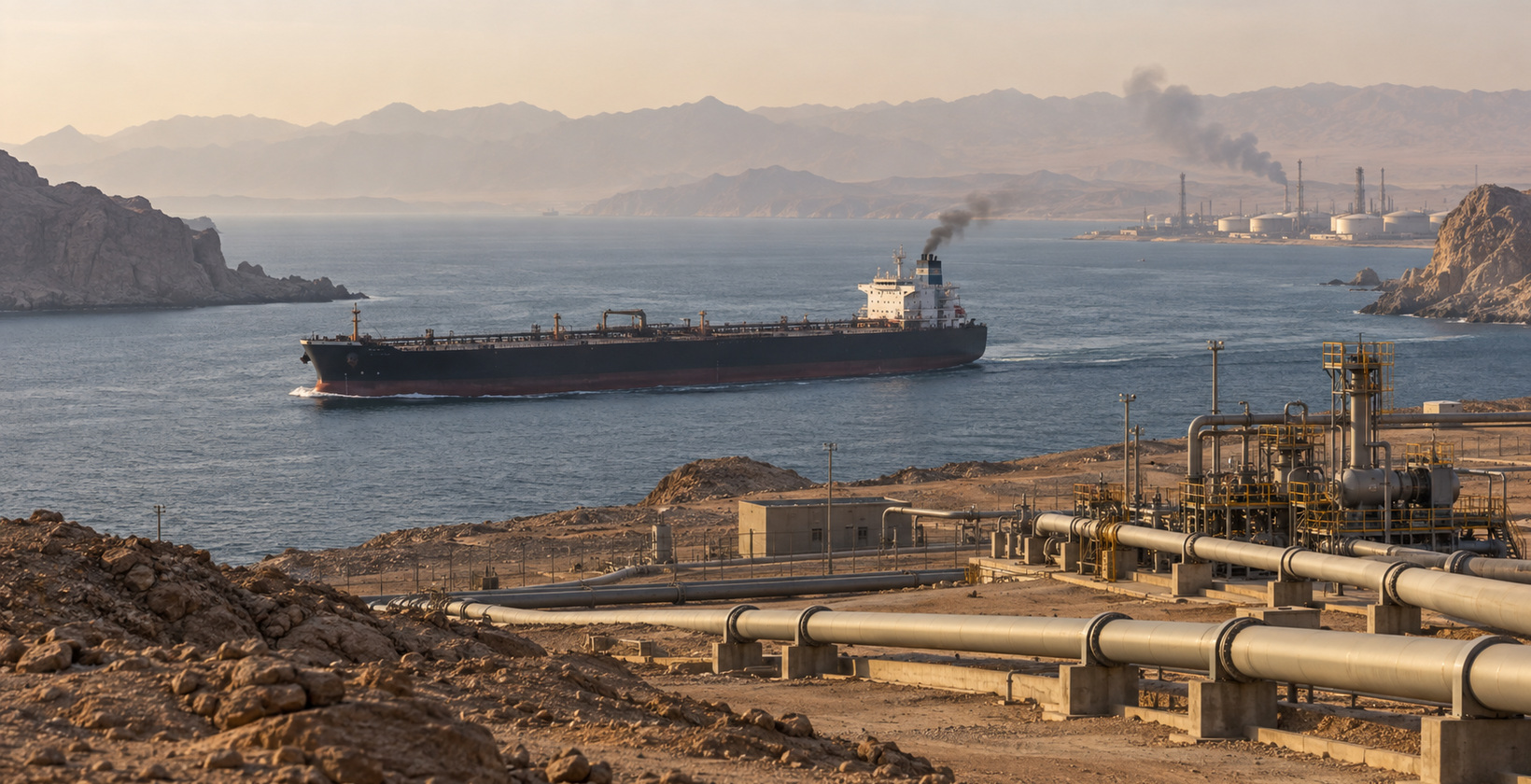
The Middle East oil-supply crisis has entered a more dangerous phase. On 13 September 2026, a vessel was reportedly struck by a projectile in the Strait of Hormuz, only a day after Saudi Arabia temporarily closed its strategic East–West oil pipeline.
The two developments are particularly significant when considered together. The Strait of Hormuz is the principal maritime route for Gulf energy exports, while the approximately 1,200-kilometre East–West pipeline has become Saudi Arabia’s main route for bypassing the strait.
According to estimates cited by Reuters from ship-tracking companies and analysts, the pipeline had recently been carrying approximately 4–5 million barrels of oil per day, equivalent to 4–5% of global supply. This does not mean that the entire volume has already been permanently removed from the market. It does, however, mean that maritime transport, land infrastructure and insurance risks are now affecting the supply system simultaneously.
What happened in the Strait of Hormuz?
The United Kingdom Maritime Trade Operations, or UKMTO, said it had received a report of a projectile striking a vessel while it was transiting the Strait of Hormuz. A fire subsequently broke out and local authorities began evacuating those on board.
Iranian state media separately reported that an Iranian commercial vessel had been attacked near Qeshm Island. Initial reports said that one person had been killed and four wounded.
The publicly available information does not yet establish whether the UKMTO report and the incident described by Iranian media concern the same vessel. The attacker and the origin of the projectile have also not been independently confirmed.
Why is the East–West pipeline so important?
Saudi Arabia’s East–West pipeline connects oil-producing areas in the east of the country with the Red Sea port of Yanbu. It therefore allows Saudi crude to reach international markets without passing through the Strait of Hormuz.
Saudi Arabia closed the pipeline as a precaution after drone strikes damaged infrastructure in the Riyadh and Medina regions. Saudi Arabia and Iraq said the drones had originated from Iraqi territory, but there was no immediate claim of responsibility and the perpetrator had not been independently confirmed.
The closure is especially important because the pipeline was no longer merely a supplementary export option. As tanker traffic through Hormuz declined, it became one of the most important routes for delivering Saudi oil to the global market.
Why has the supply situation become more dangerous?
The market might treat an isolated vessel strike as a limited security incident. A temporary pipeline shutdown could potentially be managed through inventories, alternative routes or changes to export schedules.
When both risks materialise at the same time, however, the system loses much of its flexibility:
- physical risks to ships, crews and cargoes increase in the Strait of Hormuz;
- Saudi Arabia’s principal land-based bypass route is also disrupted;
- insurers may raise war-risk premiums or restrict coverage;
- shipowners may delay voyages or demand higher compensation;
- delivery times become less predictable;
- the market has less spare logistical capacity to absorb another incident.
Oil prices are therefore influenced not only by the number of barrels currently missing from the market. They also include a risk premium reflecting the possibility that disruption will last longer or spread to additional routes.
Could oil prices continue rising?
Reuters reported that oil prices had already returned above $100 per barrel amid the growing supply threat. The next move will depend less on one vessel incident than on the duration of disruption and the availability of alternative routes.
Upward pressure may intensify if:
- repairs or inspections keep the East–West pipeline closed;
- additional vessels, ports or energy facilities are attacked;
- tanker traffic through Hormuz declines further;
- insurance costs make some voyages commercially impractical;
- disruption also expands around Bab el-Mandeb and the Red Sea.
A rapid restart of the pipeline, safer vessel movements or diplomatic progress could reduce the risk premium. Short-term conditions may therefore produce not only high prices but also sharp movements in both directions.
What does the crisis mean for Latvian businesses?
Latvia may not import large volumes of crude oil directly through Hormuz, but petroleum-product prices are formed in international markets. Prolonged disruption could therefore affect:
- wholesale diesel and petrol prices;
- road freight, courier and logistics costs;
- aviation and maritime transport prices;
- the cost of plastics, chemicals and packaging;
- energy expenditure in agriculture and manufacturing;
- inflation and household purchasing power.
Businesses with substantial fuel or transport exposure should avoid basing their budgets on a single oil-price assumption. A practical approach is to prepare at least a base scenario, a higher-price scenario and a prolonged-disruption scenario.
What should businesses review now?
- Measure how much of their cost base is directly or indirectly linked to fuel and petroleum products.
- Check whether customer and supplier contracts allow price adjustments following a substantial increase in energy costs.
- Review delivery-time and transport-cost buffers for the coming months.
- Identify alternative suppliers or routes for critical goods.
- Update cash-flow forecasts regularly instead of waiting for higher prices to appear at filling stations.
What does the situation mean for investors?
Higher oil prices can increase revenue for energy producers, but commodity prices are not the only relevant factor during a geopolitical crisis. Investors must also consider where a company’s assets are located, which export routes it uses, whether insurance remains available, its sanctions exposure and whether it can physically deliver its product.
At the same time, expensive energy can weaken margins for transport, aviation, chemicals and energy-intensive manufacturing. It may also keep inflation elevated and limit how quickly central banks can reduce interest rates.
This article is for information only and does not constitute individual investment advice.
Frequently asked questions
Is the Strait of Hormuz completely closed?
No. The latest incident alone does not establish that all shipping has been legally or physically halted. Commercial traffic nevertheless remains low, while security and insurance risks are exceptionally high.
Has the market already lost 4–5 million barrels per day?
Not necessarily. This figure describes the volume recently transported through the East–West pipeline. The actual reduction in exports will depend on the duration of the closure, available inventories and the ability to redirect flows.
Who attacked the vessel?
At the time of publication, the attacker and the origin of the projectile had not been independently confirmed.
Will fuel prices in Latvia rise immediately?
Not necessarily on the same day. Local prices are influenced by crude oil and refined-product markets, exchange rates, taxes, inventories, supply contracts and retailers’ pricing schedules.
Information updated on 13 September 2026. The situation is evolving, and information about the vessel, pipeline operations and supply volumes may be revised.
Comments
No comments yet. Yours could be the first!
Add a comment