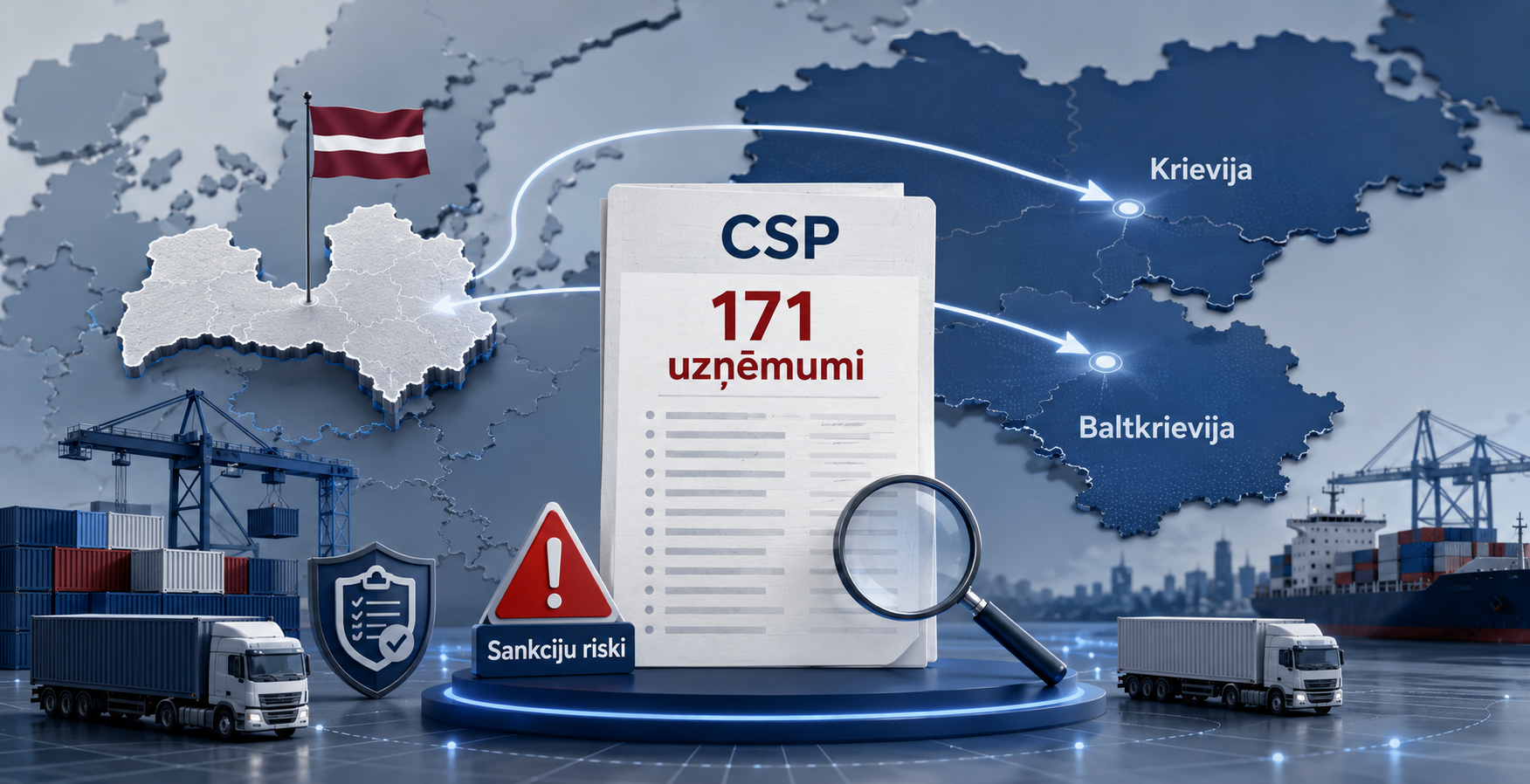
On 20 August 2026, Latvia's Central Statistical Bureau published its first list of Latvian-registered companies exporting goods to Russia or Belarus or importing goods from those countries. The July dataset contains 171 companies.
The new transparency makes it easier for businesses, investors, customers and potential partners to identify companies that continue to maintain direct goods-trading links with Russia or Belarus.
Why has the company list become public?
On 18 June 2026, Latvia's parliament adopted an amendment to the Law on Assistance to Ukrainian Civilians, which entered into force on 27 June. Article 24 requires the State Revenue Service to provide information on relevant exporters and importers to the Central Statistical Bureau, which must publish the data once a month.
Which sectors dominate the list?
Analysis of the published information shows that 55 of the 171 companies are involved in freight transport, warehousing or other logistics services, 44 operate in food or agricultural goods, and 17 are active in medical products and equipment.
Many are relatively small businesses. In 2025, 48 companies had turnover of no more than €1 million, while another 51 reported turnover between €1 million and €5 million.
Does inclusion mean sanctions have been violated?
No. Being included on the list does not by itself prove a breach of European Union sanctions or any illegal transaction.
EU sanctions restrict specific goods, technologies, services and transactions with designated persons and entities. Not all trade with Russia or Belarus is completely prohibited. Each transaction must therefore be assessed according to the goods involved, the counterparty, the end user and the applicable sanctions.
What does the list mean for businesses?
The database can serve as an additional due-diligence tool. Finding a customer or supplier on the list is not an automatic reason to end a relationship, but it may justify enhanced checks.
- check applicable sanctions lists;
- understand the nature of the trade;
- verify beneficial owners and ultimate recipients;
- assess reputational requirements imposed by banks, investors and partners.
A risk indicator, not a verdict
The published information does not show the value of individual transactions, the specific product or the ultimate recipient. Re-export activity may also affect trade statistics. The list should therefore be treated as a transparency and risk-screening tool rather than a conclusion about a company's conduct.
The data will be updated monthly, allowing businesses and the public to monitor which companies leave the list and which appear for the first time.
Frequently asked questions
How many companies are included?
The July 2026 dataset contains 171 Latvian-registered companies.
Does the list only cover exports?
No. It includes companies exporting to Russia or Belarus as well as companies importing goods from those countries.
Does inclusion prove a sanctions violation?
No. The legality of each transaction depends on the goods, counterparty, end user and sanctions applicable at the time.
Comments
No comments yet. Yours could be the first!
Add a comment