

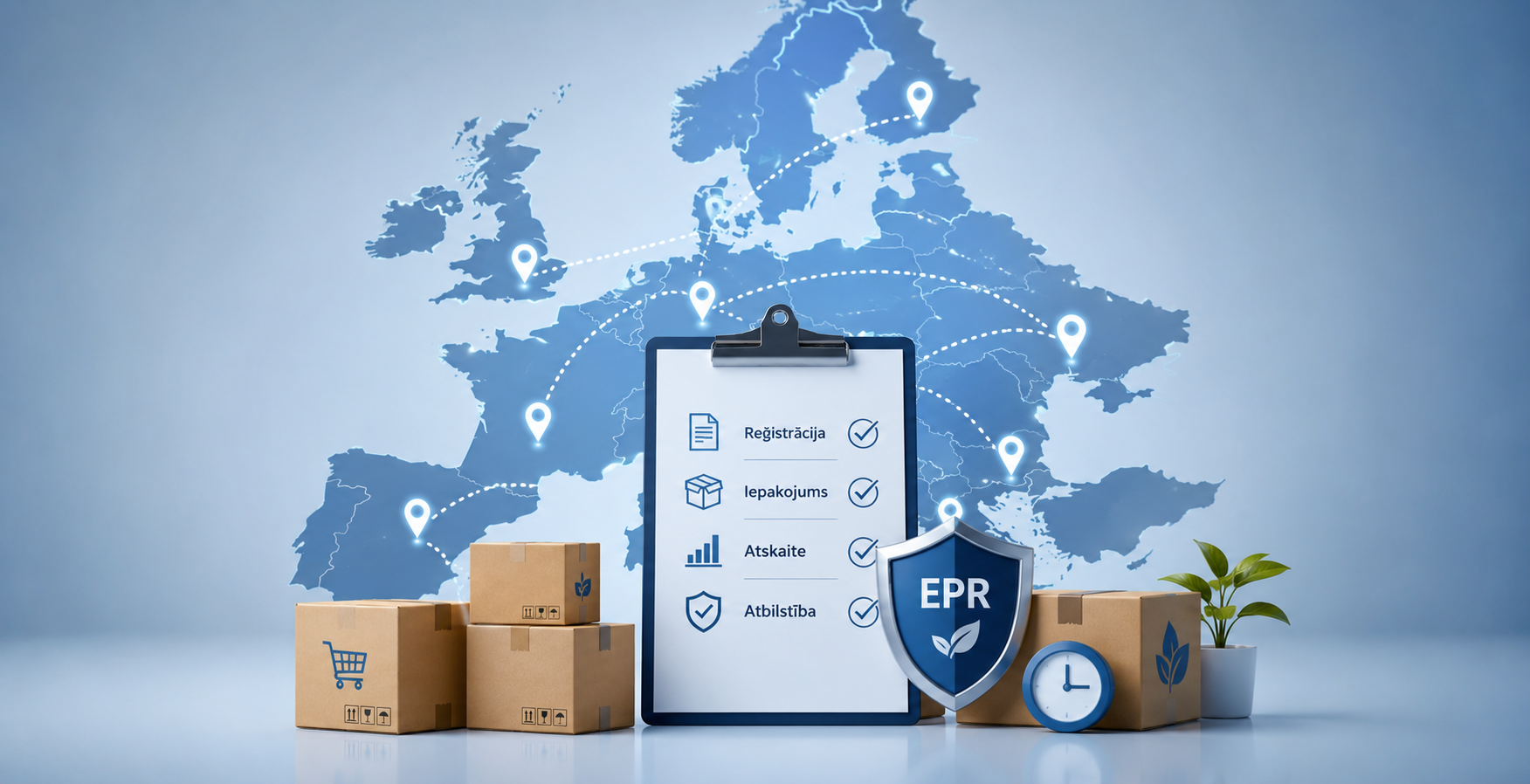
The general application of the PPWR from 12 August 2026 does not mean that Latvian online retailers must stop selling across Europe. It does, however, make the traditional model of packing an order in Latvia and shipping it anywhere in the EU more administratively demanding.
This guide does not repeat the basic PPWR requirements. Its purpose is practical: how can a small or medium-sized e-commerce business continue cross-border sales while keeping EPR administration and costs under control?
Short answer: you do not automatically need 27 registrations
The PPWR harmonises packaging rules across the European Union, but Extended Producer Responsibility remains linked to individual Member States.
A company needs to assess the countries where it actually makes packaging or packaged products available and where it qualifies as the producer under the PPWR.
If a Latvian online shop sells only in Latvia, Lithuania and Estonia, it does not automatically need registrations in Member States where it does not sell.
Direct sales of packaged goods from Latvia to end users in another Member State, however, may result in the Latvian seller becoming the producer for EPR purposes in the destination country.
1. Start with a map of the countries where you actually sell
Before purchasing compliance services, list the Member States to which the company has actually shipped goods during the previous 12 months.
Ask four questions for every country
- Do we actually sell in this country?
- Do we ship directly to an end user?
- Do we sell first to a local distributor or wholesaler?
- Who is the first operator making the packaged product available on that market?
This separates markets where the Latvian company may have direct EPR responsibility from markets where another operator may qualify as the producer.
2. A small online store does not need to deliver everywhere
One of the simplest ways to control compliance costs is to determine whether every destination market is commercially worthwhile.
If annual EPR registration, administration and representation costs in a country exceed the margin generated by sales there, keeping that delivery market open may not be economically rational.
Simple formula: required annual orders = fixed annual compliance costs / contribution margin per order.
A company can therefore focus on a limited number of profitable markets and add additional countries as sales grow.
EU geo-blocking rules do not create a general obligation for online retailers to physically deliver goods to every Member State, although delivery restrictions must still comply with EU rules against unjustified discrimination.
3. Centralise EPR administration
National registers do not require a business to manage every country manually.
A single compliance provider can coordinate registrations, producer responsibility organisations, authorised representatives and reporting across several Member States.
Request a consolidated quotation covering
- registration fees;
- annual administration;
- authorised representative costs where required;
- producer responsibility organisation charges;
- reporting frequency;
- fees for corrections or adding another market;
- data export and termination arrangements.
4. Reduce the number of packaging formats
Fewer packaging formats mean easier reporting.
Instead of maintaining many different boxes and envelopes, smaller businesses may benefit from a limited standard set.
Assign a code to each packaging format and record its material, weight, supplier and supporting documentation.
5. Build one packaging master database
A small company does not necessarily need dedicated EPR software immediately. A well-designed spreadsheet can be sufficient during the early stage.
Useful fields include
- packaging code;
- packaging type;
- material;
- weight per unit;
- supplier;
- associated SKUs;
- technical-document reference;
- destination markets.
6. Calculate packaging automatically from order data
Do not wait until the end of the year and attempt to reconstruct thousands of shipments manually.
If each order stores the packaging code used, packaging quantities can be calculated automatically.
Total packaging weight = units shipped × weight per packaging unit.
Group the result by destination country and material to create the basis for national EPR reporting.
7. A marketplace does not automatically solve EPR
The PPWR requires relevant online platforms to obtain EPR registration information from producers selling to consumers.
Sellers should therefore expect marketplaces to request national registration numbers.
The PPWR also allows certain EPR obligations to be fulfilled by the platform on behalf of the producer where there is a written mandate. This is a service arrangement, not an automatic transfer of responsibility.
8. Fulfilment does not automatically transfer producer status
Using a fulfilment warehouse in another Member State does not by itself make the fulfilment provider the EPR producer.
Producers must provide fulfilment service providers with relevant EPR registration information and self-certification.
9. A local distributor can change the supply-chain model
For commercially important markets, selling to a local distributor rather than directly to consumers may be worth considering.
If the local company actually buys the goods and is the first operator to make the packaged product available on its domestic market, the allocation of producer responsibility may differ from direct B2C sales.
A contractual statement alone cannot override the statutory definition of producer. The actual supply chain must match the agreed model.
10. Authorised representatives remain an important issue
The PPWR requires an EU-established producer making packaged products directly available to end users in another Member State through distance sales to appoint an authorised representative for EPR in that Member State.
The European Commission proposed suspending this requirement for EU-established businesses, but that change had not been adopted by August 2026.
Businesses should therefore not exclude authorised-representative costs from their current compliance planning.
Common mistakes to avoid
- Do not assume small volumes automatically remove EPR registration obligations.
- Do not assume the marketplace automatically handles all EPR duties.
- Do not assume a fulfilment warehouse becomes the producer.
- Do not purchase a 27-country compliance package before identifying your real markets.
- Do not leave packaging weights scattered across supplier emails.
Frequently asked questions
Does a Latvian online retailer need 27 EPR registrations?
No. The business needs to assess the Member States where it actually makes packaged products available and qualifies as the producer.
Is there one EU-wide EPR register?
No. Producer registers remain national. A compliance provider may manage several registrations through one service, but the legal registrations remain separate.
Can a marketplace handle EPR?
In certain circumstances, specific obligations may be fulfilled by an online platform on behalf of a producer under a written mandate. Businesses must verify whether the relevant marketplace actually offers such a service.
Does the 40% empty-space rule apply from 2026?
No. The final PPWR sets a 50% maximum empty-space ratio for grouped, transport and e-commerce packaging from 1 January 2030 or three years after the relevant Commission methodology enters into force, whichever is later.
A practical model for a small Latvian online retailer
- Select the 2–5 most important export markets.
- Determine producer status in each market.
- Obtain one consolidated compliance quotation.
- Reduce packaging to a small set of standard formats.
- Weigh each packaging format once and store the data.
- Assign a packaging code to each order.
- Aggregate data automatically by country and material.
- Add new markets only when sales justify the compliance cost.
Conclusion: turn compliance into a repeatable business process
The PPWR makes cross-border e-commerce more administratively demanding, but it does not mean smaller Latvian companies need to abandon the European market.
The expensive approach is to register everywhere without a plan and rebuild packaging data manually. The more efficient approach is to focus on profitable markets, standardise packaging, automate data collection and centralise EPR administration.
Under the PPWR, the competitive advantage will not belong to the company that spends the most on compliance, but to the one that makes compliance simple, repeatable and scalable.
Comments
No comments yet. Yours could be the first!
Add a comment