

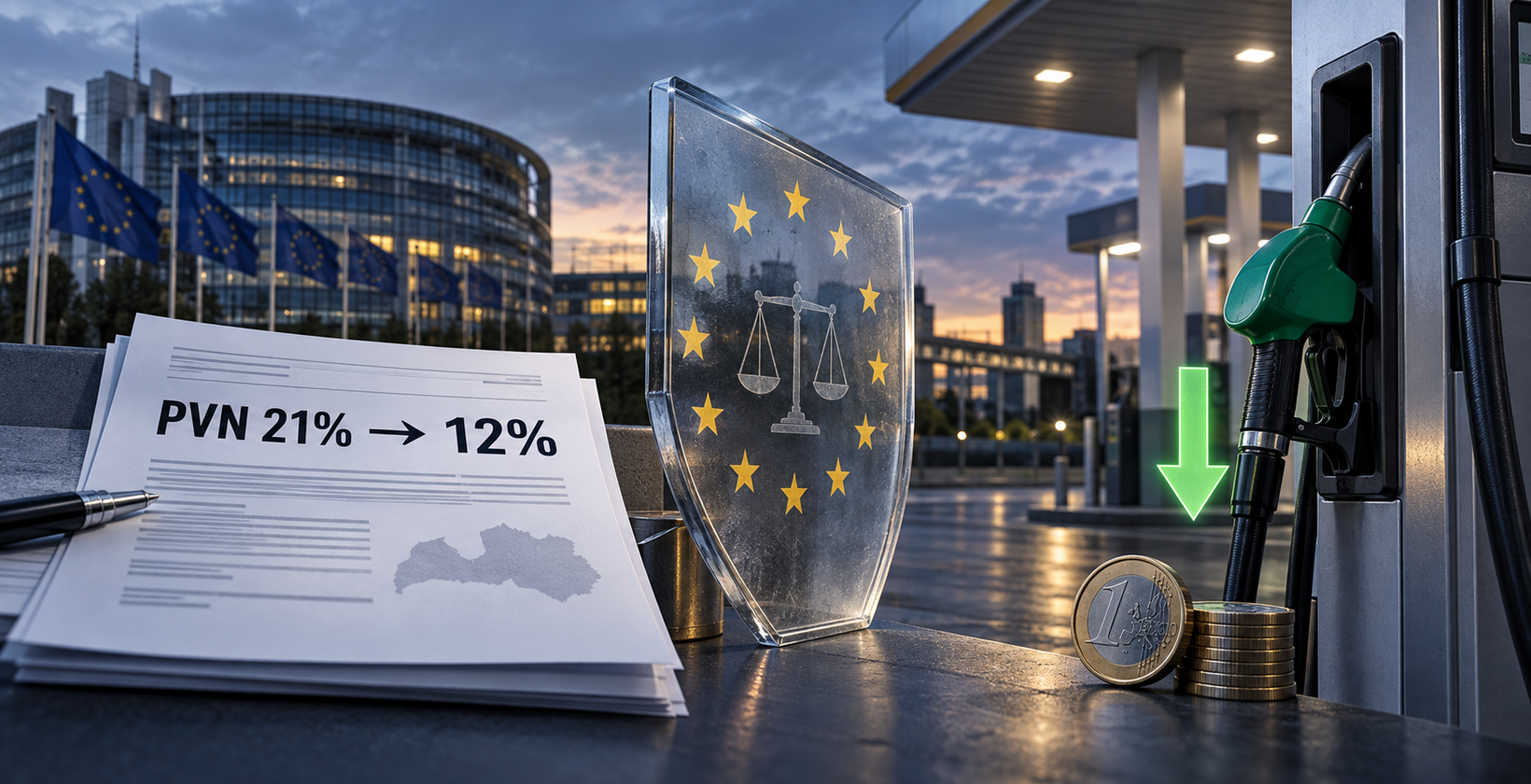
Short answer: on 15 September 2026, Latvia’s Ministry of Economics published a calculation, not a decision to reduce the tax. If VAT on petrol and diesel were temporarily cut from 21% to 12% and retailers passed on the entire tax difference, diesel could become about 15.6 cents per litre cheaper and petrol about 14.6 cents cheaper. However, the governing coalition has not agreed on the measure, and current EU VAT rules do not provide for a reduced rate on road fuel.
Motorists therefore have no reason to expect an automatic 15-cent reduction at filling stations. The figures describe a possible scenario that would require political approval, a lawful basis under EU rules and effective pass-through to retail prices.
What exactly did the Ministry of Economics calculate?
The Ministry assessed a reduction in the VAT rate on fuel from 21% to 12%. At the September 2026 price level, full pass-through would have approximately the following effect:
- diesel — about 15.6 cents per litre cheaper;
- petrol — about 14.6 cents per litre cheaper;
- theoretical reduction in the final fuel price — about 7.4%.
A nine-percentage-point rate cut does not reduce the final price by 9%. VAT is calculated on the price before tax, so moving from 21% to 12% lowers the tax-inclusive price by about 7.4% if the net price remains unchanged.
How much could a household save?
According to the Ministry, a household buying 100 litres of fuel a month could save up to about EUR 15.60 per month with full pass-through. The average benefit per final consumer in Latvia would not exceed approximately EUR 7.90 a month.
Full pass-through is not guaranteed. Competition Council data on the April 2026 excise-duty reduction show that only about 58–64% of the planned reduction reached diesel prices. If VAT pass-through were similar and reached 61%, a household using 100 litres a month would save about EUR 9.50 instead of EUR 15.60.
Why would 12% VAT not cut business fuel costs by 15 cents?
This is the key issue for businesses. VAT-registered companies that deduct input VAT on fuel used for taxable business activity assess their fuel cost excluding VAT. If the net price does not change, a lower VAT rate does not reduce their actual cost.
Therefore, freight, logistics, agriculture and manufacturing businesses with full input-VAT deduction rights would not receive the headline 15-cent saving solely from a 12% VAT rate. The direct benefit would mainly go to households, businesses that are not VAT registered and expenditure for which input VAT cannot be fully deducted.
Claims that the measure would significantly reduce transport, food or other service prices should also be treated cautiously. The Ministry concludes that second-round effects would be limited because VAT-registered businesses’ net fuel costs would remain unchanged.
How much would the measure cost the state budget?
The Ministry estimates a revenue loss of around EUR 6.3 million per month. Applying the 12% rate for three months would cost the budget approximately EUR 18–20 million.
If retailers passed on only part of the reduction, the budget loss would not fall as quickly as the consumer benefit. In the Ministry’s 61% pass-through model, the budget cost would be around EUR 6 million a month, but only around EUR 3.9 million would reach final consumers. Approximately EUR 2.2 million a month would remain in the supply and retail chain.
Would lower VAT reduce inflation?
Fuel accounts for 4.1% of Latvia’s household consumption basket in 2026. The Ministry estimates that a 7.4% fuel-price reduction with full pass-through would lower the overall consumer-price level by about 0.3 percentage points. With pass-through similar to that previously observed, the effect would be around 0.19 percentage points.
The measure would not change world oil prices or Latvia’s imported-fuel purchase price. The Ministry estimates that Latvia’s economy currently pays about EUR 64 million more for fuel each month than in January and February 2026. Most of that increase comes from higher purchase prices, which Latvia’s VAT rate cannot influence.
What is the serious EU legal obstacle?
VAT is harmonised across the European Union. Council Directive 2006/112/EC specifies the goods and services to which Member States may apply reduced rates. Latvia’s Ministry of Finance explained in April 2026 that petrol and diesel used as road fuel are not included in the permitted categories, meaning that a reduced VAT rate on fuel would conflict with current EU rules.
The explanatory documents for Latvia’s spring 2026 diesel-support legislation also stated that a reduced VAT rate on fuel was not permitted under the Directive. Latvia instead used another instrument at that time: a temporary reduction in excise duty on diesel.
A political vote in Latvia may therefore be insufficient. A legally secure 12% VAT solution would require a basis compatible with EU law or a change to the common rules. Otherwise, Latvia could face a dispute with the European Commission.
What has been decided and what has not?
- The Ministry has published an impact calculation covering prices, the budget and inflation.
- The Union of Greens and Farmers has made a political proposal to reduce fuel VAT from 21% to 12% until the end of 2026.
- There is no government or parliamentary decision introducing 12% VAT on fuel.
- Full pass-through to retail prices is not guaranteed.
- A major EU-law obstacle remains and cannot be resolved by an economic calculation alone.
What should a business do now?
- Do not build a 15-cent reduction into budgets or customer quotations until specific legislation has been adopted and promulgated.
- Check the extent to which the company may deduct input VAT on fuel. This determines whether a lower VAT rate would reduce its net costs at all.
- Use price-adjustment clauses based on the actual net fuel price in fuel-sensitive contracts, rather than on a political proposal.
- Monitor decisions by the government, parliament and European Commission, especially the proposed legal basis.
- Assess excise duty, VAT and fuel purchase prices separately because they affect VAT-registered businesses differently.
Conclusion: the Ministry’s calculation shows that 12% VAT could theoretically reduce fuel prices by around 15 cents per litre, but it is not a promise about the price at the pump. The result would depend on retail pass-through, the buyer’s VAT status, the state-budget decision and, most importantly, compliance with the EU VAT Directive.
Official information sources
- Ministry of Economics calculations published on 15 September 2026
- Ministry of Finance: VAT rates in Latvia in 2026
- Consolidated text of Council Directive 2006/112/EC
- Latvian Public Media on the 2026 excise-duty reduction and the VAT restriction
- Union of Greens and Farmers proposal to reduce fuel VAT to 12%
Comments
No comments yet. Yours could be the first!
Add a comment