

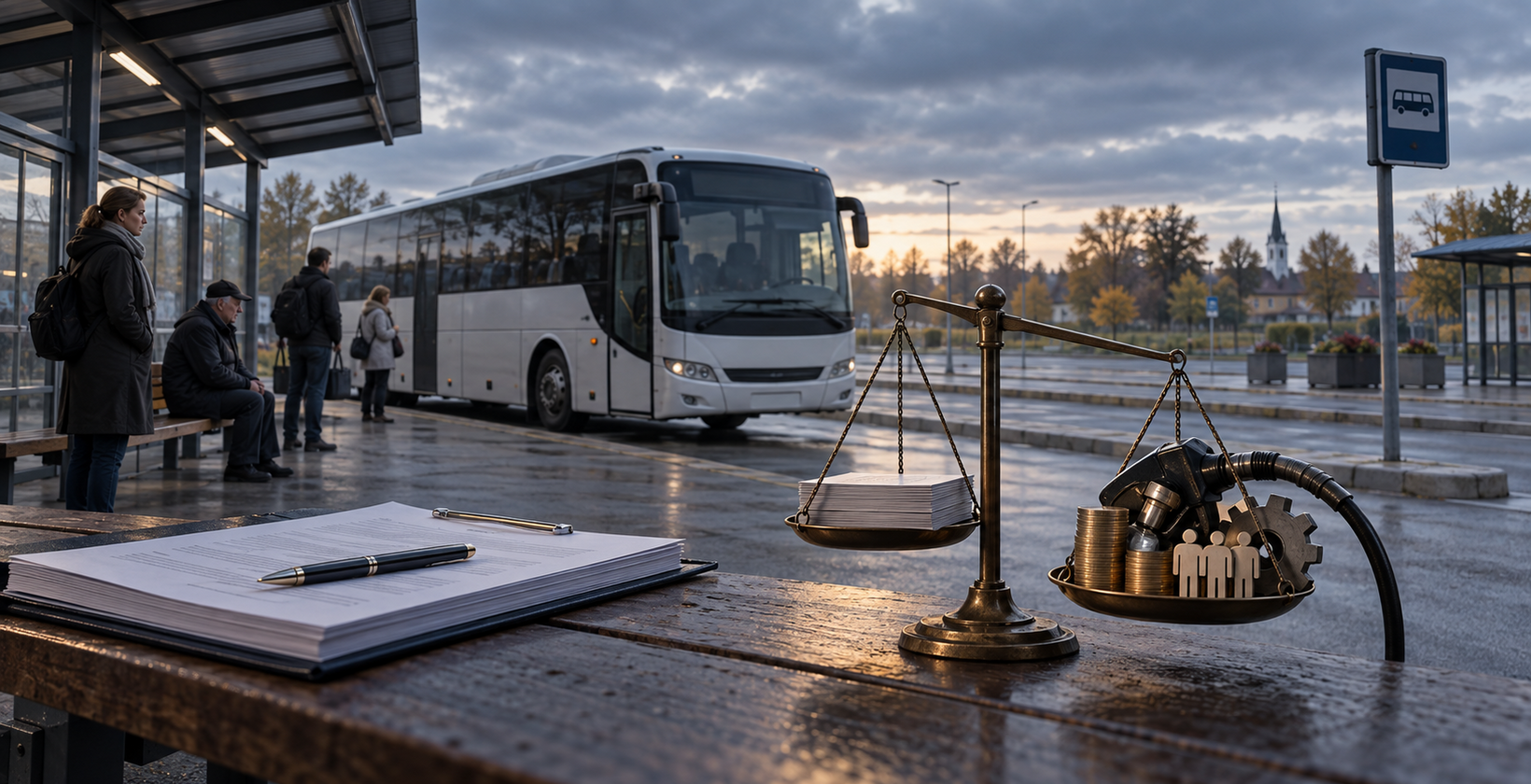
Short answer: Latvia’s regional bus protest exposes a risk extending far beyond transport. If a company wins a long-term public tender with a fixed or rarely reviewed price while fuel, wages and other costs rise much faster, a profitable contract can become structurally loss-making. However, the contract price cannot simply be increased by agreement after the event: amendments must either have been provided for in the original contract or satisfy an exception under Latvia’s Public Procurement Law.
On 16 September 2026, eight passenger carriers are participating in “A Day Without Regional Public Transport”. The Latvian Passenger Carriers Association estimated that up to 3,000 state-ordered regional bus services and up to 60,000 passengers could be affected. These figures represent the organisers’ projected impact, not final statistics for the completed day.
What is happening on 16 September?
The participating operators are Daugavpils autobusu parks, Dautrans, HANSABUSS Latvija, Liepājas autobusu parks, Norma-A, Nordeka, Rēzeknes autobusu parks and Wanema, also known as Talsu autotransports. They are not operating some or all of their state-contracted regional services.
Latvian Public Media reported cancelled morning services from Riga to Ogre, Baldone, Liepāja and other destinations. At least 846 services were expected to be cancelled in Latgale, while Liepājas autobusu parks said it would not operate around 800 regional services. International services and Liepāja city transport were not cancelled because of the protest.
The carriers demand a solution for indexation of long-term contracts and additional funding. The association wants cost indexation at least annually rather than only twice during a ten-year contract.
Why did EUR 9.85 million not stop the protest?
On 15 September, the government allocated an additional EUR 9.85 million to provide public transport services in 2026. The Ministry of Transport said the funding was needed to maintain the regional bus and rail network at its 2025 level.
The 2026 state budget allocated EUR 93.8 million to public transport, including EUR 52.9 million for regional buses. At the beginning of the year, average ticket prices were increased by 7.5% on buses and 6.6% on trains, but the additional revenue was insufficient to cover rising costs.
Two cash flows must be distinguished. Additional budget funding allows the state to maintain the ordered route network. Contract indexation determines how and how often an individual operator’s remuneration per unit of service changes. More money in the system does not automatically recalculate a particular ten-year contract to reflect current fuel and wage costs.
How sharply have operators’ costs changed?
Association president Ivo Ošenieks told Latvian Radio that diesel had risen from around EUR 1.50 per litre in March to EUR 2.19 in mid-September — an increase of approximately 46% within several months. He said operators currently bear that difference themselves.
The association’s published position says that since 2021 fuel prices and average bus-driver pay have increased by more than 60%, while general inflation has reached 38%. These are figures used in the industry association’s argument rather than an independent audit of the costs of all eight companies.
The economic problem remains real without a single universal percentage: if the contractual price changes more slowly than the largest cost components, each service delivered can gradually reduce profit and eventually increase losses.
Why can a winning price become a trap?
A bidder sets its price before the public contract is performed. Under a ten-year agreement, it must effectively forecast fuel, wages, spare parts, finance, insurance and maintenance costs years in advance.
An excessive risk reserve may lose the tender. An insufficient reserve may help win it but leaves the company exposed to a cost shock. If the evaluation is dominated by the lowest price and the indexation formula is weak, bidders are encouraged to assume risks they may later be unable to finance.
The operator is not the only party that loses. The contracting authority may have to find additional budget funds, reduce routes, impose penalties, terminate the agreement or conduct a new procurement. Passengers receive a less stable service. Good indexation is therefore not automatically a gift to the supplier: it can be an instrument for allocating risk and preserving service continuity.
Can the state simply increase the contract price?
No. Section 61 of Latvia’s Public Procurement Law limits amendments to an awarded public contract. The purpose is to protect competition: other bidders submitted prices based on the original terms, so the winner must not receive post-award advantages that could have changed the result of the procedure.
Latvia’s Procurement Monitoring Bureau explains that the safest solution is for procurement documents and the contract to specify clearly and unambiguously:
- whether the contract price may be reviewed;
- which events trigger indexation;
- which index or cost basket is used;
- how frequently the price is reviewed;
- the permitted extent of changes and the price components affected.
The law also permits other grounds for amendment. In specified circumstances, material amendments may be allowed where they are required by circumstances that a diligent contracting authority could not have foreseen; each such price increase is subject to a 50% limit. A separate route exists for lower-value amendments within the statutory limits.
Cost increases must nevertheless be objectively demonstrated, for example using official statistical or other verifiable data. Amendments must not alter the overall nature of the contract. If a price increase materially changes the original economic balance in favour of the winner or could have allowed other bidders to participate, the legal risk rises sharply.
Does the protest release carriers from contractual obligations?
No. An industry or political protest does not by itself suspend an existing contract. Jānis Lapiņš, head of Latvia’s Road Transport Administration, said that the contracts provide for penalties for unperformed services and that the potential penalty for some carriers could exceed EUR 100,000.
The participating companies therefore assume reputational risk, passenger-relations risk and a direct contractual cost. The contracting authority must also apply the contract consistently: it cannot disregard non-performance merely because the underlying economic complaint is understandable.
What should companies learn before bidding for public contracts?
- Do not confuse revenue with profitability. A large ten-year government order is not secure business if the unit price does not cover variable costs.
- Build a cost-sensitivity model. Before bidding, test scenarios in which fuel, wages, interest rates or materials increase by 10%, 25% and 50%.
- Read the indexation formula, not only the price. The base date, indices, weights, review frequency, threshold, cap and time lag all matter.
- Request clarification before submitting the bid. Repairing a defective price-review mechanism after award is legally much harder.
- Retain evidence. Invoices, payroll data, supplier quotations and official indices will be needed to substantiate an objective cost increase.
- Assess cash flow. Even legally possible compensation may take months to approve, while fuel and wages must be paid today.
- Calculate the exit price. Penalties, guarantees, vehicle finance and the risks of a replacement procurement may make termination more expensive than temporary losses.
What should contracting authorities change?
For long-term service contracts, authorities should assess not only the lowest initial price but the contract’s viability over its entire duration. Indexation should use publicly verifiable indices relevant to the service and transparent weights for each cost component.
Automatic indexation must not compensate every supplier inefficiency or guarantee profit. It should separate external market risk from the company’s own management risk. A fuel-market index may justify a change to the fuel component, for example, but not every increase in the operator’s administrative costs.
Indexation that is too infrequent can also produce a more expensive final outcome: emergency budget requests, contract disputes, interrupted services and repeat procurements. This is a systemic choice between predictable allocation of risk at the start and crisis management in the middle of the contract.
The main conclusion for Latvian businesses
The regional bus protest is about more than up to 3,000 potentially unperformed services. It warns every company selling a long-term service to the state at a price calculated today.
The lowest price on award day can become the most expensive mistake in year five. The company must be able to substantiate and finance its bid, while the contracting authority must design a contract that protects competition and preserves the service’s economic viability. If this balance is not built into the procurement, restoring it later is both expensive and legally difficult.
Official information sources
- Latvian Public Media: carriers’ protest on 16 September 2026
- Ministry of Transport: additional EUR 9.85 million for regional transport
- Passenger Carriers Association statement on the protest and contract indexation
- Latvia’s Public Procurement Law
- Procurement Monitoring Bureau guidance on contract amendments
- Road Transport Administration explanation of penalties for unperformed services
Comments
No comments yet. Yours could be the first!
Add a comment