

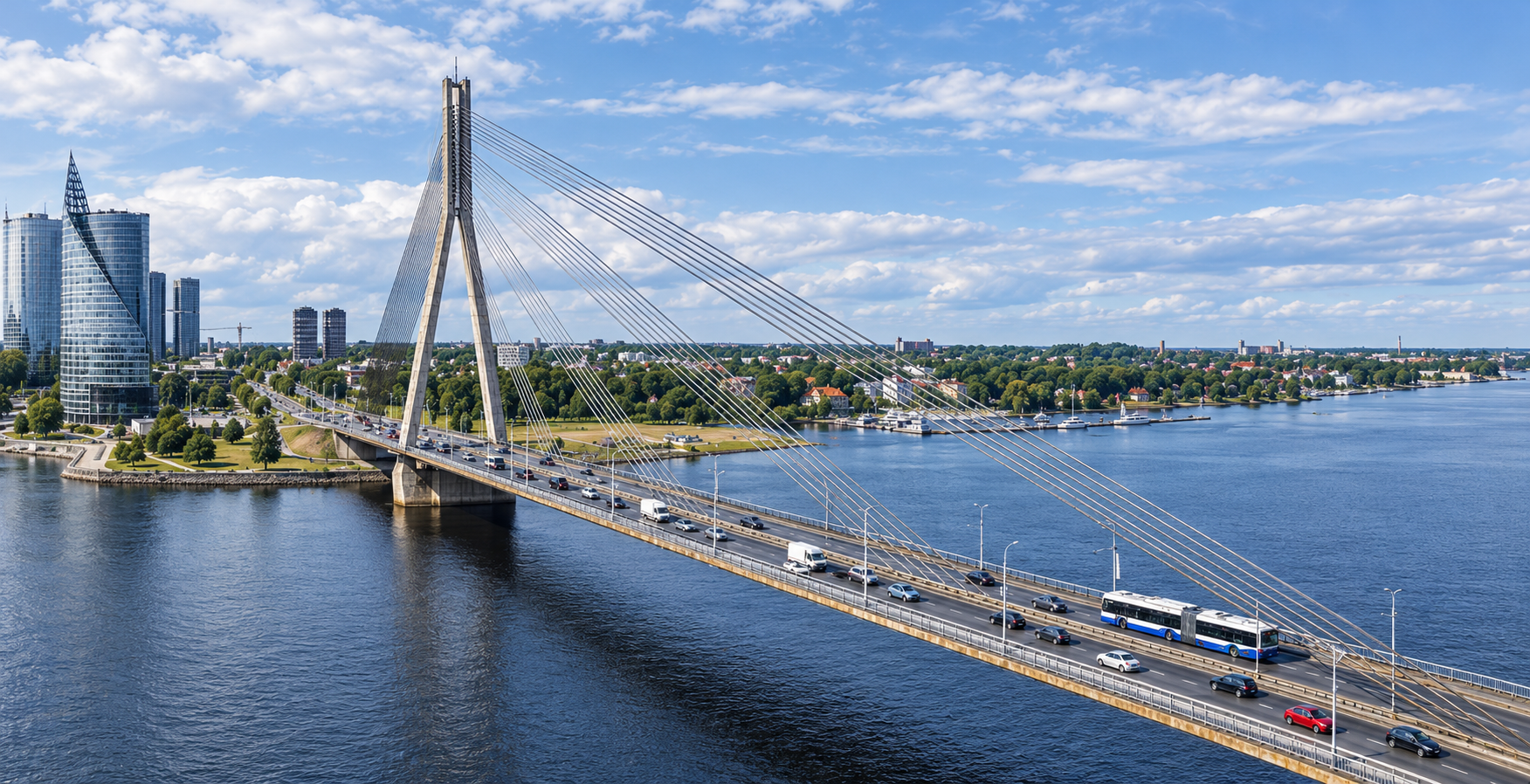
For businesses, Vanšu Bridge reconstruction is primarily about planning deliveries, staff journeys and customer access. Prepare alternative actions, but base specific departure times and routes on approved traffic arrangements. An unfounded assumption about closure can be as disruptive as failing to prepare for changes.
What is contracted, and what remains under assessment?
Riga announced on 16 January a design-and-build contract with the “Vanšu tilts” consortium: €69,802,998 excluding VAT. This is the signed contract amount, not the combined cost of every possible additional solution.
LTV's “De facto” reported on 18 October: the contract covers replacing all river-side cables and removing one land-side cable for inspection. The contractor proposes replacing all cables using savings elsewhere; the city is checking permissible amendments. Traffic modelling continues; a temporary bridge needs additional funding.
Changes in scope may affect costs and schedules. However, a proposal is not an approved price increase or delay. The editorial team recommends requesting a comparable calculation of changes to the work, total price and delivery terms.
Does a temporary bridge already resolve the traffic question?
The municipality's 21 September announcement called for preparations for a temporary bridge. That instruction is not a completed solution with secured funding and a published traffic plan. Business planning should distinguish an announced intention from a verifiable implementation decision.
The start of works and the start of traffic disruption need not coincide. Changing delivery schedules requires information about specific lanes, directions and time slots. This article does not establish a bridge closure date or duration.
How should a business assess its exposure?
Start with a typical working week: how many deliveries cross the Daugava, which customers visit in person, and which employees depend on a particular route? Use actual journey and order data rather than a citywide assumption.
- Deliveries: compare an alternative route's time, distance and costs. Separately check goods-receiving windows and opportunities to combine deliveries.
- Employees: consider shift starting times and remote working where duties permit.
- Customers: prepare access directions that can be updated; publish verified restrictions, not speculation about closure of the entire centre.
- Contracts: check price revisions, delay notifications and liability. A potential disruption alone does not establish who pays additional costs.
Create a baseline and an alternative scenario, identifying the approved traffic decision that would trigger activation. Assign one employee to updates. This helps avoid reorganising operations after every interview.
Agree communication procedures with key suppliers for sudden changes. Before ordering a new service, request separate prices for additional mileage, waiting and repeat deliveries so that quotations can be compared on equal terms.
How can practical alternatives be prepared?
If a registered-address or company-document change later becomes necessary, consider services for businesses. For potential partners, browse business listings and check each offer's terms. These options do not replace municipal traffic information.
A business decision needs an actionable plan, not just the project's total price. The next important document will identify specific access changes and preparation time. Until then, prepared scenarios are more useful than unsupported certainty.
Comments
No comments yet. Yours could be the first!
Add a comment