Short answer: Latvia’s Parliament has placed a new simplified tax regime for small-scale economic activity on the agenda for its final reading on 17 September 2026. It would introduce a 10% tax on turnover of up to €12,000 a year, automatic withholding through a dedicated business income account and a return prepared by the State Revenue Service. This is not a general reduction of Latvia’s micro-enterprise tax: the regime is intended only for certain first-time operators selling goods or services to private consumers.
This article was prepared before publication of the final vote. The parliamentary agenda lists Bill No. 1407/Lp14, Amendments to the Micro-enterprise Tax Law, for its third reading. If adopted, the parliamentary committee’s public information provides for the new system to apply from 1 April 2027.
What is the starter micro-business tax?
The proposal creates a new status for a small-scale economic operator and starter micro-enterprise taxpayer. The tax base would be turnover rather than profit, and the rate would be 10%.
In practice, a person earning €500 a month from private tutoring, gardening, beauty services or another household service would have €50 withheld as tax. At €1,000 in monthly turnover, the tax would be €100.
The key limitation is that business expenses cannot be deducted from the tax base. A 10% turnover tax may therefore be attractive for a low-cost activity but less suitable where materials, transport, premises or equipment absorb a large share of revenue.
Who would qualify for the 10% regime?
The version supported by the parliamentary committee sets several cumulative conditions:
- the operator must be a natural person;
- annual turnover may not exceed €12,000;
- goods or services may be sold only to natural persons who do not buy them for their own economic activity;
- the operator may not employ staff;
- the operator may not conduct another economic activity at the same time;
- no economic activity may be registered on the application date or during the two preceding tax periods;
- all revenue must enter the dedicated business income account, including cash that was initially received outside it;
- the person may not be registered for VAT under the general procedure, except for the special cross-border VAT scheme for small enterprises referred to in the bill.
The 10% regime would therefore not be available to an established business, to an owner seeking to shift part of a company’s revenue into a cheaper regime or to a self-employed person serving corporate customers. It is a narrow entry regime for a person selling goods or services to end consumers on a small scale.
How would the bank and the State Revenue Service automate the tax?
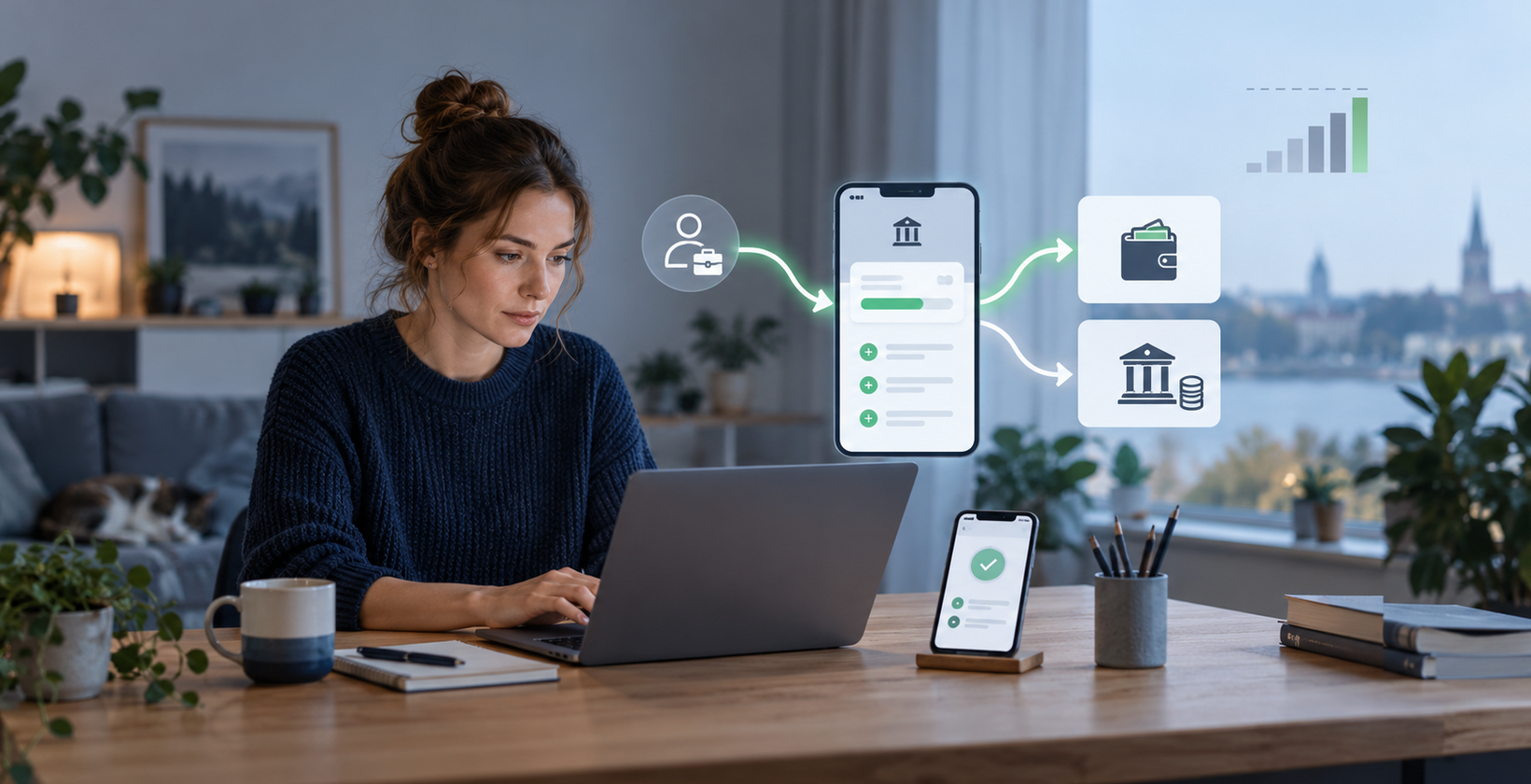
The person would open a dedicated business income account. The account provider and the State Revenue Service would exchange registration information, while the credit institution would automatically withhold the tax from incoming revenue and transfer it to the unified tax account.
The State Revenue Service would record turnover and tax paid and prepare the quarterly micro-enterprise tax return in its electronic filing system. The main advantage is therefore not only the lower rate but also reduced administration: the taxpayer would not calculate the quarterly payment manually.
Why could 10% become 25%?
If a person breaches the regime’s conditions — for example, by exceeding €12,000 in turnover, receiving business revenue outside the dedicated account or completing an ineligible transaction — an additional 15% rate is planned from the date of the breach until the end of the tax year. Together with the original 10%, the burden on the relevant revenue would reach 25%.
Following a breach, the person would be barred from using the regime for the next two years. Monitoring turnover, client status and payment flows will therefore remain essential even though the bank performs the tax calculation.
The most common misunderstanding
The 10% rate would not permit invoices to be issued to any customer as long as annual turnover remains below €12,000. A sale to a limited company, an association, a self-employed operator or another person purchasing for business purposes would fall outside the central logic of the proposed regime.
Who could benefit?
- a private tutor serving families;
- a person performing gardening or small household jobs in their spare time;
- a low-turnover beauty service provider without employees;
- a craft maker selling small quantities directly to consumers;
- a person testing a small business idea legally without complex tax bookkeeping.
The regime may be unsuitable for activities with significant deductible costs, business customers, employees, rapidly growing turnover or an imminent need for VAT registration. In those cases, the general self-employed regime, the existing micro-enterprise tax and incorporation should be compared before registration.
How does it differ from the current micro-enterprise tax?
Latvia’s current general micro-enterprise tax rate is 25% of turnover. The proposed 10% rate would not automatically apply to all micro-enterprise taxpayers. It would be a separate, narrowly targeted system for first-time operators with turnover of up to €12,000 and private-consumer customers only.
It would therefore be misleading to say that Latvia is “cutting the micro-enterprise tax to 10%”. More precisely, Latvia is considering a new 10% sub-regime for small-scale economic activity, while the rules applicable to other taxpayers remain in place.
What should a prospective user do?
- Wait for the final parliamentary vote and promulgation of the law.
- Check that no economic activity was registered on the application date or in the two preceding tax periods.
- Calculate both expected revenue and the cost ratio, because the 10% is charged on turnover.
- Confirm that every customer will be an end consumer rather than a business operator.
- Set a turnover warning before reaching the €12,000 threshold.
- Before starting, check the State Revenue Service’s final guidance and the available providers of business income accounts.
What would the regime change for starting a business?
If adopted, the reform would create a simpler path from informal side income to legal economic activity. The bank would technically pay the tax, the State Revenue Service would prepare the return, and the person would mainly need to control three things: the type of customer, the use of one income account and the €12,000 annual ceiling.
However, it is not a “mini-company without rules”. The low rate is exchanged for a very narrow business model. Anyone planning to grow, sell to companies or hire staff should have a transition plan to another tax regime and legal form from the outset.
Official information sources
- Latvian Parliament legislative database — Bill No. 1407/Lp14
- Agenda of the Latvian Parliament sitting of 17 September 2026
- Parliamentary Budget Committee notice on the version supported for final reading
- State Revenue Service — current micro-enterprise tax rate
- Latvian Public Media — eligibility conditions and impact estimates
Comments
No comments yet. Yours could be the first!
Add a comment