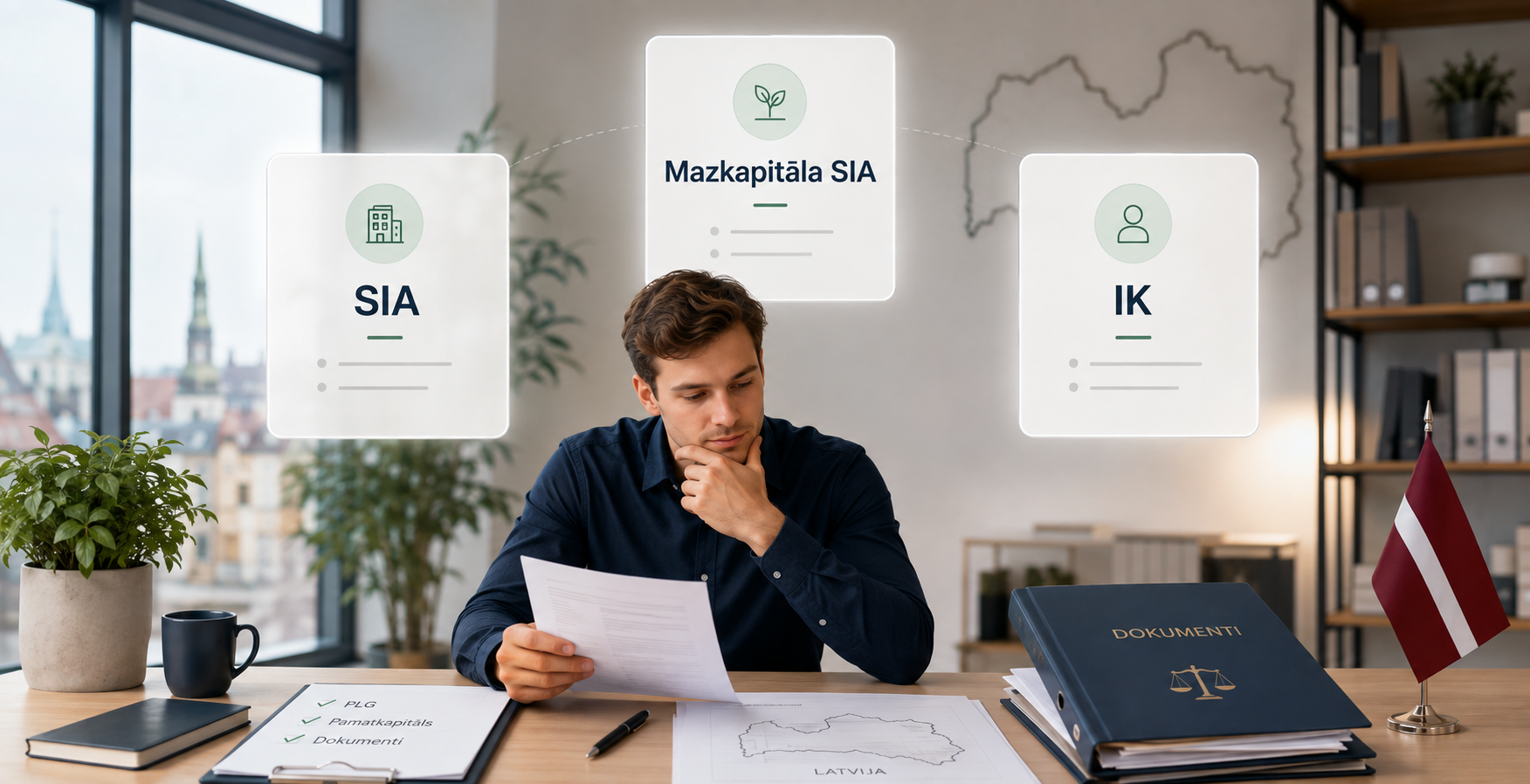
Choosing the right legal structure is one of the first important decisions when starting a business in Latvia. It affects the owners' liability, taxation, profit distribution, capital requirements and the company's ability to bring in additional owners in the future.
Small and newly established businesses most commonly consider a Latvian limited liability company, or SIA, a reduced-capital SIA, or registration of business activity as an individual. An individual merchant is another option, but it is legally different from an individual registered with the State Revenue Service as carrying out economic activity.
Reduced-capital SIA – lower starting capital with additional restrictions
A reduced-capital SIA remains a limited liability company, but its share capital is below the EUR 2,800 minimum applicable to a standard SIA.
Under current Latvian Commercial Register rules, its share capital may range from EUR 0.01 to EUR 2,799.99.
Main conditions
- All founders must be natural persons.
- There may be no more than five founders and shareholders.
- All members of the management board must also be shareholders.
- A person may simultaneously be a shareholder in only one reduced-capital SIA.
- Share capital may be paid only in cash.
- The full amount must be paid before the registration application is submitted.
A reduced-capital SIA must also allocate at least 25% of its annual profit to a mandatory reserve while its share capital remains below EUR 2,800.
This structure may be suitable for one or several individual founders who want to start with limited capital while separating the company's assets and liabilities from their personal property.
Standard SIA – greater flexibility for ownership and growth
The minimum share capital of a standard SIA is EUR 2,800. Unlike a reduced-capital SIA, its shareholders may also include legal entities.
A standard SIA may therefore be more appropriate where investors, corporate shareholders or a more complex ownership structure are planned.
Payment of share capital
The share capital must generally be fully paid before the incorporation application is submitted to the Latvian Register of Enterprises.
Standard SIA capital may consist of:
- cash contributions;
- contributions in kind subject to the applicable valuation rules;
- a combination of both.
For a cash contribution, a payment account must be opened in the name of the company being incorporated and the capital must be deposited into that account.
Where the cash contribution does not exceed EUR 50,000, a separate certificate from a bank or payment service provider generally does not have to be submitted to the Register of Enterprises. The founders confirm the opening of the account and payment of the capital in the application.
Economic activity and an individual merchant are not the same thing
Terms such as self-employed person, person carrying out economic activity and individual merchant are often used interchangeably, but they do not describe the same legal status.
Person carrying out economic activity
An individual can register economic activity directly with the Latvian State Revenue Service without creating a separate legal entity.
This can be suitable for consultants, individual service providers, craftspeople and other relatively small businesses.
The individual and the business are not legally separate, meaning the individual may be personally liable for obligations arising from the activity.
Individual merchant
An individual merchant is a natural person entered in the Commercial Register as a merchant. The individual merchant also remains personally liable with their own property for business obligations.
In certain circumstances defined by the Commercial Law, registration as an individual merchant becomes mandatory when the scale or characteristics of the person's commercial activity meet statutory criteria.
Which model may fit which business?
- Reduced-capital SIA – a smaller business with one to five individual shareholders and limited starting capital.
- Standard SIA – a business that may have corporate shareholders, investors or a more complex ownership structure.
- Individual economic activity – individual work where personal liability is acceptable.
- Individual merchant – commercial activity carried out by a natural person where merchant status is chosen or required.
The legal form does not alone determine every tax consequence. Expected turnover, employees, VAT status, profit distribution and other factors should be considered with an accountant before registration.
Bank account or payment institution?
A Latvian company is not necessarily limited to a traditional Latvian bank for all payment services. Payment services within the European Union are provided by credit institutions, payment institutions and electronic-money institutions.
Before choosing a provider, however, confirm that it offers the type of corporate account required by the business and, where relevant, supports an account suitable for depositing share capital before incorporation.
What information may a financial institution request?
Financial institutions must perform customer due diligence. A new company may therefore be asked to provide information about:
- its business model and industry;
- expected transaction volumes;
- geographical markets and business partners;
- ultimate beneficial owners;
- the source of share capital or other funds.
There is no universal account-opening timeframe applicable to every company. The extent of due diligence depends on the business risk profile and the information available to the financial institution.
FinTech solutions – an alternative, not automatically the better choice
Digital payment institutions may provide convenient remote onboarding and international payment functions, but the services offered by individual providers differ significantly.
Before choosing one, verify:
- that the provider is properly authorised and supervised;
- that the account is opened in the company's name;
- that the necessary EUR and SEPA payments are supported;
- whether the account is suitable for a share-capital deposit where needed;
- whether it integrates with the company's accounting and payment processes.
Ultimate beneficial owners – a critical part of registration
An ultimate beneficial owner is generally a natural person who directly or indirectly owns more than 25% of a company's shares or voting rights, or otherwise exercises control over the company.
For a simple single-owner SIA the identification is usually straightforward. More complex ownership structures require the chain of control to be traced to the relevant natural person.
Incomplete beneficial-owner information or an unclear description of how control is exercised may delay registration and require additional documentation.
Electronic signatures – sign the final version
Where electronic submission requires certified signatures, the relevant documents must be signed with a qualified or otherwise accepted secure electronic signature.
In practice:
- all required signatories should sign the final document version;
- the document should not be edited after signing;
- information in the signed documents should match the registration application;
- the actual signed electronic document should be submitted rather than a screenshot or modified copy.
Use current Register of Enterprises forms
The Latvian Register of Enterprises provides current application forms through its service portal and, in certain incorporation scenarios, can automatically prepare the standard founding documents.
For example, a standard or reduced-capital SIA with one individual founder may use a registration process in which the system prepares the relevant documents automatically.
This can reduce technical errors, although documents should still be reviewed carefully when the company has multiple shareholders or requires non-standard articles of association.
Common incorporation risks
- Choosing the wrong legal structure for the planned ownership, liability or growth model.
- Incorrect share-capital arrangements, including failure to pay the required amount before applying.
- Incomplete beneficial-owner information.
- Inconsistent founding documents, where the application, articles and founding decision contain different information.
- Signing the wrong document version before submission.
Conclusion – choose the structure for the business, not merely the cheapest registration
Low share capital does not automatically make a reduced-capital SIA the best choice. Its shareholder, management and profit-distribution restrictions may become inconvenient as a business grows.
A standard SIA requires more initial capital but provides greater flexibility in building an ownership structure and bringing in corporate shareholders.
Individual economic activity and the individual merchant model may be simpler, but personal liability remains an important factor.
The right business structure is not simply the one that is easiest to register today, but the one that will continue to fit the owners, risks and growth plans of the business in the years ahead.
Comments
No comments yet. Yours could be the first!
Add a comment