
RUMOURS AND FACTS — 🔴 OUTDATED INFORMATION
Claims that structured e-invoices became mandatory for all Latvian businesses in every domestic transaction from 2026 can still be found online. This no longer reflects the current rules.
Short answer: what is mandatory in 2026 and what starts only in 2028?
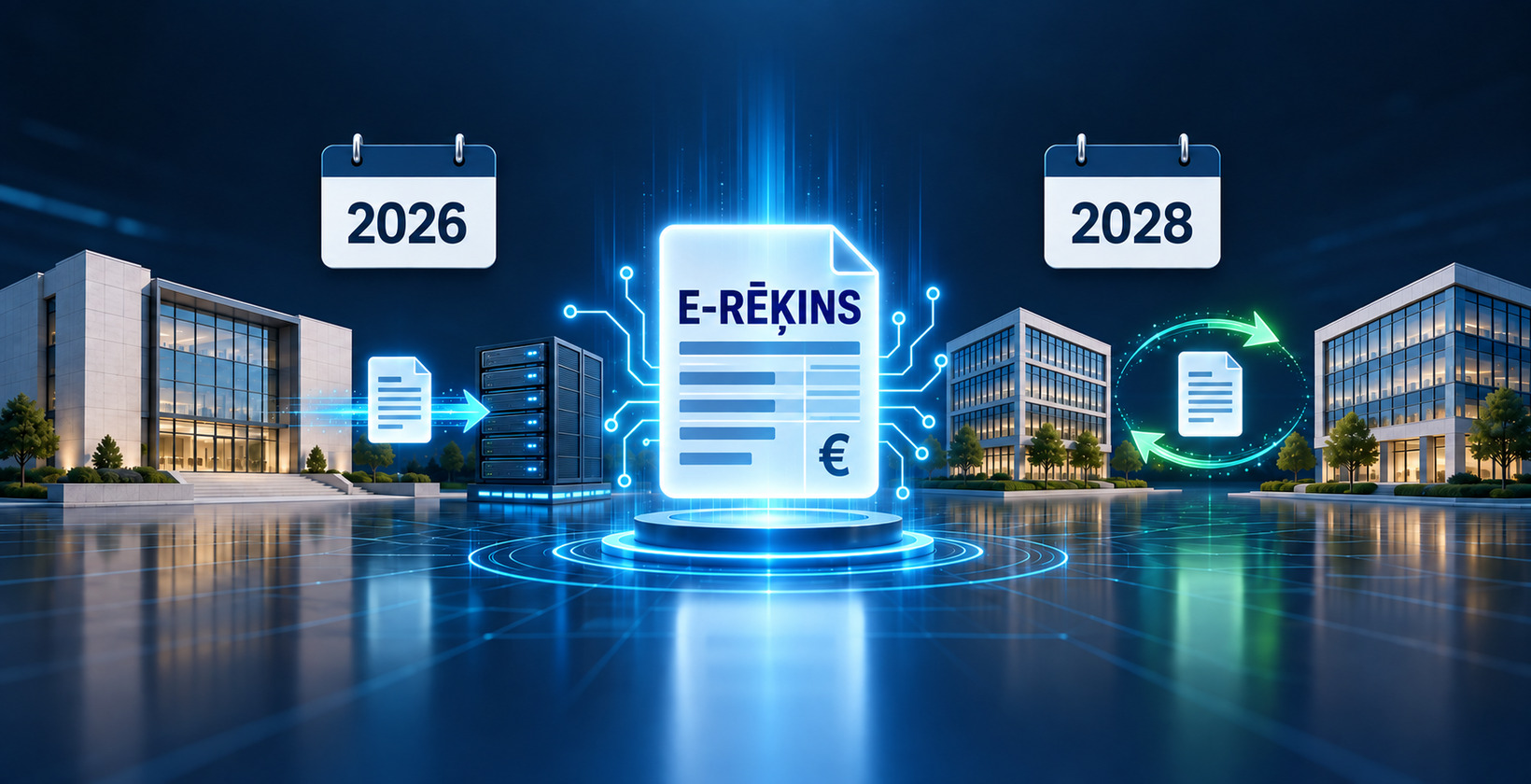
The general requirement to issue structured electronic invoices in domestic B2B transactions between Latvian businesses has been postponed until 1 January 2028. This is set out in paragraph 8 of the transitional provisions of the Accounting Law currently in force.
A separate obligation involving public-sector transactions continues in 2026. Structured e-invoices for transactions with budget institutions have been mandatory since 2025, and from 1 January 2026 the data from those invoices must also be submitted to the State Revenue Service. An e-invoice must be submitted once, no later than five working days after the date on which it was sent.
Businesses that are not budget institutions and exchange e-invoices with each other may submit them voluntarily to the State Revenue Service during 2026 and 2027. The mandatory B2B requirement begins on 1 January 2028.
Why does 2026 still appear online?
The original legislation did envisage a broader e-invoicing requirement for business-to-business transactions from 2026. However, amendments adopted on 5 June 2025 postponed that deadline until the beginning of 2028. The Ministry of Finance states this explicitly in its current guidance.
Older articles, presentations, service-provider advertising and search-result snippets may therefore show the previously planned deadline. A publication date alone does not establish whether the information remains valid. Deadlines should be checked against the current wording of the Accounting Law and the State Revenue Service e-invoice page, which was updated on 28 September 2026.
Three dates businesses should not confuse
1 January 2025 — e-invoices in transactions with budget institutions
A Latvian entity subject to the Accounting Law must issue a structured e-invoice when billing a budget institution for payment. The rule applies to both goods and services. The law provided a transition until 1 January 2026 for certain transactions concluded by 31 December 2024.
1 January 2026 — submission to the tax authority in public-sector transactions
From this date, the State Revenue Service receives structured e-invoices in G2G, B2G and G2B transactions, meaning transactions between government and business or between public-sector institutions. The invoice must be submitted once, no later than five working days after it was sent.
Submission channels include Latvia’s official electronic address, an operator connected to the State Revenue Service API, or the API and XML upload facility in the Electronic Declaration System. If an e-invoice has already been transmitted automatically through the selected channel, it does not need to be submitted again.
1 January 2028 — mandatory structured e-invoices in B2B transactions
From this date, an invoice issued for payment by one Latvian-registered business to another Latvian-registered business that is not a budget institution must be prepared as a structured e-invoice. The issued e-invoice data must also be submitted to the State Revenue Service.
The Accounting Law contains specific exceptions, including certain transactions documented under cash-register rules and invoices generated in particular state information systems. The phrase “every invoice without exception” is therefore not legally precise.
A PDF invoice is not a structured e-invoice
One of the most common mistakes is to call any document sent electronically an e-invoice. A PDF, Word file, scanned paper invoice or image is not by itself a structured e-invoice.
A structured e-invoice is a machine-readable document that information systems can process automatically. The XML structure used in Latvia must comply with the applicable UBL 2.1 and PEPPOL BIS Billing 3.0 requirements. A human-readable PDF may be part of the workflow, but it does not replace the structured data.
Who is subject to the five-working-day deadline in 2026?
The five-working-day deadline applies to e-invoices that must be submitted to the State Revenue Service under the rules in force. In 2026, mandatory submission primarily concerns public-sector transactions. For ordinary B2B transactions between businesses that are not budget institutions, submission remains voluntary until the end of 2027.
If an information-system failure prevents timely submission, Cabinet Regulation No. 749 establishes a specific notification and later-submission procedure. A business should not simply wait for the problem to disappear; it should record the disruption and act within the deadlines set by the regulation.
What should a business do now?
- Map the transactions. Check whether you issue invoices to budget institutions or receive them from the public sector. The 2026 requirements already apply to these transactions.
- Verify the invoice format. Confirm that your system creates a proper structured XML e-invoice rather than only a PDF file.
- Identify the submission channel. Document whether invoices are sent to the State Revenue Service through the official electronic address, an operator, an API or an employee uploading XML through the Electronic Declaration System.
- Prevent duplicate submission. Make sure the same invoice is not submitted repeatedly through multiple channels.
- Prepare a B2B transition plan. The 2028 deadline is not a reason to postpone technical assessment until the last minute. Review customer and supplier data, invoice fields, integrations, credit-note handling and error procedures.
- Update internal instructions. If company procedures still state that all B2B e-invoices became mandatory in 2026, correct them.
The most common mistake: confusing invoice format with data submission
There are two separate questions: whether a particular invoice must be issued in a structured format and whether its data must be submitted to the State Revenue Service. In 2026, these obligations are not identical for every B2B transaction. Many outdated headlines omit precisely this distinction.
Businesses using invoicing software or an external operator should obtain written confirmation of three points: whether the solution creates compliant XML, which channel delivers it to the recipient, and whether submission to the State Revenue Service is automatic. If you use KomercRēķini or another invoicing system, check the provider’s current implementation roadmap rather than relying on old promotional material.
Conclusion
The statement “e-invoices became mandatory for all businesses from 2026” is too broad and is now misleading. The correct timeline is: public-sector e-invoicing has been mandatory since 2025, submission of those invoices to the State Revenue Service began in 2026, and the general obligation for domestic B2B transactions begins on 1 January 2028.
This article provides general information. The applicability of the rules and statutory exceptions to a particular transaction should be assessed according to the entity’s status and the type of transaction.
Comments
No comments yet. Yours could be the first!
Add a comment