

RUMOURS AND FACTS — 🟡 PARTLY TRUE
It is confirmed that MiTek Industries has been unable to open a fully operational current account for approximately four months and that Latvijas Banka has started mediation involving two commercial banks. However, the public claim that the only obstacle was a demand for a copy of Warren Buffett’s passport has not been established. Latvijas Banka’s preliminary information points to possible FATCA compliance and the need to obtain a US taxpayer identification number, or TIN.
Short answer: registration with Latvia’s Enterprise Register and receipt of a VAT number do not by themselves guarantee that a current account will be opened. A bank must separately complete customer due diligence, beneficial-owner and tax-residence checks. At the same time, the bank’s requests and communication must be proportionate — this is what Latvijas Banka will now assess through mediation.
What happened with the MiTek Industries account application?
MiTek Baltic previously operated in Latvia as a branch of a Swedish company. Following the group’s decision to separate the operation into a new company, SIA MiTek Industries was registered on 16 July 2026 with share capital of €400,000. Its sole owner is the US-registered MiTek Inc., which belongs to the Berkshire Hathaway group.
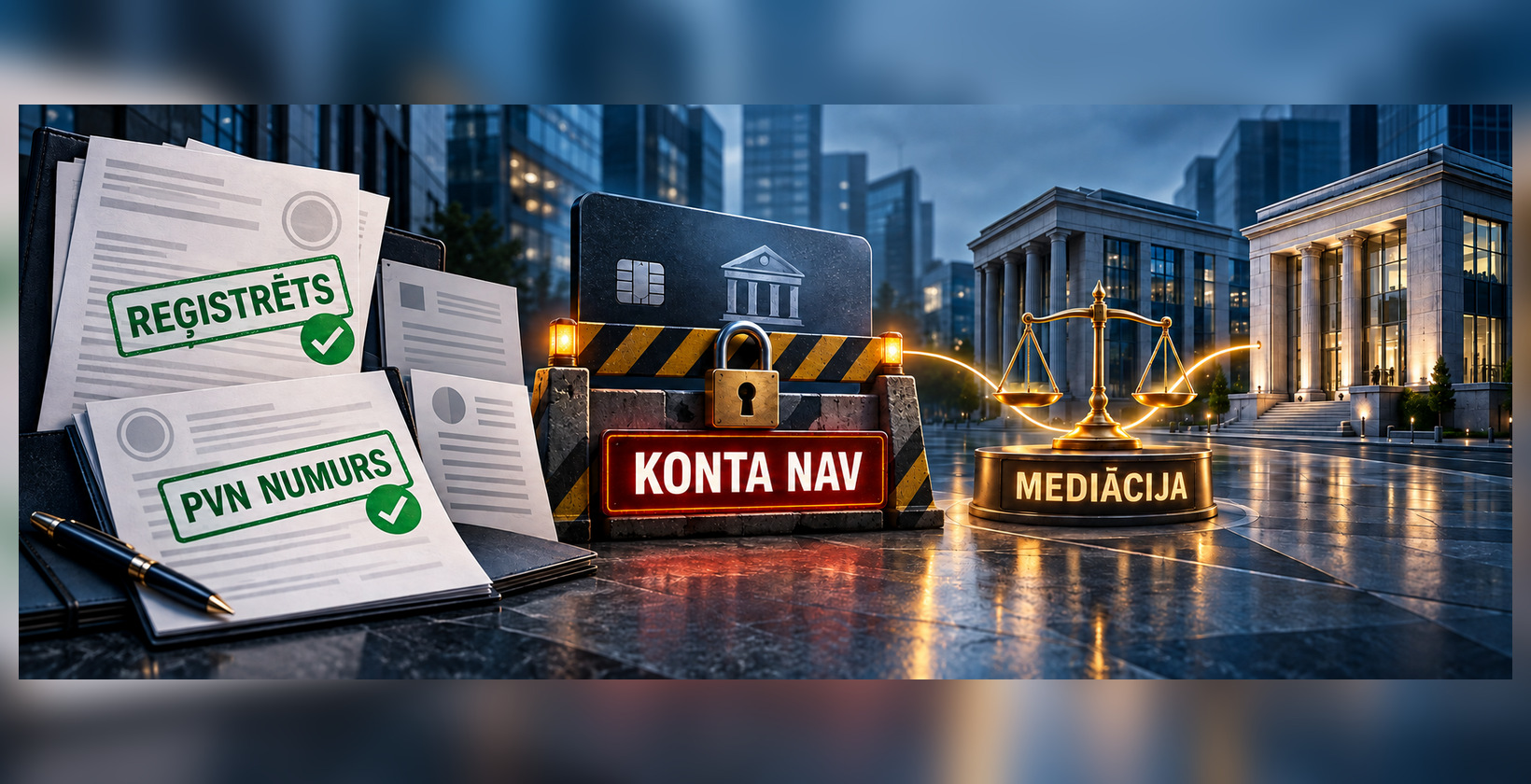
The company has been registered and issued a VAT number, but it has not been able to open a fully operational account for everyday payments. Publicly available information indicates that it has a temporary account, but that account cannot be used for ordinary business transactions.
Did a bank really demand a copy of Warren Buffett’s passport?
Company manager Intars Dīcmanis told Latvian Radio that a bank initially requested a passport copy connected with beneficial owner Warren Buffett and later requested passport data and a social security number. According to the company, it was unable to obtain that information.
This is, however, the company’s public account of events, not the conclusion of a completed regulatory review. On 1 October 2026, Latvijas Banka said that preliminary information instead indicated requirements arising from the US Foreign Account Tax Compliance Act, or FATCA. Those requirements may make it necessary for a bank to obtain a taxpayer identification number, or TIN, and report information concerning US tax residents.
The statement that “the account was refused because Buffett’s passport copy was missing” is therefore too simplistic. The mediation must still establish what the two banks actually requested, why the specific data were necessary and whether the company was offered a reasonable alternative way to submit or verify the information.
What will Latvijas Banka do?
After the case became public, Latvijas Banka contacted MiTek Industries, requested explanations from two commercial banks and launched mediation. Mediation does not yet mean that a bank has broken the law or that it must open the account. Its purpose is to assess both sides’ arguments and propose a solution consistent with legal requirements and good practice.
The regulator also reminded banks that they may obtain, free of charge, documents from the non-public part of a company’s registration file when requested from the Enterprise Register. Banks can use this option to verify the reliability of information submitted about beneficial owners.
Is this a systemic problem in Latvia’s banking sector?
Latvijas Banka currently says that refusal to open accounts, termination of cooperation or prolonged non-execution of transactions is not a systemic problem in Latvia’s financial sector. The regulator nevertheless acknowledges that individual cases have revealed shortcomings in customer service and communication, and that some requirements imposed on customers have been disproportionate.
The MiTek Industries case is notable because it does not concern an anonymous shell company or a business without a verifiable operating history. MiTek operates in construction technology, software and engineering solutions and has been part of the Berkshire Hathaway group since 2001. Even a well-known international owner, however, does not remove a bank’s FATCA, AML and customer-due-diligence obligations.
What does this mean for other foreign investors?
The case highlights the gap between legally establishing a company and being able to begin practical operations. An SIA may be registered, its capital paid and a VAT number issued, yet without a functioning current account it cannot normally pay employees, suppliers, the tax administration or receive customer payments.
Foreign groups establishing a company in Latvia should prepare the following before a reorganisation or transfer of operations:
- the complete ownership and control chain up to the natural person;
- beneficial-owner identification documents or an explanation of why a particular document is objectively unavailable;
- for US persons, FATCA status and the required TIN;
- an explanation of the business model, planned payments, business partners and source of funds;
- extra time for follow-up questions from banks and an alternative payment arrangement for the transition period.
The key lesson: company registration and bank customer due diligence are separate processes. A decision by the Enterprise Register or the State Revenue Service does not replace a bank’s own checks, but a bank should not indefinitely demand documents that are practically unobtainable without explaining their legal necessity and considering other verification options.
What remains unknown?
- Which two commercial banks will provide explanations to Latvijas Banka?
- Is the actual obstacle the TIN, beneficial-owner identification or a combination of requirements?
- Were the requested data mandatory in precisely the form demanded by the banks?
- Will mediation result in an account being opened, and how long will the process take?
Until mediation is completed, there is no basis for claiming either that the banks’ requirements were definitely unlawful or that the company failed to submit all objectively available information. What is confirmed is that the problem exists, two banks are involved and the regulator has begun actively assessing the case.
Comments
No comments yet. Yours could be the first!
Add a comment