
RUMOURS AND FACTS — 🟡 PARTLY TRUE
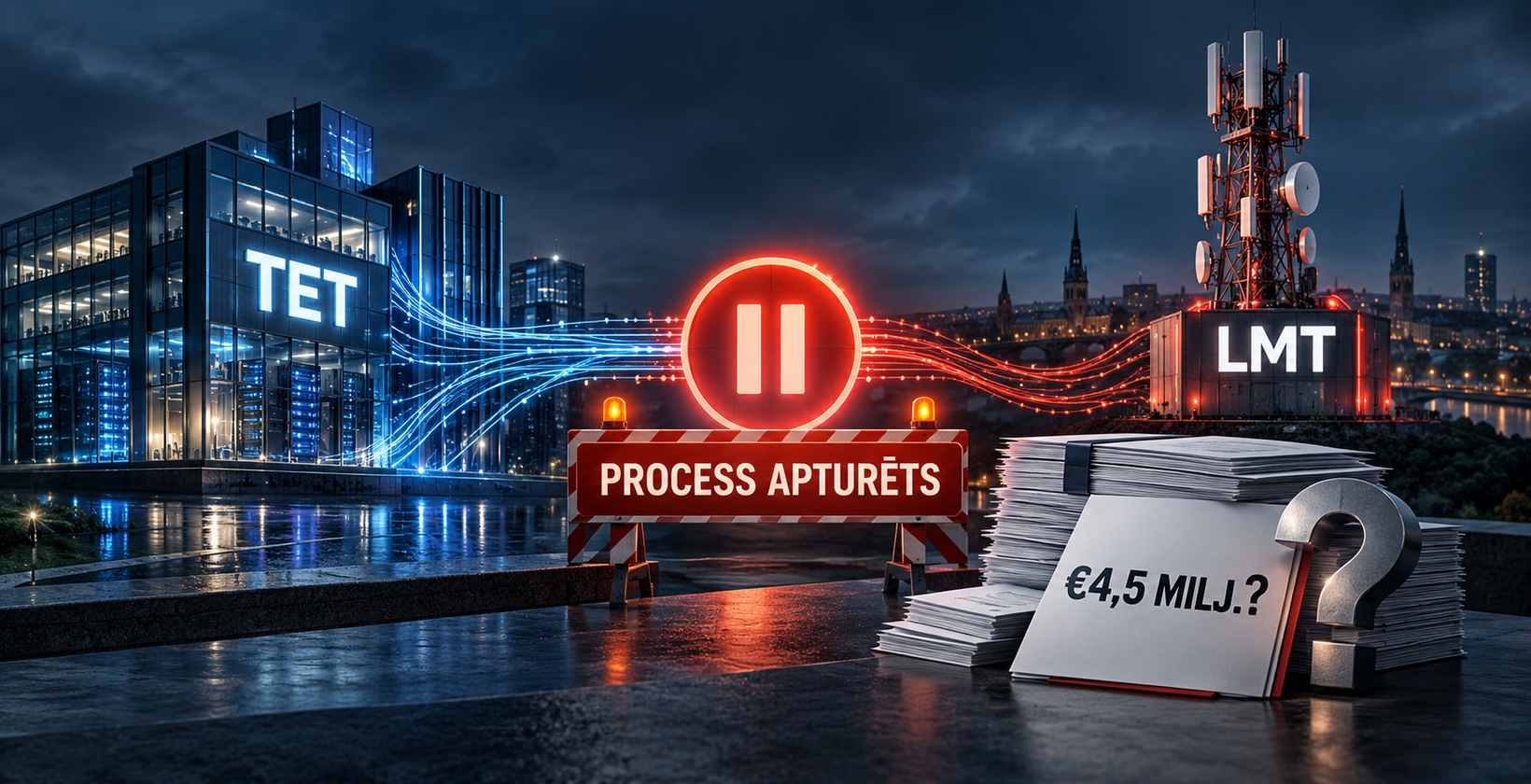
The merger of Tet and LMT has not been cancelled. On 30 September 2026, the prime minister announced that the process in its current form had been halted and that the expensive engagement of advisers should end. At the same time, the publicly stated adviser cost of almost €4.5 million has become disputed.
Short answer: has the Tet–LMT merger been halted?
The existing transaction structure has been halted, not the objective of merging Tet and LMT. Prime Minister Andris Kulbergs announced on 30 September that the process would not continue in its previous form and that the economics minister should terminate the adviser contracts. At the same time, the prime minister stressed that the two companies should still be merged.
The announcement must also be distinguished from a completed action: in the public information released on 30 September, the prime minister called on the economics minister to terminate the adviser contracts immediately. At that point, it had not been publicly confirmed that all contracts had already been terminated.
What failed in the previous process?
On 10 June 2025, the government instructed the parties to attract an experienced international private investor from the telecommunications sector through an open selection process. According to information published by the Cabinet of Ministers, non-binding investor offers were expected by the end of July 2026, but no offer had been received by 30 September.
The memorandum of understanding signed with Swedish telecommunications company Telia in 2025 also expired on 31 July 2026 and was not extended. Consequently, the transaction envisaged by that memorandum is no longer proceeding under that specific structure.
As recently as January 2026, the public timetable envisaged signing the share purchase agreement in July, completing the transaction and attracting an additional strategic investor in the second half of the year. By the end of September, that timetable was no longer achievable.
Have almost €4.5 million already been spent on advisers?
The State Chancellery’s published account is as follows: almost €4.5 million including VAT had been spent on adviser services by 31 August 2026. If the project had been completed in its existing form by the end of the year, the cost would have reached €13.6 million including VAT. A further €80,000 including VAT was reportedly spent on an unsuccessful search for the chair of the merged company’s management board.
However, this figure is disputed. The Ministry of Economics told Latvian Television that the publicly mentioned €4.5 million was incorrect and several times higher than the actual cost. Latvenergo and LVRTC also stated that the public information did not match the figures submitted to the Cabinet, but they did not disclose specific amounts, citing contractual confidentiality.
The accurate formulation is therefore not “€4.5 million has been proven to have been spent”, but rather “the State Chancellery reports almost €4.5 million, while the Ministry of Economics and the participating companies dispute that figure”. Until a detailed cost breakdown or audit is published, the disagreement remains unresolved.
Who were the advisers?
The adviser agreements were signed at the end of January 2026, and their work was publicly announced on 2 February. The lead adviser was US investment bank J.P. Morgan. The adviser teams also included A&O Shearman, WALLESS, Deloitte, TEGOS and Hardiman Telecommunications.
Their assignments included conducting due diligence, structuring the acquisition of Telia’s stakes, attracting an investor, coordinating the transaction and developing a joint growth strategy.
Why is a private financial investor no longer considered sufficient?
The Cabinet statement criticises the structure proposed by the Ministry of Economics, under which the state, Latvenergo, LVRTC and a private financial investor would each hold approximately 25% of the capital. In the prime minister’s view, a financial investor is not equivalent to the strategic telecommunications-sector partner originally requested by the government.
The distinction matters. A financial investor primarily assesses investment returns and exit options, whereas a strategic industry partner may contribute technology, market access, expertise and a long-term development direction. This does not mean that a financial investor is automatically a poor solution, but it is not identical to the model initially defined by the government.
What new route has the prime minister proposed?
The prime minister proposes changing the sequence of the transaction:
- Tet and LMT would themselves buy out Telia’s stakes.
- The two companies would then merge into a single company.
- The merged company would attract a strategic partner from among leading telecommunications companies.
For now, this is a publicly stated proposal by the prime minister, not a completed transaction. It still requires negotiations with Telia, corporate and shareholder decisions, a financing model, a legal structure and the necessary competition and security assessments.
Why is the ownership structure of Tet and LMT complicated?
The Latvian state owns 51% of Tet through Possessor, while Telia group company Tilts Communications owns 49%. In LMT, 49% is held by Telia and its subsidiary Sonera Holding, 23% by LVRTC, 23% by Tet and 5% by Possessor.
Tet is therefore both a separate telecommunications company and a major shareholder in LMT. This interlinked structure complicates pricing, financing, control and decision-making. It also explains why the seemingly simple phrase “just merge the two companies” in practice entails several interdependent transactions.
What does the process mean for businesses and customers?
No changes to the day-to-day provision of Tet or LMT services have been announced. Customer contracts, prices and services do not change merely because the ownership transaction process is being redesigned.
In the longer term, however, a merger could affect competition, service bundles, network investment, procurement, jobs and cooperation with Latvian technology companies. The prime minister’s statement expressly mentions removing duplicate management and support functions and optimising the workforce, meaning that a possible merger would be more than a legal change of ownership.
What remains unanswered?
- Will the adviser contracts actually be terminated, and what would termination cost?
- What is the amount actually paid so far, and what exactly is included in the publicly stated figure of almost €4.5 million?
- Why was no non-binding investor offer received by the end of July?
- Will Telia accept the new transaction sequence and pricing model?
- How would Tet and LMT finance the purchase of Telia’s stakes?
- How would competition and national-security authorities assess the merger?
Conclusion
It would be incorrect to say that “the Tet–LMT merger has been cancelled”. The memorandum with Telia has expired, no non-binding investor offer has been received, and the prime minister has announced that the existing process is being halted and called for the adviser contracts to end. The political objective of merging the two companies remains, but a different transaction sequence is being proposed.
The figure of almost €4.5 million in adviser costs should currently be described as a number published by the State Chancellery but disputed by the Ministry of Economics and the companies involved. A detailed cost report and the State Chancellery’s review will be the next documents needed to assess the efficiency of the process and the accountability of officials.
Official information sources
- Cabinet of Ministers — prime minister’s statement on the Tet–LMT process
- Ministry of Economics — transaction timetable published in January 2026
- Latvenergo — information on the engagement of advisers
Comments
No comments yet. Yours could be the first!
Add a comment